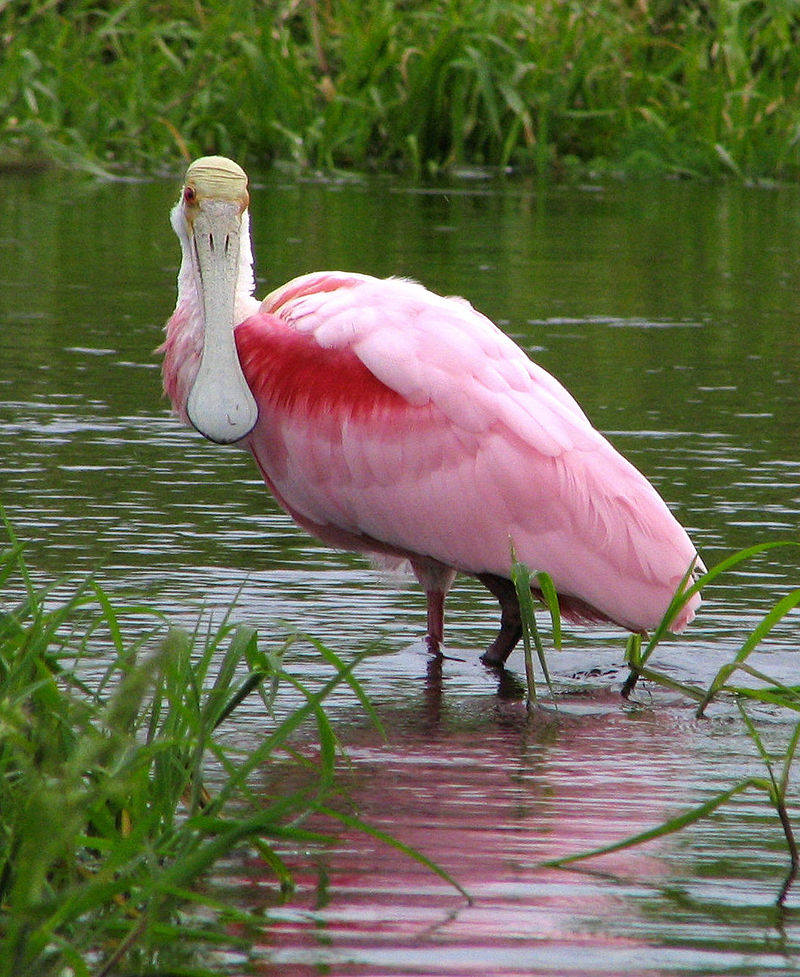
File:Roseate_Spoonbill_-_Myakka_River_State_Park.jpg · Wikimedia Commons · See Wikimedia Commons
Platalea
Sign in to saveAlso known as Spoonbill
Spoonbills are a genus, Platalea, of large, long-legged wading birds. The spoonbills have a global distribution, being found on every continent except Antarctica. The genus name Platalea derives from Ancient Greek and means "broad", referring to the distinctive shape of the bill. Six species are recognised, which although usually placed in a single genus have sometimes been split into three genera.
OverviewAI-generated
Platalea is a genus within the family Threskiornithidae. It belongs to the class Aves and the phylum Chordata. Taxonomic sources place the genus in either the order Pelecaniformes or Ciconiiformes. The scientific name is Platalea Linnaeus, 1758, and its status is accepted. The common name in Japanese is ヘラサギ属.
The genus inhabits marine, brackish, and freshwater environments. Records are associated with the United States, India, Madagascar, and the Netherlands. Institutions holding records include UF, NMV, MNHN, PMNS, and LSUMZ. The taxon has been described in the Armenian Soviet Encyclopedia and the Encyclopædia Britannica 11th edition.
Synthesized by Vinony from 33 facts across 6 sources: Wikidata, GBIF, Gbif Occ, WoRMS, iDigBio, Vinony graph. Generated from structured data (not the Wikipedia text) and checked against those facts — may still contain errors.
Species
ヘラサギ属
Platalea
GENUS
- KingdomAnimalia
- PhylumChordata
- ClassAves
- OrderPelecaniformes
- FamilyThreskiornithidae
Царство: Животные Подцарство: Эуметазои Без ранга: Двусторонне-симметричные Без ранга: Вторичноротые Тип: Хордовые Подтип: Позвоночные Инфратип: Челюстноротые Надкласс: Четвероногие Класс: Птицы Подкласс: Настоящие птицы Инфракласс: Новонёбные Отряд: Аистообразные Семейство: Ибисовые Подсемейство: Колпицы (Plataleinae Bonaparte, 1838) Род: Колпицы Международное научное название Platalea Linnaeus, 1758 Виды Обыкновенная колпица (Platalea leucorodia) Малая колпица (Platalea minor) Белая колпица (Platalea alba) Королевская колпица (Platalea regia) Желтоклювая колпица (Platalea flavipes) Розовая колпица (Platalea ajaja) Систематикана ВикивидахИзображенияна Викискладе ITIS 174932NCBI 33577EOL 83002FW 368588 Ко́лпицы[1] (лат. Platalea) — род птиц из отряда голенастых семейства ибисовых, содержащий шесть видов. Содержание 1 Распространение 1.1 В России 2 Телостроение 3 Образ жизни 4 Примечания Распространение Колпицы распространены преимущественно в аридном поясе Евразии. Наиболее многочисленные популяции обитают в регионе Средиземного, Чёрного, Жёлтого и Японского морей. Некоторые популяции живут в восточной Африке и Индии. В России В России два вида: колпица, или обыкновенная колпица (P
via GBIF
Museum specimens
- Specimen records
- 30
- Family
- Threskiornithidae
- Collections
- UF, NMV, MNHN, PMNS, LSUMZ, ANSP
- Recorded in
- United States, India, Madagascar, Netherlands
Wikidata facts
- Instance of
- taxon
- Image
- Royal Spoonbill mouth open.jpg
Show 7 more facts
- Commons category
- Platalea
- taxon rank
- genus
- taxon name
- Platalea
- topic's main category
- Category:Platalea
- Commons gallery
- Platalea
- described by source
- Encyclopædia Britannica 11th edition
- on focus list of Wikimedia project
- Wikipedia:Vital articles/Level/4
Sources (2)
via Wikidata · CC0
~5 min read
Encyclopedic overview
6 sectionsContents
- Taxonomy
- Description
- Breeding
- Species and distribution
- References
- External links
Spoonbills are a genus, Platalea, of large, long-legged wading birds. The spoonbills have a global distribution, being found on every continent except Antarctica. The genus name Platalea derives from Ancient Greek and means "broad", referring to the distinctive shape of the bill. Six species are recognised, which although usually placed in a single genus have sometimes been split into three genera.
All spoonbills have large, flat, spatulate bills and feed by wading through shallow water, sweeping the partly opened bill from side to side. The moment any small aquatic creature touches the inside of the bill—an insect, crustacean, or tiny fish—it is snapped shut. Spoonbills generally prefer fresh water to salt but are found in both environments. They need to feed many hours each day.
Excerpted from Wikipedia’s “Platalea” article, available under the CC BY-SA 4.0 licence.
Gallery (20)
Available in 69 languages
- Español
- Français
- Deutsch
- 中文
- 日本語
- Русский
- Português
- Italiano
- العربية
- हिन्दी
- Afrikaans
- Armenian
- Asturian
- azb
- Azerbaijani
- Bahasa Indonesia
- Basque
- Belarusian
Show 50 more
- Breton
- Burmese
- Catalan
- Cebuano
- Czech
- Danish
- Egyptian Arabic
- Esperanto
- Finnish
- Galician
- Georgian
- Hebrew
- Hungarian
- Irish
- Javanese
- Kannada
- Kazakh
- Kotava
- Latin
- Latvian
- Lithuanian
- Malay
- Malayalam
- Mazanderani
- Mongolian
- Navajo
- Nederlands
- Norwegian
- Norwegian Nynorsk
- Polski
- Romanian
- Serbian
- Sicilian
- simple
- Slovenian
- Svenska
- Swahili
- Tamil
- Telugu
- Tiếng Việt
- Türkçe
- Ukrainian
- Waray
- Western Frisian
- Western Mari
- Western Panjabi
- Wu Chinese
- zh_yue
- فارسی
- 한국어
via Wikidata sitelinks · CC0