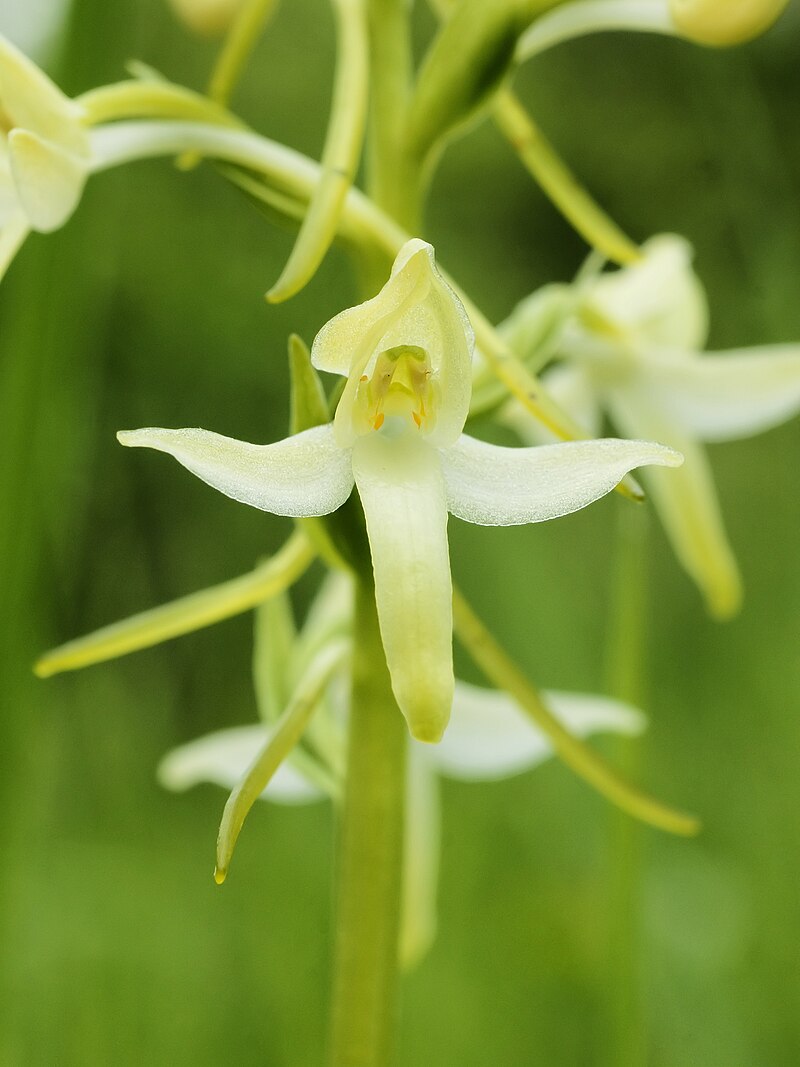
File:Platanthera_bifolia_(flower).jpg · Wikimedia Commons · See Wikimedia Commons
Platanthera
Sign in to saveThe genus Platanthera belongs to the subfamily Orchidoideae of the family Orchidaceae, and comprises about 150 species of orchids. The members of this genus, known as the butterfly orchids or fringed orchids, were previously included in the genus Orchis, which is a close relative (along with the genus Habenaria). They are distributed throughout the temperate regions of the Northern Hemisphere. They are terrestrial and have tubercules. The genomes of Platanthera zijinensis and Platanthera guangdongensis have been sequenced as model species to study partial and full mycoheterotrophy.
OverviewAI-generated
Platanthera is a genus within the plant kingdom, specifically classified under the phylum Tracheophyta, class Liliopsida, and order Asparagales. It belongs to the family Orchidaceae. This terrestrial genus typically grows in damp environments.
The native range of Platanthera includes regions such as Alabama, Alaska, Albania, Alberta, Aleutian Is., Algeria, Altay, Amur, Arizona, Arkansas, Assam, and Austria. Records of the genus are held by institutions including the University of Alberta Museums, INECOL, CAS, and BRIT, with occurrences documented in Canada, the United States, and Mexico.
Synthesized by Vinony from 23 facts across 6 sources: Wikidata, GBIF, Plants of the World, Gbif Occ, iDigBio, Vinony graph. Generated from structured data (not the Wikipedia text) and checked against those facts — may still contain errors.
Species
GENUS
- KingdomPlantae
- PhylumTracheophyta
- ClassLiliopsida
- OrderAsparagales
- FamilyOrchidaceae
General: The terrestrial genus Platanthera usually grows on damp
via GBIF · Kew POWO
Museum specimens
- Specimen records
- 1,176
- With media
- 817
- Family
- Orchidaceae
- Collections
- UNIVERSITY OF ALBERTA MUSEUMS, INECOL, CAS, BRIT
- Recorded in
- Canada, United States, Mexico
Wikidata facts
- Instance of
- taxon
- Parent taxon
- Orchidinae
- Image
- Platanthera bifolia (flower).jpg
Show 8 more facts
- Commons category
- Platanthera
- topic's main category
- Category:Platanthera
- taxon rank
- genus
- taxon name
- Platanthera
- Commons gallery
- Platanthera
- taxon common name
- 舌唇兰属
- has fruit type
- capsule
via Wikidata · CC0
~4 min read
Encyclopedic overview
5 sectionsContents
- Etymology
- Description and habitat
- Species
- References
- External links
The genus Platanthera belongs to the subfamily Orchidoideae of the family Orchidaceae, and comprises about 150 species of orchids. The members of this genus, known as the butterfly orchids or fringed orchids, were previously included in the genus Orchis, which is a close relative (along with the genus Habenaria). They are distributed throughout the temperate regions of the Northern Hemisphere. They are terrestrial and have tubercules. The genomes of Platanthera zijinensis and Platanthera guangdongensis have been sequenced as model species to study partial and full mycoheterotrophy.
== Etymology == Louis Claude Richard chose the name Platanthera for this genus; it comes from the Greek and means 'broad or wide anther', referring to the separation of the base of the pollinia in the type species of the genus. Richard felt that this characteristic distinguished the genus Platanthera from both the genus Orchis and the genus Habenaria. However, today the defining characteristics of the genus are generally accepted to be the absence of both stigmatic processes (typical in Habenaria) and ovoid root-tuberoids (characteristic of both Habenaria and Orchis). Still, P. nivea, P. clavellata and P. integra all have stigmatic processes, showing the limitations of morphological characteristics in defining this clade.
Excerpted from Wikipedia’s “Platanthera” article, available under the CC BY-SA 4.0 licence.