Playland
Sign in to saveAlso known as Rye Playland, Playland Amusement Park
amusement park in Rye, New York
Described at
Sanitizing Playland: Establishing Expectations for Public Behavior in Greater New York’s Parks — The Gotham Center for New York City History
Sanitizing Playland: Establishing Expectations for Public Behavior in Greater New York’s Parks By Kara Murphy Schlichting, Sanitizing Playland: Establishing Expectations for Public Behavior in Greater New York’s Parks By Kara Murphy Schlichting
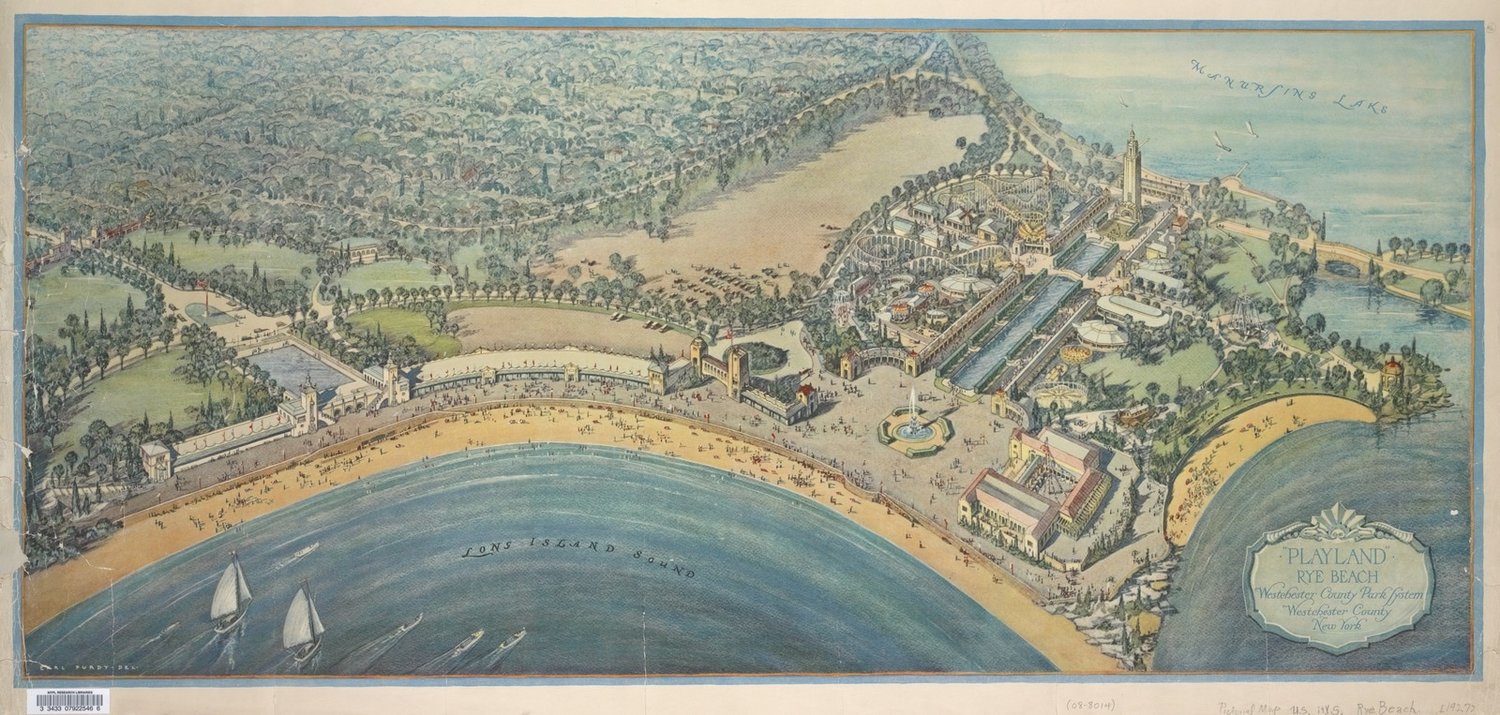
gothamcenter.org →When temperatures climb during the summer months, New Yorkers and residents of the city’s suburban counties beat the heat with a visit to the shores of New Jersey, Long Island, and Long Island Sound. Although the Sound lacked the surf and wide, sandy beaches of the Jersey and southern Long Island shores, recreationalists frequented its rocky beaches, picnic grounds, modest amusement parks, hotels, and private clubs. By the early 1900s, Long Island Sound’s shores comprised a residential and recreational hinterland of greater New York. This development irrevocably linked coastal communities along the Sound to the modernizing metropolis. Playland, Rye Beach: Westchester County, New York. Maps of New York City and State collection, New York Public Library The Sound beaches of Westchester, the mainland New York county directly northeast of the Bronx, provide an opportunity to study the evolving relations between city and suburb in metropolitan New York. Westchester reveals the central role that public parks played in the relationship. The democratization of leisure during Progressive era and New Deal increased the number of greater New Yorkers with the resources and time to visit Sound resorts. It also stirred worry among social scientists and government officials who feared uncontrolled mass leisure and who labored to establish behavioral prescriptions in park design.[[1]]( As a result, metropolitan New York’s park builders promoted a shared belief that modern design would alter recreational behavior patterns. In the 1920s, Westchester earned national recognition as an archetype of twentieth-century suburbanization and a vanguard in regional park planning. In 1922, the county Board of Supervisors originated New York State’s first county park commission, the Westchester County Park Commission (WCPC). In less than a decade, the WCPC built a sprawling, celebrated park system of parkways, wooded reserves, three golf courses, six swimming centers with beaches as well as pools, and Playland, its famous Art-Deco amusement park in Rye. “Playland Mall,” Photograph. (n.d.). Playland Photograph Collection, Westchester County Archives (Jul. 2008) (18 Oct. 2012). Westchester’s park planners took a multi-pronged approach to shaping an idealized public for county parks. The WCPC took an unusually explicit step towards regulating public behavior through directed play in its public spaces with the creation of the county Recreation Commission in 1924. In the words of the New York Times, the leading citizens who peopled the commission were “to teach a county to play.” The authority, only the second of its kind in the country, collaborated with the WCPC. Its goal, the newly appointed Superintendent of Recreation told American City magazine, was to establish “ethical standards of play, [and] clean, wholesome bodies” at all county parks.[[2]]( As Susan Currell argues, Depression-era leisure was a growing focus of government oversight; social scientists had come to believe, in the words of one sociologist , that “there [could] be no doubt of the right of government to prevent the sale of unwholesome recreation just as it has the right to prevent the sale of unwholesome food.”[[3]]( Westchester’s Recreation Commission focused on working-class conduct and explicitly articulated an agenda of cultural uplift through directed play.[[4]]( The commissioners expressed the belief that Westchester had special recreation needs because of its proximity to the city, arguing that in the Bronx and Manhattan Westchesterites found “the wrong sort of enjoyment in commercialized recreation.” To counteract the appeal of such amusements, the recreation commission offered art and acting classes and summer camps where working-class citizens could, the Recreation Commissioner explained, “be induced, or even coaxed ever so gently, into the formation of new desires, new abilities, new tastes.”[[5]]( The Recreation Commission articulated an agenda of cultural uplift that was
Excerpt from a page describing this subject · 23,849 chars · not written by Vinony
Wikidata facts
- Instance of
- amusement park
- Country
- United States
- Located in
- Rye
- Area
- 280
- Official website
- www.ryeplayland.org
- Image
- Playland Gondola Wheel.jpg
Show 4 more facts
- Commons category
- Playland (New York)
- inception
- 1928-00-00
- described at URL
- www.gothamcenter.org/blog/sanitizing-playland-establishing-expectations-for-public-behavior-in-greater-new-yorks-parks
- social media followers
- 3306
Sources (1)
via Wikidata · CC0