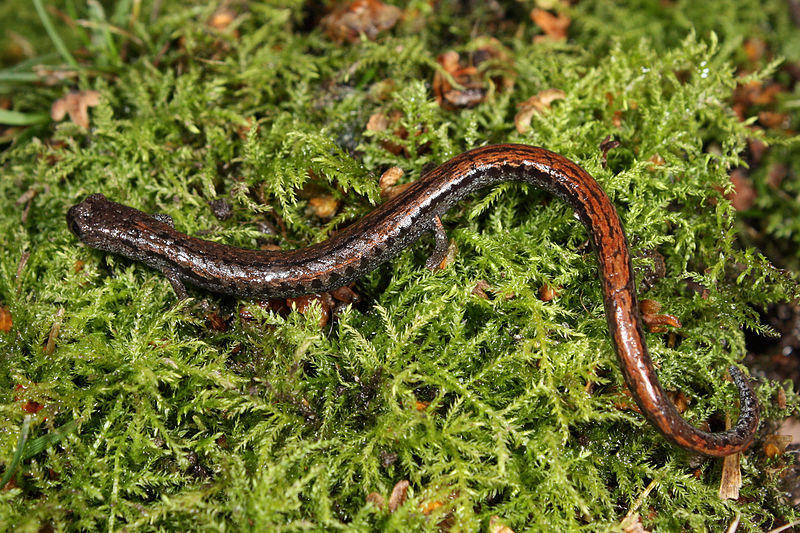
File:Kaldari_Batrachoseps_attenuatus_02.jpg · Wikimedia Commons · See Wikimedia Commons
Plethodontidae
Sign in to saveAlso known as the lungless salamander family, lungless salamander, lungless salamanders, plethodontid, plethodontids, plethodont, plethodonts
Plethodontidae, or lungless salamanders, are a family of salamanders. With over 500 species, lungless salamanders are by far the largest family of salamanders in terms of their diversity. Most species are native to the Western Hemisphere, from British Columbia to Brazil. Only two extant genera occur in the Eastern Hemisphere: Speleomantes (native to Sardinia and mainland Europe south of the Alps) and Karsenia (native to South Korea).
OverviewAI-generated
Plethodontidae is a family of amphibians within the order Caudata, class Amphibia, and phylum Chordata. The taxon was described by Gray in 1850 and is currently accepted. It belongs to the kingdom Animalia and has existed for approximately 71 million years.
The family is associated with freshwater habitats. Records indicate its presence in the United States and Mexico, with specimens held by institutions including CM, ENCB-IPN, NMMNHS, SDNHM, and UCMP. There are 192 records and 2 media items associated with these institutions. A total of 1,054,612 occurrences have been documented.
Synthesized by Vinony from 25 facts across 6 sources: Wikidata, GBIF, Gbif Occ, WoRMS, iDigBio, Vinony graph. Generated from structured data (not the Wikipedia text) and checked against those facts — may still contain errors.
Species
FAMILY
- KingdomAnimalia
- PhylumChordata
- ClassAmphibia
- OrderCaudata
- FamilyPlethodontidae
无肺螈科是蠑螈中最大、多樣性最豐富的一科,約有400種。分布於溫帶、亞熱帶和熱帶地區,是唯一分布於熱帶的蠑螈。除了5種Speleomantes屬分布於義大利和一種Karsenia屬分布於韓國以外,所有種類的无肺螈都分布於西半球。 肋骨間溝明顯。無肺部構造,完全使用皮膚進行氣體交換。身體纖細,四肢短小。通常有背部條紋。
via GBIF
Museum specimens
- Specimen records
- 192
- With media
- 2
- Family
- Plethodontidae
- Collections
- CM, ENCB-IPN, NMMNHS, SDNHM, UCMP, CUMV
- Recorded in
- United States, Mexico
Wikidata facts
Show 6 more facts
- taxon name
- Plethodontidae
- Commons category
- Plethodontidae
- taxon rank
- family
- topic's main category
- Category:Plethodontidae
- taxon common name
- plethodontids
- start time
- 70600000-0
Sources (1)
via Wikidata · CC0
~12 min read
Encyclopedic overview
9 sectionsContents
- Biology
- Courtship and mating
- Respiration
- Chemoreception
- Evolutionary history
- Subfamilies and genera
- Conservation status
- References
- External links
Plethodontidae, or lungless salamanders, are a family of salamanders. With over 500 species, lungless salamanders are by far the largest family of salamanders in terms of their diversity. Most species are native to the Western Hemisphere, from British Columbia to Brazil. Only two extant genera occur in the Eastern Hemisphere: Speleomantes (native to Sardinia and mainland Europe south of the Alps) and Karsenia (native to South Korea).
==Biology== thumb|left|Palaeoplethodon hispaniolae preserved in [[amber]] Adult lungless salamanders have four limbs, with four toes on the fore limbs, and usually with five on the hind limbs. Within many species, mating and reproduction occur solely on land. Accordingly, many species also lack an aquatic larval stage, a phenomenon known as direct development in which the offspring hatch as fully-formed, miniature adults. Direct development is correlated with changes in the developmental characteristics of plethodontids compared to other families of salamanders including increases in egg size and duration of embryonic development. Additionally, the evolutionary loss of the aquatic larval stage is related to a diminishing dependence on aquatic habitats for reproduction. The lift of this constraint allowed widespread colonization and diversification within a broad number of terrestrial habitats which is a testament to the high success and proliferation of Plethodontidae.
Excerpted from Wikipedia’s “Plethodontidae” article, available under the CC BY-SA 4.0 licence.