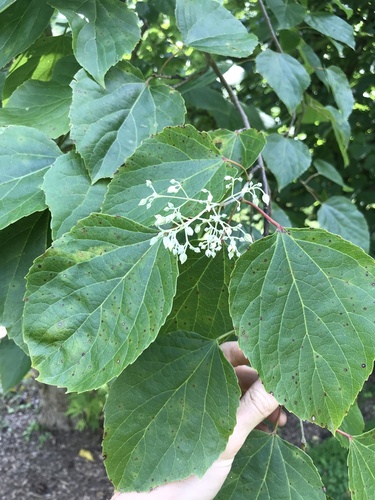
(c) Andrew Conboy, some rights reserved (CC BY), uploaded by Andrew Conboy · cc-by
Poliothyrsis
Sign in to savePoliothyrsis is a monotypic genus of flowering plants belonging to the willow family Salicaceae (although placed formerly in the now defunct family Flacourtiaceae (within which it is usually to be found listed in older works of reference)). The single arborescent species is Poliothyrsis sinensis, Chinese common name: 山拐枣 shān guǎi zǎo English common name: Chinese pearl-bloom tree
Species
Chinese pearlbloom
GENUS
- KingdomPlantae
- PhylumTracheophyta
- ClassMagnoliopsida
- OrderMalpighiales
- FamilySalicaceae
via GBIF · Kew POWO
Wikidata facts
- Instance of
- taxon
- Parent taxon
- Salicaceae
- Image
- Poliothyrsis sinensis feuille.jpg
Show 6 more facts
- taxon name
- Poliothyrsis
- taxon rank
- genus
- Commons category
- Poliothyrsis
- topic's main category
- Category:Poliothyrsis
- taxon common name
- 山拐枣属
Sources (2)
via Wikidata · CC0
~9 min read
Encyclopedic overview
15 sectionsContents
- Description
- Unusual seed capsules
- Resemblance to ''Idesia''
- Etymology of scientific names
- Etymology of Chinese common name
- Range
- Habitat
- Ornamental
- Aesthetic appeal
- Cultivation
- Hardiness
- Uses
- Chemistry
- Gallery
- References
Poliothyrsis is a monotypic genus of flowering plants belonging to the willow family Salicaceae (although placed formerly in the now defunct family Flacourtiaceae (within which it is usually to be found listed in older works of reference)). The single arborescent species is Poliothyrsis sinensis, Chinese common name: 山拐枣 shān guǎi zǎo English common name: Chinese pearl-bloom tree
==Description== A small deciduous tree 7-15m in height and circa 6m in spread, with pubescent young shoots. Leaves ovate, long-pointed 11.5 to 15 cm in length, very downy beneath when young, petioles reddish, 19-38mm long. Flowers small, circa 8.5mm across, at first white but becoming yellowish, in terminal, loose panicles 15 cm or more in length, both male and female in the same inflorescence, borne in June–July. Fruit a dry capsule, ovoid, tomentose, individual valves acutely fusiform (= spindle-shaped), 2–3 cm, ca. 1 cm in diam. Seeds wind-dispersed, compressed-flat, each surrounded and enclosed by a ± elliptic or oblong wing 5–10 mm, seed proper small, less than 1/2 as long as wing. Fruits borne July–September.
Excerpted from Wikipedia’s “Poliothyrsis” article, available under the CC BY-SA 4.0 licence.