File:Draupadi_and_Pandavas.jpg · Wikimedia Commons · See Wikimedia Commons
polyandry
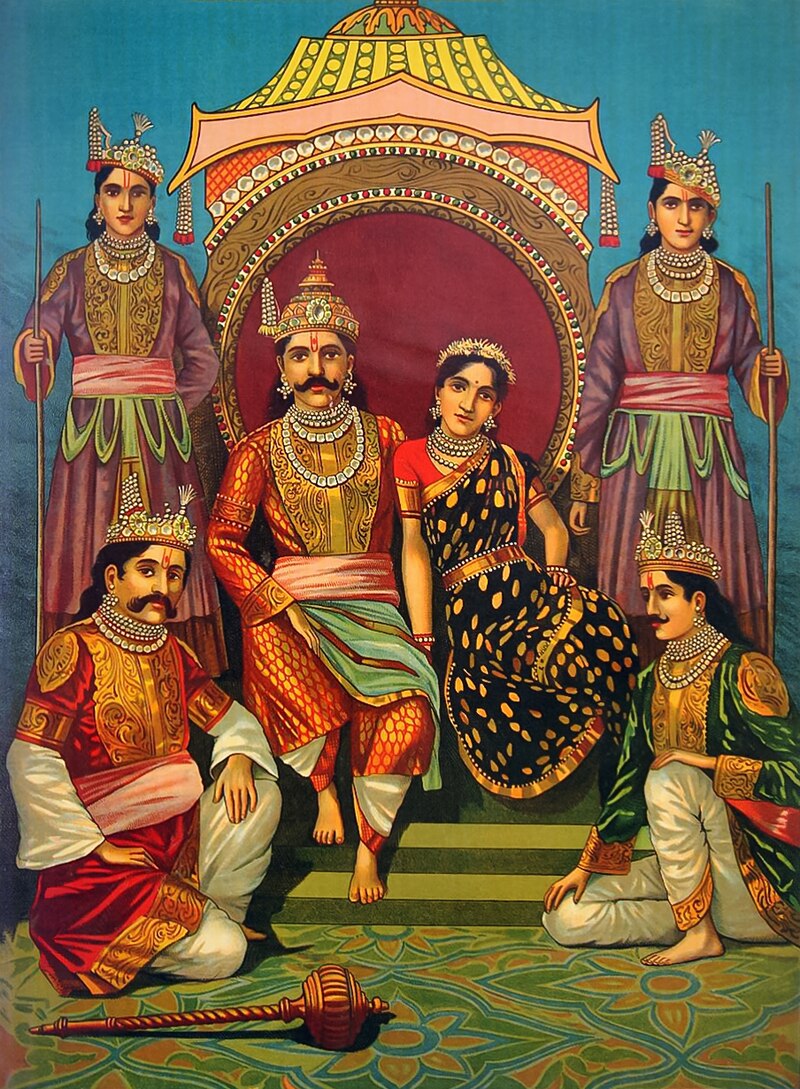
Sign in to savethumb|upright=1.20|alt=Illustration of Draupadi, a princess and queen in the ancient Indian epic "Mahabharata", with her five brother husbands|[[Draupadi and her five brother husbands, the Pandavas. Top down, from left to right: the twins Nakula and Sahadeva stand either side of the throne on which Yudhishthira and Draupadi sit between Bhima and Arjuna.]]
Polyandry is a marriage arrangement in which one woman has multiple husbands at the same time, as illustrated by the ancient Indian epic "Mahabharata," where the princess Draupadi was married to five brothers. It matters as a historical and cultural practice that challenges modern assumptions about marriage and reveals the diversity of family structures that have existed across different societies and time periods.
AI-generated from the Wikipedia summary — may contain errors.
Wikidata facts
- Subclass of
- polygamy
- Image
- Pandavas with Draupadi OR ayudhapurushas facing Madhu Kaitabha.jpg
Show 2 more facts
- opposite of
- polygynous marriage
- topic's main category
- Category:Polyandry
Sources (1)
via Wikidata · CC0
~17 min read
Encyclopedic overview
24 sectionsContents
- Types
- Successional polyandry
- Associated polyandry
- Fraternal polyandry
- Partible paternity
- Culture
- Known cases
- Africa
- Asia
- Europe
- North America
- Oceania
- South America
- Religious attitudes
- Hinduism
- Judaism
- Christianity
- Latter-Day Saints
- Islam
- In biology
- See also
- References
- Further reading
- External links
thumb|upright=1.20|alt=Illustration of Draupadi, a princess and queen in the ancient Indian epic "Mahabharata", with her five brother husbands|[[Draupadi and her five brother husbands, the Pandavas. Top down, from left to right: the twins Nakula and Sahadeva stand either side of the throne on which Yudhishthira and Draupadi sit between Bhima and Arjuna.]]
Polyandry (; ) is a form of polygamy in which a woman takes two or more husbands at the same time. Polyandry is contrasted with polygyny, involving one male and two or more females. If a marriage involves a plural number of "husbands and wives" participants of each gender, then it can be called polygamy, group or conjoint marriage. In its broadest use, polyandry refers to sexual relations with multiple males within or without marriage.
Excerpted from Wikipedia’s “polyandry” article, available under the CC BY-SA 4.0 licence.