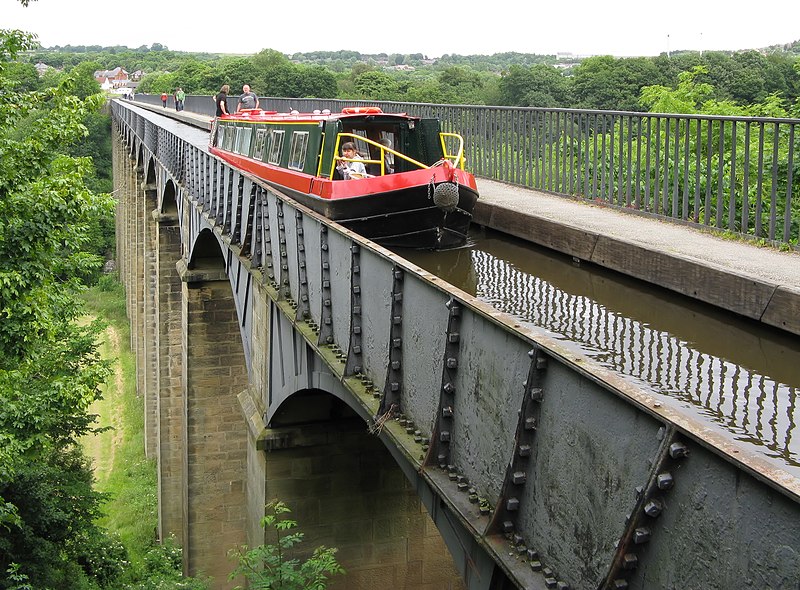
File:Pontcysyllte_aqueduct_arp.jpg · Wikimedia Commons · See Wikimedia Commons
Pontcysyllte Aqueduct
Sign in to saveAlso known as Pontcysyllte Aqueduct and Canal
navigable aqueduct in Wales
Key facts
- Os grid reference
- SJ270420
- Carries
- Llangollen Canal
- Crosses
- River Dee
- Locale
- Froncysyllte , Wrexham , Wales
- Maintained by
- Glandŵr Cymru – the Canal & River Trust
- Heritage status
- Grade I listed
- Trough construction
- Cast iron
- Pier construction
- Stone
- Total length
- 336 yd (307 m)
- Width
- 11 ft 10 in (3.61 m)
- Height
- 127 ft (39 m)
- Water depth
- 5 ft 3 in (1.60 m)
- Traversable
- Yes
- Towpaths
- East side
- Designer
- Thomas Telford
- Construction start
- 25 July 1795
- Opened
- 26 November 1805
- Official name
- Pontcysyllte Aqueduct and Canal
via Wikipedia infobox
Wikidata facts
- Instance of
- aqueduct
- Part of
- Llangollen Canal
- Country
- United Kingdom
- Located in
- Llangollen Rural
- Area
- 105
- Elevation
- 63.6
- Material used
- cast iron
- Location
- Llangollen
- Designed by
- Thomas Telford
- Official website
- www.pontcysyllte-aqueduct.co.uk
- Image
- Pontcysyllte aqueduct arp.jpg
- Height
- 40
- Length
- 307
Show 10 more facts
- start time
- 1805-11-26
- number of spans
- 18
- architect
- William Jessop
- Commons category
- Pontcysyllte Aqueduct
- heritage designation
- scheduled monument
- located in/on physical feature
- Llangollen Canal
- crosses
- River Dee
- carries thoroughfare
- Llangollen Canal
- historic county
- Denbighshire
- P12749
- Bundesautobahn 270
Sources (5)
via Wikidata · CC0
~18 min read
Encyclopedic overview
The Pontcysyllte Aqueduct ( Welsh pronunciation: [ˌpɔntkəˈsəɬtɛ]; Welsh: Traphont Ddŵr Pontcysyllte) is a navigable aqueduct that carries the Llangollen Canal across the River Dee in the Vale of Llangollen in northeast Wales.
The 19-arched stone and cast iron structure is for use by narrowboats and was completed in 1805 having taken ten years to design and build. It is 12 feet (3.7 metres) wide and is the longest aqueduct in Great Britain as well as the highest canal aqueduct in the world. A towpath runs alongside the watercourse on one side.
Excerpted from Wikipedia’s “Pontcysyllte Aqueduct” article, available under the CC BY-SA 4.0 licence.