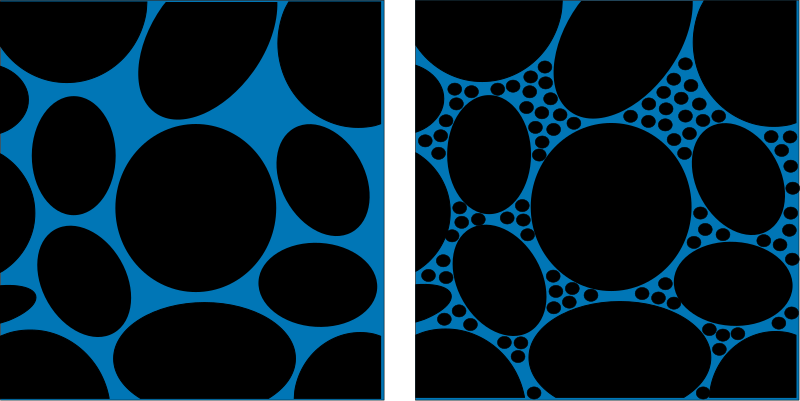
File:Well_sorted_vs_poorly_sorted_porosity.svg · Wikimedia Commons · See Wikimedia Commons
porosity
Sign in to saveAlso known as void ratio, void fraction
Porosity or void fraction is a measure of the void (i.e. "empty") spaces in a material, and is a fraction of the volume of voids over the total volume, between 0 and 1, or as a percentage between 0% and 100%. Strictly speaking, some tests measure the "accessible void", the total amount of void space accessible from the surface (cf. closed-cell foam).
Research
77,056 papers- Estimating Effective Porosity in Bedrock Aquifers.Ground water · 2022
- Effect of Stent Porosity, Platelet Function Test Usage, and Dual Antiplatelet Therapy Duration on Clinical and Radiographic Outcomes After Stenting for Cerebral Aneurysms: A Meta-Analysis.World neurosurgery · 2023
- High porosity 3D printed titanium mesh allows better bone regeneration.BMC oral health · 2023
- Porosity dominates over microgel stiffness for promoting chondrogenesis in zwitterionic granular hydrogels.Biomaterials science · 2024
- GA-coupled ANN model for predicting porosity in alginate gel scaffolds.Journal of the mechanical behavior of biomedical materials · 2023
via PubMed
Wikidata facts
- Subclass of
- dimensionless quantity
Show 5 more facts
- Commons category
- Porosity
- Commons gallery
- Porosity
- described by source
- New International Encyclopedia
- quantity symbol (string)
- ϕ
- has cause
- pore
via Wikidata · CC0
~16 min read
Encyclopedic overview
14 sectionsContents
- Void fraction in two-phase flow
- Porosity in earth sciences and construction
- Porosity and hydraulic conductivity
- Sorting and porosity
- Porosity of rocks
- Porosity of soil
- Types of geologic porosities
- Porosity of fabric or aerodynamic porosity
- Die casting porosity
- Measuring porosity
- See also
- References
- Footnotes
- External links
Porosity or void fraction is a measure of the void (i.e. "empty") spaces in a material, and is a fraction of the volume of voids over the total volume, between 0 and 1, or as a percentage between 0% and 100%. Strictly speaking, some tests measure the "accessible void", the total amount of void space accessible from the surface (cf. closed-cell foam).
There are many ways to test porosity in a substance or part, such as industrial CT scanning.
Excerpted from Wikipedia’s “porosity” article, available under the CC BY-SA 4.0 licence.