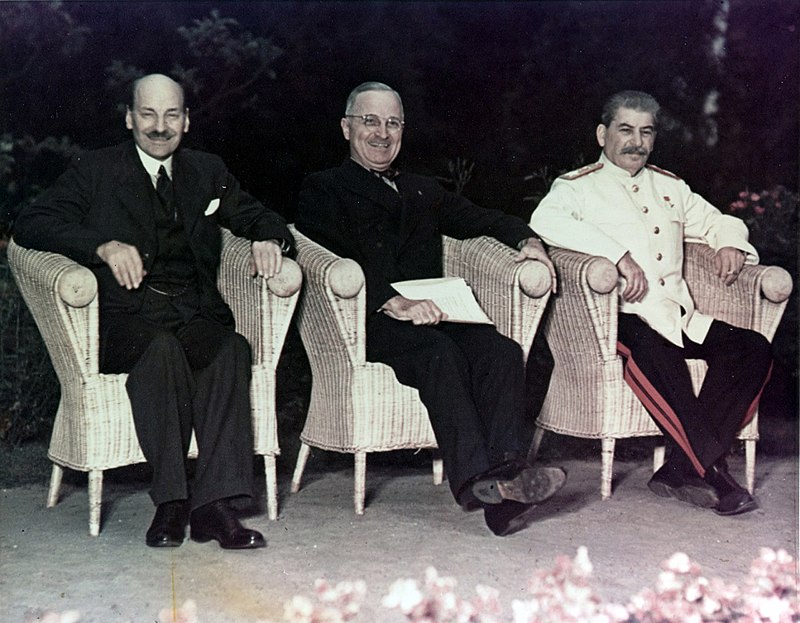
File:Attlee,_Truman_and_Stalin_at_Potsdam.jpg · Wikimedia Commons · See Wikimedia Commons
Potsdam Conference
Sign in to savemeeting of the Allied heads of state near the end of World War II
The Potsdam Conference was a meeting of the Allied leaders near the end of World War II to discuss how to handle Germany's defeat and shape the post-war world. It matters because the decisions made there had major consequences for Europe's future and helped establish the framework for the Cold War that would follow.
AI-generated from the Wikipedia summary — may contain errors.
Wikidata facts
- Instance of
- treaty
- Country
- Germany
- Located in
- Potsdam
- Followed by
- Paris Peace Treaties
- Follows
- Yalta Conference
- Location
- Cecilienhof
- Image
- Last meeting of the Potsdam Conference in Potsdam, Germany. Seated around the conference table, President Harry S.... - NARA - 198951.jpg
- Participant
- Soviet Union
Show 8 more facts
- signatory
- Clement Attlee
- Commons category
- Potsdam Conference
- Commons gallery
- Potsdam Conference
- start time
- 1945-07-17
- end time
- 1945-08-02
- located in/on physical feature
- Potsdam
- time period
- World War II
- P12749
- Myricaria
via Wikidata · CC0
~40 min read
Encyclopedic overview
A conference session including Clement Attlee, Ernest Bevin, Joseph Stalin, Vyacheslav Molotov, William D. Leahy, Joseph E. Davies, James F. Byrnes, and Harry S. Truman From left to right, first row: General Secretary Joseph Stalin; President Harry Truman, Soviet Ambassador to the United States Andrei Gromyko, Secretary of State James F. Byrnes, and Soviet Foreign Minister Vyacheslav Molotov. Second row: Brigadier General Harry H. Vaughan, Truman's confidant and military aide, Russian interpreter Charles Bohlen, Truman naval aide James K. Vardaman Jr., and (partially obscured) Charles Griffith Ross Sitting (from left): Clement Attlee, Harry S. Truman, Joseph Stalin, and behind: Fleet Admiral William Daniel Leahy, Foreign Secretary Ernest Bevin, Secretary of State James F. Byrnes, and Foreign Minister Vyacheslav MolotovThe Potsdam Conference (German: Potsdamer Konferenz) was held at Potsdam in the Soviet occupation zone from 17 July to 2 August 1945, to allow the three leading Allies to plan the postwar peace, while avoiding the mistakes of the Paris Peace Conference of 1919. The participants were the Soviet Union, the United Kingdom, and the United States. They were represented respectively by General Secretary Joseph Stalin, prime ministers Winston Churchill and Clement Attlee, and President Harry S. Truman. They gathered to decide how to administer Germany, which had agreed to an unconditional surrender nine weeks earlier. The goals of the conference also included establishing the postwar order, solving issues on the peace treaty, and countering the effects of the war.
The foreign ministers and aides played key roles: Vyacheslav Molotov, Anthony Eden and Ernest Bevin, and James F. Byrnes. From 17 July to 25 July, nine meetings were held, when the Conference was interrupted for two days, as the results of the British general election were announced. By 28 July, Attlee had defeated Churchill and replaced him as Britain's representative, with Britain's new Secretary of State for Foreign Affairs, Ernest Bevin, replacing Anthony Eden. Four days of further discussion followed. During the conference, there were meetings of the three heads of government with their foreign secretaries, as well as meetings of only the foreign secretaries. Committees that were appointed by the latter for precursory consideration of questions before the conference also met daily. During the Conference, Truman was secretly informed that the Trinity test of the first atomic bomb on 16 July had been successful. He hinted to Stalin that the U.S. was about to use a new kind of weapon against the Japanese. Though this was the first time the Soviets had been officially given information about the atomic bomb, Stalin was already aware of the bomb project, having learned about it through espionage long before.
Excerpted from Wikipedia’s “Potsdam Conference” article, available under the CC BY-SA 4.0 licence.
Gallery (9)
Available in 74 languages
- Español
- Français
- Deutsch
- 中文
- 日本語
- Русский
- Português
- Italiano
- العربية
- Aragonese
- Armenian
- Asturian
- Azerbaijani
- Bahasa Indonesia
- Bashkir
- Basque
- be_x_old
- Belarusian
Show 55 more
- Bulgarian
- Catalan
- Croatian
- Czech
- Danish
- Egyptian Arabic
- Esperanto
- Estonian
- Filipino
- Finnish
- Galician
- Georgian
- Greek
- Hebrew
- Hungarian
- hyw
- Icelandic
- Interlingua
- Irish
- Kazakh
- Kyrgyz
- Latvian
- Lithuanian
- Macedonian
- Malay
- Malayalam
- Mongolian
- Nederlands
- Norwegian
- Occitan
- Polski
- Romanian
- Rusyn
- Scots
- Serbian
- Serbian (Latin)
- simple
- Slovak
- Slovenian
- Svenska
- Swahili
- Tatar
- Telugu
- Tiếng Việt
- Türkçe
- Ukrainian
- Uzbek
- Venetian
- Welsh
- Western Frisian
- Wu Chinese
- zh_yue
- فارسی
- ไทย
- 한국어
via Wikidata sitelinks · CC0