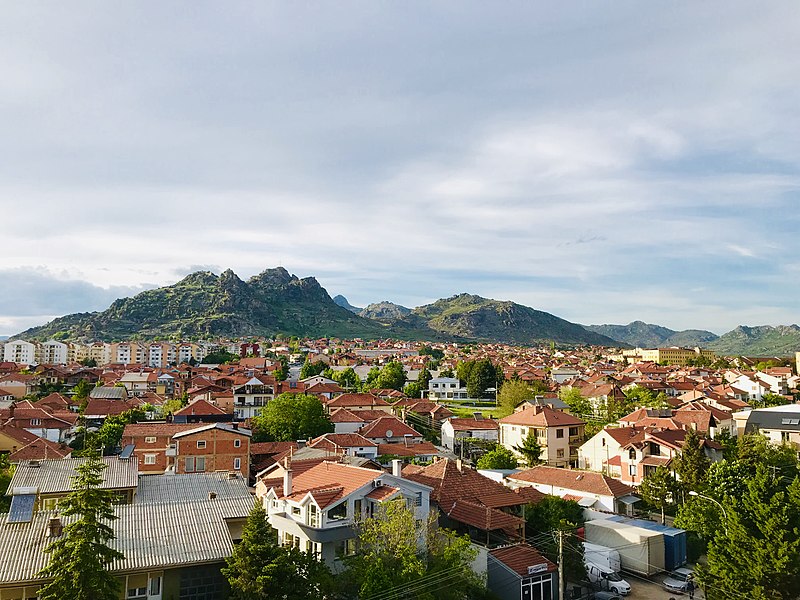
File:Panorama_of_Prilep,_2019.jpg · Wikimedia Commons · See Wikimedia Commons
Prilep
Sign in to savePrilep ( ) is the fourth-largest city in North Macedonia, after Skopje, Kumanovo, and Bitola. According to the 2021 census, it had a population of 63,308, while its broader municipal area has 79,834 inhabitants in total.
OverviewAI-generated
Prilep is a city in North Macedonia, serving as the capital of Prilep Municipality. It is situated in the Pelagonia region and has at various times been part of the Ottoman Empire, the Kingdom of Serbs, Croats and Slovenes, and Yugoslavia. The city’s native label is Прилеп, and it operates within the Central European Time zone.
The municipality covers an area of 1194.44 square kilometers. Population figures vary by source, with one listing 66,817 residents (33,603 male and 33,214 female) and another citing 73,814. Prilep is twinned with Zadar, Radom, Garfield, and Deyang. Its postal code is 7500, and the local dialing code is 048.
Synthesized by Vinony from 52 facts across 7 sources: Wikidata, Open Meteo, Openweathermap, OpenStreetMap, GeoNames, Vinony graph, Geo. Generated from structured data (not the Wikipedia text) and checked against those facts — may still contain errors.
Weather now
7-day forecast
via Open-Meteo
Place details
- Locality
- Прилеп
- Region
- Prilep
- Country
- Северна Македонија
- Population
- 73,814
- Timezone
- Europe/Skopje
via OpenStreetMap · GeoNames
Key facts
- Settlement.name
- Prilep
- Settlement.nickname
- "The city under Marko's Towers"
- Settlement.settlement_type
- Town
- Settlement.image_caption
- From top, clockwise: panorama of Prilep from Hotel Kristal Palas; Čento Square; Čarši Mosque ruins; Mound of the Unbeaten; Memorial Museum of October 11, 1941; Church of Saints Cyril and Methodius; commercial building in city centre
- Settlement.image_flag
- Flag of Prilep Municipality.svg
- Settlement.image_seal
- Coat of arms of Prilep Municipality.svg
- Settlement.image_map
- Прилеп во Општина Прилеп.svg
- Settlement.map_caption
- Location in Prilep Municipality
- Settlement.pushpin_map
- North Macedonia#Balkans
- Settlement.pushpin_map_caption
- Location in North Macedonia
- Settlement.subdivision_type
- Country
- Settlement.subdivision_type1
- Region
- Settlement.subdivision_name1
- 13px Pelagonia
- Settlement.subdivision_type2
- Municipality
- Settlement.subdivision_name2
- 13px Prilep
- Settlement.leader_title
- Mayor
- Settlement.leader_name
- Dejan Prodanoski (VMRO-DPMNE)
- Settlement.area_total_km2
- 1194.44
via Wikipedia infobox
Wikidata facts
- Instance of
- city
- Country
- Byzantine Empire
- Located in
- Strymon
- Population
- 63308
- Area
- 1194.44
- Elevation
- 620
- Time zone
- Central European Summer Time
- Capital of
- Prilep Municipality
- Official website
- prilep.gov.mk
- Image
- Prilep from Towers of Marko.jpg
- Dialing code
- 048
- Licence plate code
- PR
- Patron saint
- Saint Nicholas
Show 13 more facts
- twinned administrative body
- Nikšić
- Commons category
- Prilep
- topic's main category
- Category:Prilep
- category of associated people
- Category:People from Prilep
- located in/on physical feature
- Pelagonia
- postal code
- 7500
- native label
- Прилеп
- category for people born here
- Category:Births in Prilep
- category for people who died here
- Category:Deaths in Prilep
- male population
- 31223
- female population
- 32085
- different from
- Prilep
- P12749
- Aube
Sources (10)
via Wikidata · CC0
Travel guide
Understand
What is most striking about Prilep is the strange bare scenery with huge rocks scattered around. The city is nestled below a bare hill. On the top of the hill, ruins of a medieval fortress stand. All around the city are tobacco fields, and if one visits the city in late summer or fall, one will see tobacco drying everywhere he turns. What is unique about Prilep is the strange sense of humor its inhabitants have and the way they have preserved their traditional way of life. Near Prilep is the Mariovo region, one of the most untouched regions of Macedonia, with small, half-deserted villages scattered in untouched nature.
Get around
The centre is small and it's easiest to get around on foot.
The bus station is in the centre too.
To get to Varosh village, you can get a taxi for around MKD50 - ask to be dropped at the monastery and then walk down to visit the churches, or walk for about 20 to 30 minutes.
See
thumb|280px|Heading into the Old Bazaar with the Clock Tower in full view thumb|280px|The Mound of the Unbeaten thumb|280px|Marko's Towers thumb|280px|The secluded Treskavec Monastery looks down onto the Pelagonia plain from Mount Zlatovrv Prilep is one of Macedonia's foremost cities. While it perhaps saw its greatest importance in the medieval era, there are monuments from the ancient, Byzantine, Ottoman, neoclassical, communist, and modern eras as well that showcase Prilep's fascinating past. Coupled with the unique landscape in and around the city, Prilep is not to be missed when visiting Macedonia.
Eat
thumb|250px|Širden Prilep is the origin of the traditional Macedonian food Širden. It is prepared with an elastic muscle organ of a sheep or lamb, which is washed and then stuffed with three kinds of chopped meat, onions, and paprika and seasoned with black pepper, pimento, and salt. A little water is added and the opening is sewn with a needle and a thread. It is baked with lard in an earthen casserole.
There are many burek and pastry places and restaurants in the centre but for best grill and local food head for:
Drink
There is a selection of cafes, bars and clubs in Prilep, most of them in and around the old bazaar and in the shopping mall that stands on the main square. Here are some of the popular destinations: In the center of the town there are at least twenty cafe bars offering a variety of fun and you can have a nice time enjoying some very modern or rustique views of architecture.
Go next
Bitola- Visit the “city of consuls”. Cozy Old Town and a very ruined, ancient city remains. Certainly worth stopping off here for a few hours if travelling from Prilep to Ohrid. Kicevo - There is the St. Bogorodica Precista a monastery with the 'flying icon' Ohrid- A couple bus per day (via Bitola). With ancient churches and flower-filled balconies in the hillside old city, and beach life down below on the lake coast, this is no doubt the "Macedonian Riviera" Skopje - around dozen of buses and couple of trains depart to the Capital Veles - 65 km NE. - Visit the nearby Saint Jovan Vetersko monastery
Travel guide from Wikivoyage (CC BY-SA 4.0)
~19 min read
Encyclopedic overview
15 sectionsContents
- Name
- Economy
- History
- Culture
- Language
- Art and architecture
- Geography
- Demographics
- Climate
- Sports
- Notable people
- Twin towns – sister cities
- Notes
- References
- External links
Prilep ( ) is the fourth-largest city in North Macedonia, after Skopje, Kumanovo, and Bitola. According to the 2021 census, it had a population of 63,308, while its broader municipal area has 79,834 inhabitants in total.
==Name== thumbnail|View of Prilep and the surrounding mountains
Excerpted from Wikipedia’s “Prilep” article, available under the CC BY-SA 4.0 licence.
Gallery (36)
On the map
3 mapped locations
Available in 66 languages
- Español
- Deutsch
- 中文
- 日本語
- Русский
- Português
- العربية
- Albanian
- Armenian
- Azerbaijani
- Bahasa Indonesia
- be_x_old
- Belarusian
- Bosnian
- Bulgarian
- Cebuano
- Church Slavic
- Croatian
Show 47 more
- Czech
- Danish
- Egyptian Arabic
- Esperanto
- Estonian
- Finnish
- Georgian
- Greek
- Hebrew
- Hungarian
- Interlingue
- Irish
- Kazakh
- Latin
- Latvian
- Lithuanian
- Luxembourgish
- Macedonian
- Malay
- Mingrelian
- Moksha
- Nederlands
- Northern Frisian
- Norwegian
- Norwegian Nynorsk
- Ossetic
- Pashto
- Polski
- Romanian
- Scots
- Serbian
- Serbian (Latin)
- simple
- Slovenian
- Svenska
- Tatar
- Türkçe
- Ukrainian
- Upper Sorbian
- Urdu
- Volapük
- Welsh
- Wu Chinese
- zh_min_nan
- فارسی
- ไทย
- 한국어
via Wikidata sitelinks · CC0