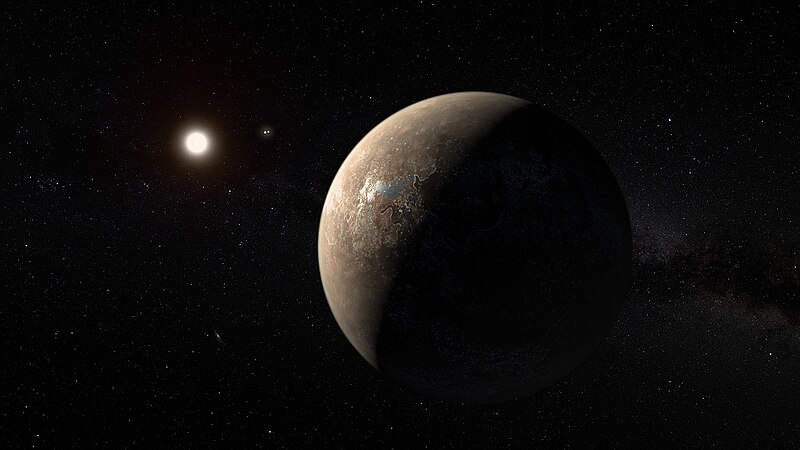
File:Artist’s_impression_of_Proxima_Centauri_b_shown_hypothetically_as_an_arid_rocky_super-earth.jpg · Wikimedia Commons · See Wikimedia Commons
Proxima Centauri b
Sign in to saveAlso known as Alpha Centauri Cb, Proxima b, NAME V645 Cen b, NAME Proxima Centauri b, TIC 388857263b
pianeta extrasolare
Proxima Centauri b is an Earth-sized planet that orbits Proxima Centauri, the star closest to our Sun at about 4.2 light-years away. It matters because it's one of the nearest potentially habitable worlds we've discovered, making it a prime target for future study to understand whether life could exist beyond our solar system.
AI-generated from the Wikipedia summary — may contain errors.
Astronomical data · SIMBAD
- Object type
- Pl
- Distance
- 4 light-years
- Coordinates
- RA 217.4289° · Dec -62.6795°
via SIMBAD · CDS Strasbourg
Wikidata facts
- Constellation
- Centaurus
- Parent body
- Proxima Centauri
- Mass
- 0.00337
- Orbital period
- 11.1881
- Image
- Artist’s impression of Proxima Centauri b shown hypothetically as an arid rocky super-earth.jpg
Show 15 more facts
- discovery method
- Doppler spectroscopy
- semi-major axis of an orbit
- 0.04856
- time of discovery or invention
- 2016-08-00
- Commons category
- Proxima Centauri b
- right ascension
- 217.42893801442040
- declination
- -62.67949189414083
- epoch
- J2000.0
- argument of periapsis
- 3.3
- catalog code
- TIC 388857263b
- right ascension component of proper motion
- -3781.306
- M sin i
- 0.00337
- orbital eccentricity
- 0
- declination component of proper motion
- 769.766
- parallax
- 768.5004
- time of periapsis
- 245813.5
Sources (2)
via Wikidata · CC0
Article · Italiano
Proxima Centauri b (o più semplicemente Proxima b) è un pianeta extrasolare in orbita nella zona abitabile della nana rossa Proxima Centauri (componente C del sistema Alfa Centauri che si trova nella costellazione del Centauro). Proxima Centauri, distante dalla Terra 4,224 anni luce, è la stella più vicina al Sistema Solare e questo rende Proxima b l'esopianeta conosciuto più vicino possibile alla Terra e, a maggio 2020, quello con l'ottavo ESI (indice di similarità terrestre) più alto tra tutti gli esopianeti conosciuti (0,87).
Abstract from DBpedia / Wikipedia · CC BY-SA
Gallery (11)
Available in 59 languages
- Español
- Français
- Deutsch
- 中文
- 日本語
- Русский
- Português
- Italiano
- العربية
- हिन्दी
- Afrikaans
- Aragonese
- Armenian
- Azerbaijani
- Bahasa Indonesia
- Basque
- Belarusian
- Bosnian
Show 40 more
- Bulgarian
- Catalan
- Croatian
- Czech
- Danish
- Esperanto
- Estonian
- Finnish
- Galician
- Georgian
- Greek
- Hebrew
- Hungarian
- Kannada
- Latvian
- Lithuanian
- Luxembourgish
- Nederlands
- Norwegian
- Norwegian Nynorsk
- Occitan
- Polski
- Romanian
- Serbian
- Serbian (Latin)
- simple
- Slovak
- Slovenian
- Svenska
- Tamil
- Tiếng Việt
- Türkçe
- Ukrainian
- Urdu
- Welsh
- Wu Chinese
- zh_yue
- فارسی
- ไทย
- 한국어
via Wikidata sitelinks · CC0