File:Proxy_concept_en.svg · Wikimedia Commons · See Wikimedia Commons
A proxy server is a computer that acts as a middleman between you and the websites you visit, making requests on your behalf and receiving the responses. This matters because it can provide benefits like hiding your actual location, improving security, or allowing you to access content that might otherwise be restricted.
AI-generated from the Wikipedia summary — may contain errors.
Described at

Proxy server - Wikipedia
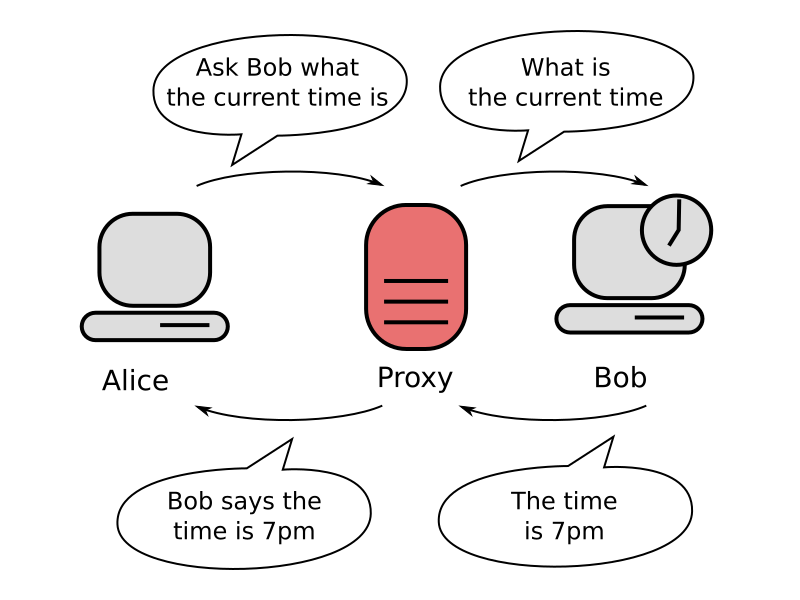
en.wikipedia.org →For Wikipedia's policy on editing from open proxies, see Wikipedia:Open proxies . Communication between two computers connected through a third computer acting as a proxy server. This can protect Alice's privacy , as Bob only knows about the proxy and cannot identify or contact Alice directly. Anonymous proxy : This server reveals its identity as a proxy server but does not disclose the originating IP address of the client. Although discovered easily as a proxy server, it can be beneficial for some users as it hides the originating IP address. Forwarding headers : Some proxies append HTTP headers to disclose client or proxy information that would otherwise be lost when a request is forwarded. Historically this has often been done with non-standard fields such as X-Forwarded-For , while the standardised Forwarded field provides a defined syntax for similar information.[[5]]( Such headers are deployment-dependent and should not be treated as inherently trustworthy, since they may be absent, modified, or contain values added by multiple proxies.[[6]]( A reverse proxy taking requests from the Internet and forwarding them to servers in an internal network. Those making requests connect to the proxy and may not be aware of the internal network. A reverse proxy (or surrogate) is a proxy server that appears to clients to be an ordinary server. Reverse proxies send requests to one or more ordinary servers that handle the request. The response from the original server is returned as if it came directly from the proxy server, leaving the client with no knowledge of the original server.[[7]]( Reverse proxies are installed in the vicinity of one or more web servers. All traffic coming from the Internet and with a destination of one of the neighborhood's web servers goes through the proxy server. The use of "reverse" originates in its counterpart, the "forward" proxy. The reverse proxy sits closer to the web server and serves only a restricted set of websites. There are several reasons for installing reverse proxy servers: TLS termination : Reverse proxies often terminate TLS connections from clients and forward requests to backend servers. This can centralise certificate management, access control, logging, and request routing, and can reduce the TLS-related work performed by backend servers. Backend connections may use HTTP or HTTPS depending on the deployment and security requirements. Modern deployments usually perform TLS termination in software, optionally with hardware assistance, rather than requiring dedicated SSL acceleration hardware. Certificates for multiple names can be handled using mechanisms such as Subject Alternative Name certificates, wildcard certificates , and Server Name Indication (SNI).[[8]]( [[9]]( [[10]]( A forward proxy is a server that routes traffic between clients and another system, which is, in most cases, external to the network. This means it can regulate traffic according to preset policies, convert and mask client IP addresses, enforce security protocols, and block unknown traffic. A forward proxy enhances security and policy enforcement within an internal network.[[11]]( A reverse proxy, instead of protecting the client, is used to protect the servers. A reverse proxy accepts a request from a client, forwards that request to another one of many other servers, and then returns the results from the server that specifically processed the request to the client. Effectively, a reverse proxy acts as a gateway between clients, users, and application servers and handles all the traffic routing whilst also protecting the identity of the server that physically processes the request.[[12]]( A content-filtering web proxy server provides administrative control over the content that may be relayed in one or both directions through the proxy. It is commonly used in both commercial and non-commercial organizations (especially schools) to ensure that Internet usage conforms to acceptable use policy . Content fi
Excerpt from a page describing this subject · 40,000 chars · not written by Vinony
Wikidata facts
- Instance of
- software category
- Subclass of
- network service
- Has part
- TLS termination proxy
- Image
- Open proxy h2g2bob.svg
- Has use
- network security
Show 5 more facts
- Stack Exchange tag
- stackoverflow.com/tags/proxy
- Commons category
- Proxy servers
- topic's main category
- Category:Proxy servers
- different from
- firewall
- described at URL
- en.wikipedia.org/wiki/Proxy_server
Sources (7)
via Wikidata · CC0
Article · 中文
代理(英語:Proxy)也称网络代理,是一种特殊的网络服务,允许一个终端(一般为客户端)通过这个服务与另一个终端(一般为服务器)进行非直接的连接。一些网关、路由器等网络设备具备网络代理功能。一般認為代理服务有利于保障网络終端的私隱或安全,在一定程度上能够阻止网络攻击。 提供代理服务的電腦系统或其它类型的网络终端称为代理服务器英語:Proxy Server。一个完整的代理请求过程为:客户端首先根据代理服务器所使用的代理协议,与代理服务器建立连接,接着按照协议请求对目标服务器建立连接、或者获得目标服务器的指定资源(如:文件)。在后一种情况中,代理服务器可能对目标服务器的资源下載至本地缓存,如果客户端所要获取的资源在代理服务器的缓存之中,则代理服务器并不会向目标服务器发送请求,而是直接傳回已缓存的资源。一些代理协议允许代理服务器改变客户端的原始请求、目标服务器的原始响应,以满足代理协议的需要。 另外在部分实行网络审查的国家(如中华人民共和国),可以通过使用代理服务器的方式以突破网络审查(俗称“翻墙”) 持有资源实体的服务器被称为源服务器,从源服务器返回的响应经过代理服务器后再传给客户端。
Abstract from DBpedia / Wikipedia · CC BY-SA