Schmidt, Christian
Pseudohemihyalea
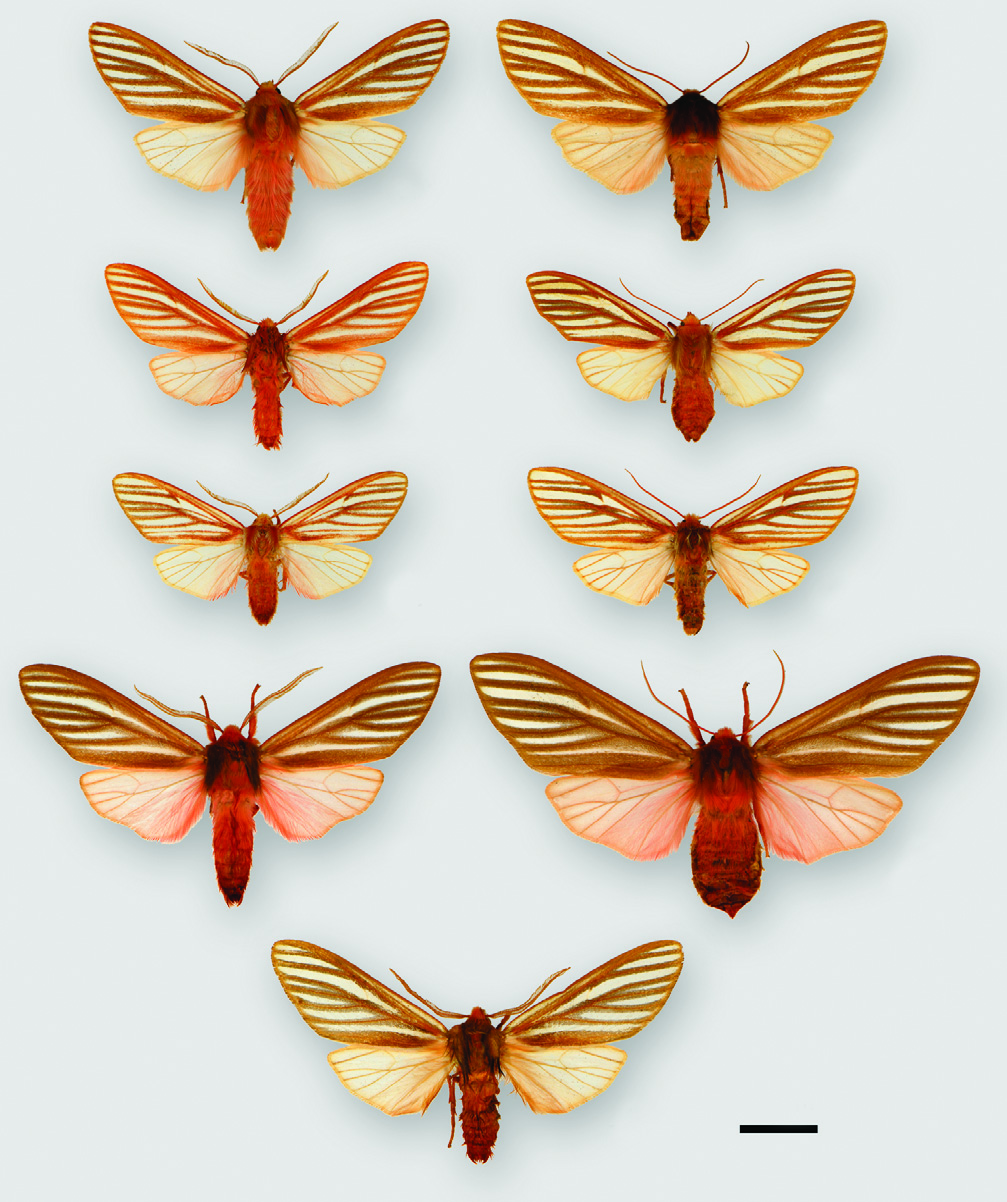
Sign in to savePseudohemihyalea is a genus of moths in the family Erebidae described by Régo Barros in 1956. While the caterpillars of most species of Pseudohemihyalea feed on broad-leaved trees (e.g. oaks, Quercus), the P. ambigua group has larvae that feed on conifers. Their forewing coloration has accordingly evolved to light-and-dark lengthwise striping, giving better camouflage among the slim needles of the host plants. In this, they seem to be convergent to certain geometer moths, such as Caripeta piniata or Sabulodes niveostriata.
Species
Edwards' Glassy-wing Moth
GENUS
- KingdomAnimalia
- PhylumArthropoda
- ClassInsecta
- OrderLepidoptera
- FamilyArctiidae
via GBIF
Museum specimens
- Specimen records
- 188
- With media
- 31
- Family
- Erebidae
- Collections
- MISSA, YPM, ANSP, MNA, CSU
- Recorded in
- Panama, Guatemala, United States, Costa Rica, Mexico
~3 min read
Encyclopedic overview
5 sectionsContents
- Taxonomy
- Selected species
- Footnotes
- References
- External links
Pseudohemihyalea is a genus of moths in the family Erebidae described by Régo Barros in 1956. While the caterpillars of most species of Pseudohemihyalea feed on broad-leaved trees (e.g. oaks, Quercus), the P. ambigua group has larvae that feed on conifers. Their forewing coloration has accordingly evolved to light-and-dark lengthwise striping, giving better camouflage among the slim needles of the host plants. In this, they seem to be convergent to certain geometer moths, such as Caripeta piniata or Sabulodes niveostriata.
==Taxonomy== The genus was long included in Hemihyalea when the latter was still unresolved versus Amastus, but seems to be distinct and in fact contain more species than originally believed. The initial confusion stems partly from the fact that Régo Barros when describing the genus set the type species to be Phaegoptera rhoda, but he had actually misidentified Pseudohemihyalea schausi specimens as P. rhoda.
Excerpted from Wikipedia’s “Pseudohemihyalea” article, available under the CC BY-SA 4.0 licence.