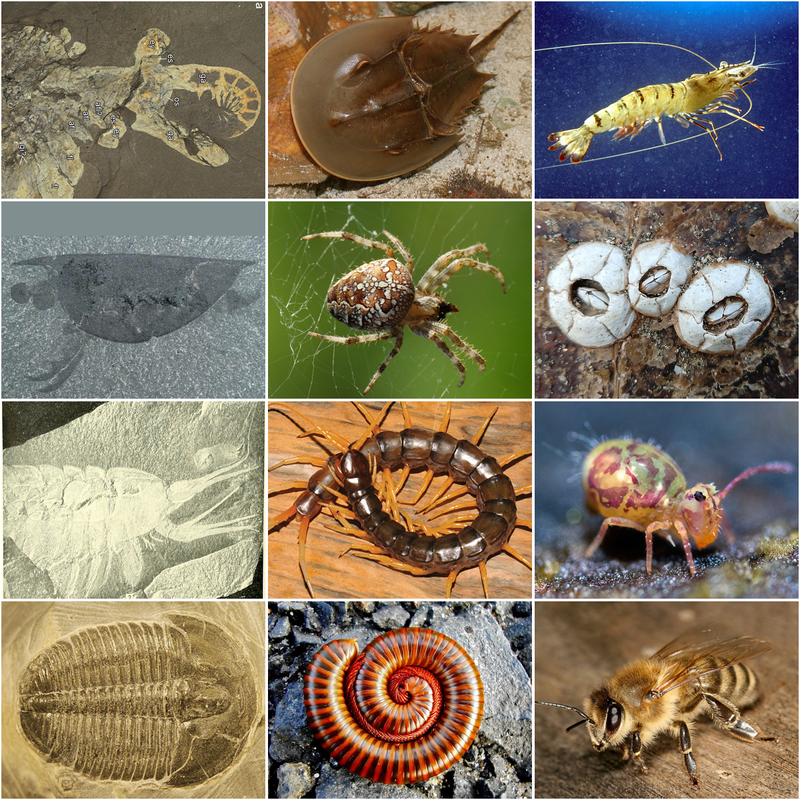
File:Arthropoda_collage.png · Wikimedia Commons · See Wikimedia Commons
arthropod
Sign in to saveAlso known as arthropods, arthropod animal, arthropod animals, Arthropoda
Arthropods ( ) are invertebrates in the phylum Arthropoda. They possess an exoskeleton with a cuticle made of chitin, often mineralised with calcium carbonate, a body with differentiated (metameric) segments, and paired jointed appendages. In order to keep growing, they must go through stages of moulting, a process by which they shed their exoskeleton to reveal a new one. They form an extremely diverse group of up to ten million species.
OverviewAI-generated
Arthropoda is a phylum within the Ecdysozoa, Panarthropoda, and Tactopoda clades. It is classified as an invertebrate taxon. The group includes organisms that reproduce via oviparity. Their temporal range began in the Cambrian period, approximately 540 million years ago. Arthropods inhabit marine, brackish, and freshwater environments. The authority for this phylum is Gravenhorst, 1843.
The study of these organisms is called arthropodology. They are featured on the Wikipedia:List of articles all languages should have and Wikipedia:Vital articles/Level/4. The topic has a main category of Category:Arthropods and Category:Arthropoda. It is also associated with the Portal:Arthropods. The Unicode character 🐛 represents the topic.
Arthropoda is referenced by 241,609 other encyclopedia articles. It appears in the Brockhaus and Efron Encyclopedic Dictionary, Granat Encyclopedic Dictionary, Encyclopædia Britannica 11th edition, and New International Encyclopedia. In PubMed, the query "arthropod" yields 503,964 results.
Synthesized by Vinony from 32 facts across 5 sources: Wikidata, PubMed, iNaturalist, WoRMS, Vinony graph. Generated from structured data (not the Wikipedia text) and checked against those facts — may still contain errors.
Species
arthropods
Phylum
- PhylumArthropoda
节肢動物是動物的一类/门,由昆虫纲、甲壳纲、蛛形纲等外骨骼動物組成被稱为节肢动物门(学名:Arthropoda)的分類單位。在動物界中所屬物種最多的一門,已被人類命名的昆蟲類就有超過75萬種[1] [2] [3]。除昆蟲外,常見的蝦、蟹、蜘蛛、蜈蚣及已滅絕的三葉蟲都屬於节肢動物。 节肢動物的特點為其分節的肢體,以及主要成份為α-甲殼素的角質層。甲壳生物的角質層中也包括了碳酸鈣,是生物礦化(英语:biomineralization)的產物。 目录 1 特徵 2 神经系统 3 分類 4 和人類的關係 5 参见 6 注释 7 參考文献 8 外部連結 特徵 节肢动物基本上都是有性繁殖、卵生的。也有孤雌生殖的現象。 其身體表面有幾丁質組成的外骨骼;隨着身體的長大,需要經歷蛻皮的階段,將舊的外骨骼脫掉。 身體兩側對稱,身體分節,像環節類動物,但部分體節融合成特別部位,如頭部及胸部。有些節肢動物,例如蜘蛛,頭部及胸部進一步融合成頭胸部。每個特化部位的機能亦作相應的變化。 身體,取體節的反復構造,被外骨骼包圍而形成身體表面的體節單位。體節之間關節可動。根據種類的不同,也有如果體節裡面特定的東西組合能相合一下繼續的外骨骼被覆蓋等,外表上某在構成機能上的單位。譬如,有分成頭部,胸部,腹部3部分,或頭胸部,腹部的2部分的身體稱呼,這個作為每節肢動物的各分類群的特徵採用。 身體的附肢,例如足部、觸角、口器等都分節。 附肢的功能亦高度特化,負責感覺、行走、游泳、進食、以至生殖等。 從各體節,有腳出。腳同樣用外骨骼覆蓋,腳上也有關節。 一部分的分類群,成為由蛋孵化的幼體性成熟的成體的過程,有進行顯著地形態變化的生物變態。甲殼類和昆蟲類等。 神经系统 节肢动物体内有腹神经索,并且在每个體節中,连着一对神经节,感觉神经和运动神经从神经节连接到身体其他部分。 脑部位于头部,在食道上方。 分類 节肢动物 单支类 有爪动物门 六足亚门 多足亚门 甲壳亚门 螯肢亚门 S. M. Manton's (1973) polyphyletic Arthropod hypothesis with Uniramia as one of three Phyla.[4] 節肢動物通常分為5亞門,其中一個已滅絕: 三葉蟲亞門 Trilobitomorpha 三葉蟲綱 Trilobita - 三葉蟲 (已滅絕) 螯肢亞門 Chelicerata 蛛形綱 Arachnida - 蜘蛛、蝎子 肢口綱 Merostomata - 鲎 海蜘蛛綱 Pycnogonida - 海蜘蛛 多足亞門 Myriapoda 唇足綱 Chilopoda - 蜈蚣 倍足綱 Diplopoda - 馬陸 少腳綱(少足綱)Pauropoda 結合綱(綜合綱 ) Symphyla 六足亞門 Hexapoda 昆虫纲 Insecta - 昆蟲 內口綱
via
Research
503,964 papers- Arthropod spatial cognition.ReviewAnimal cognition · 2020Pfeffer S, Wolf HDOI: 10.1007/s10071-020-01446-4
- Arthropod venoms: Biochemistry, ecology and evolution.ReviewToxicon : official journal of the International Society on Toxinology · 2019Senji Laxme RR, Suranse V, Sunagar KDOI: 10.1016/j.toxicon.2018.11.433
- Immunometabolism in Arthropod Vectors: Redefining Interspecies Relationships.ReviewTrends in parasitology · 2020Samaddar S, Marnin L, Butler LR et al.DOI: 10.1016/j.pt.2020.07.010
- Arthropod exosomes as bubbles with message(s) to transmit vector-borne diseases.ReviewCurrent opinion in insect science · 2020Sultana H, Neelakanta GDOI: 10.1016/j.cois.2020.05.017
- Arthropod assassins: Crawling biochemists with diverse toxin pharmacopeias.Toxicon : official journal of the International Society on Toxinology · 2019Herzig VDOI: 10.1016/j.toxicon.2018.11.312
- The moulting arthropod: a complete genetic toolkit review.ReviewBiological reviews of the Cambridge Philosophical Society · 2024Campli G, Volovych O, Kim K et al.DOI: 10.1111/brv.13123
- Decoding arthropod vector immunology through bona fide pathogens.ReviewTrends in parasitology · 2025Wu-Chuang A, Laukaitis-Yousey HJ, Butnaru M et al.DOI: 10.1016/j.pt.2025.03.004
- Arthropod venoms and cancer.ReviewToxicon : official journal of the International Society on Toxinology · 2011Heinen TE, da Veiga ABDOI: 10.1016/j.toxicon.2011.01.002
via PubMed
Wikidata facts
- Instance of
- taxon
- Subclass of
- invertebrate
- Parent taxon
- Tactopoda
- Image
- Asian forest scorpion in Khao Yai National Park.JPG
Show 12 more facts
- taxon rank
- phylum
- Commons category
- Arthropoda
- taxon name
- Arthropoda
- topic's main category
- Category:Arthropoda
- taxon common name
- leddyr
- Unicode character
- 🐛
- on focus list of Wikimedia project
- Wikipedia:Vital articles/Level/4
- topic has template
- Template:Arthropods
- start time
- 540000000-
- topic's main Wikimedia portal
- Portal:Arthropods
- mode of reproduction
- oviparity
- temporal range start
- Cambrian
Sources (9)
via Wikidata · CC0
~49 min read
Encyclopedic overview
27 sectionsContents
- Etymology
- Description
- Diversity
- Segmentation
- Exoskeleton
- Moulting
- Internal organs
- Respiration and circulation
- Nervous system
- Excretory system
- Senses
- Optical
- Olfaction
- Reproduction and development
- Evolutionary history
- Last common ancestor
- Fossil record
- External phylogeny
- Internal phylogeny
- Early arthropods
- Living arthropods
- Interaction with humans
- See also
- Notes
- References
- Bibliography
- External links
Arthropods ( ) are invertebrates in the phylum Arthropoda. They possess an exoskeleton with a cuticle made of chitin, often mineralised with calcium carbonate, a body with differentiated (metameric) segments, and paired jointed appendages. In order to keep growing, they must go through stages of moulting, a process by which they shed their exoskeleton to reveal a new one. They form an extremely diverse group of up to ten million species.
Haemolymph is the analogue of blood for most arthropods. An arthropod has an open circulatory system, with a body cavity called a haemocoel through which haemolymph circulates to the interior organs. Like their exteriors, the internal organs of arthropods are generally built of repeated segments. They have ladder-like nervous systems, with paired ventral nerve cords running through all segments and forming paired ganglia in each segment. Their heads are formed by fusion of varying numbers of segments, and their brains are formed by fusion of the ganglia of these segments and encircle the esophagus. The respiratory and excretory systems of arthropods vary, depending as much on their environment as on the subphylum to which they belong.
Excerpted from Wikipedia’s “arthropod” article, available under the CC BY-SA 4.0 licence.
Gallery (35)
Available in 141 languages
- Español
- Français
- Deutsch
- 中文
- 日本語
- Русский
- Português
- Italiano
- العربية
- हिन्दी
- abstract
- Afrikaans
- Albanian
- Albanian
- Amharic
- Aragonese
- Armenian
- Assamese
Show 122 more
- Asturian
- azb
- Azerbaijani
- Bahasa Indonesia
- Balinese
- Bangla
- Bashkir
- Basque
- bat_smg
- be_x_old
- Belarusian
- Bosnian
- Breton
- Bulgarian
- Buriat
- Burmese
- Catalan
- Cebuano
- Central Kurdish
- Chuvash
- Cornish
- Corsican
- Croatian
- Czech
- Danish
- Egyptian Arabic
- Esperanto
- Estonian
- Faroese
- Fiji Hindi
- Filipino
- Finnish
- Galician
- Georgian
- Greek
- Guarani
- Gujarati
- Haitian Creole
- Hausa
- Hebrew
- Hungarian
- Icelandic
- Ido
- Igbo
- Iloko
- Interlingua
- Interlingue
- Irish
- Javanese
- Kabyle
- Kannada
- Kashmiri
- Kazakh
- Kurdish
- Kyrgyz
- Latin
- Latvian
- Limburgish
- Lingua Franca Nova
- Lithuanian
- Low German
- Luxembourgish
- Macedonian
- Malagasy
- Malay
- Malayalam
- Mazanderani
- Minangkabau
- Mongolian
- Moroccan Arabic
- Navajo
- Nederlands
- Nepali
- Newari
- Northern Frisian
- Norwegian
- Norwegian Nynorsk
- Occitan
- Oromo
- Ossetic
- Pashto
- Piedmontese
- Polski
- Punjabi
- Quechua
- Romanian
- Rusyn
- Scots
- Serbian
- Serbian (Latin)
- Sicilian
- simple
- Sindhi
- Slovak
- Slovenian
- Sundanese
- Svenska
- Swahili
- Tajik
- Tamil
- Tatar
- Telugu
- Tiếng Việt
- Tok Pisin
- Tongan
- Türkçe
- Ukrainian
- Urdu
- Uzbek
- Veps
- Waray
- Welsh
- West Flemish
- Western Mari
- Western Panjabi
- Wu Chinese
- Yiddish
- zh_min_nan
- zh_yue
- فارسی
- ไทย
- 한국어
via Wikidata sitelinks · CC0