Lonsdale, Owen
Psilidae
Sign in to saveAlso known as Rust flies
The Psilidae are family of flies. Commonly called the rust flies, at least 38 species are in four genera. The carrot fly (Chamaepsila rosae) is a member of this group. They are found mainly in the Holarctic.
Species
FAMILY
- KingdomAnimalia
- PhylumArthropoda
- ClassInsecta
- OrderDiptera
- FamilyPsilidae
Безволоски, или лыски (лат. Psilidae), — небольшое семейство насекомых из отряда двукрылых надсемейства Diopsoidea.
via GBIF
Museum specimens
- Specimen records
- 771
- With media
- 2
- Family
- Psilidae
- Collections
- UAM, NRM
- Recorded in
- United States, Sweden
Wikidata facts
- Instance of
- taxon
- Parent taxon
- Muscomorpha
- Image
- Chamaepsila.sp.1.jpg
Show 6 more facts
- taxon rank
- family
- taxon name
- Psilidae
- topic's main category
- Category:Psilidae
- Commons category
- Psilidae
- taxon common name
- rotfluer
- diel cycle
- diurnality
Sources (1)
via Wikidata · CC0
~3 min read
Encyclopedic overview
8 sectionsContents
- Description
- Biology
- List of genera
- Further reading
- Distribution
- Identification
- References
- External links
The Psilidae are family of flies. Commonly called the rust flies, at least 38 species are in four genera. The carrot fly (Chamaepsila rosae) is a member of this group. They are found mainly in the Holarctic.
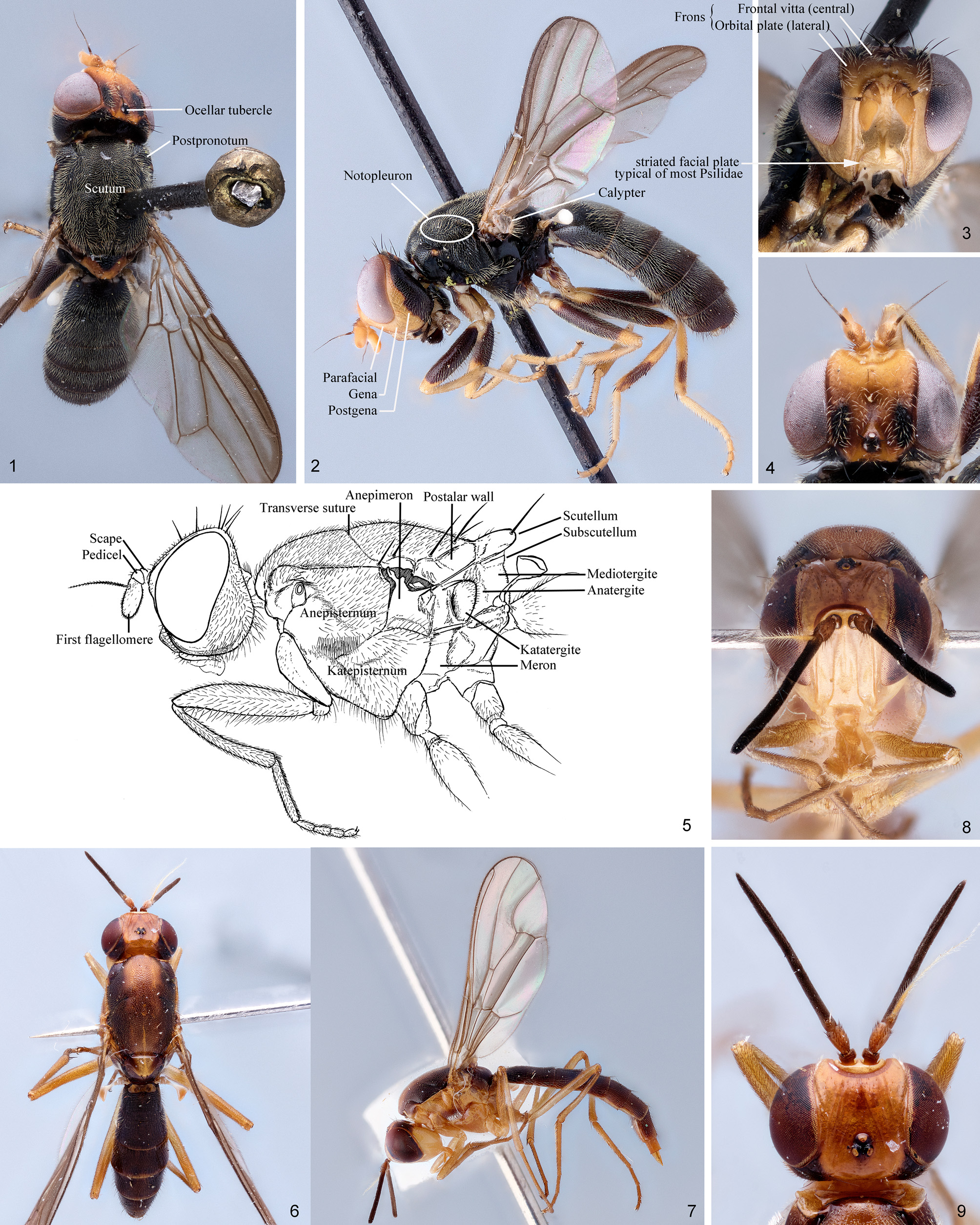
==Description== For terms see Morphology of Diptera These are small or medium-sized (1.5 mm.-10 mm.) flies with slender bodies. They are yellow to reddish, brown or black in colour. The head is spherical with (relatively) small eyes and the face is often slanted backward. The antennae are small, with the third antennal segment conspicuously elongated. The arista has a short or long pubescence. The postvertical bristles are divergent or absent. Ocelli and ocellar bristles are present. Vibrissae are always absent. Up to two pairs of frontal bristles and scattered interfrontal setulae are present. The costa is interrupted at some distance from R1 and only the basal part of the subcosta is developed. The vein bordering the anal cell is straight on the outer side. Crossvein BM-Cu is present and the cell cup is closed. The wing is usually clear to slightly tinged, but in some cases along the costa, the wing tip or the cross-veins there are dark bands. The wing has a transverse weakening in the basal half. Tibiae are without a dorsal preapical bristle. See Description and plates from Francis Walker's Insecta Britannica Diptera.
Excerpted from Wikipedia’s “Psilidae” article, available under the CC BY-SA 4.0 licence.
Gallery (4)
Available in 16 languages
- Français
- 中文
- Русский
- العربية
- Belarusian
- Cebuano
- Egyptian Arabic
- Finnish
- Nederlands
- Norwegian
- Svenska
- Tiếng Việt
- Türkçe
- Waray
- فارسی
via Wikidata sitelinks · CC0