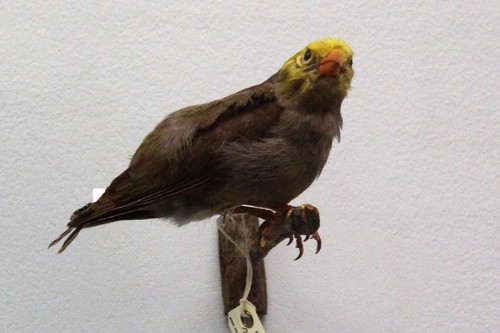
(c) Emőke Dénes, some rights reserved (CC BY-SA) · cc-by-sa
Psittirostra psittacea
Sign in to saveAlso known as Oíu, Oiu, ʻŌʻū
The ʻōʻū (pronounced ) (Psittirostra psittacea) is an extinct species of Hawaiian honeycreeper that was endemic to the Hawaiian islands. It had a dark green back and olive green underparts; males had a yellow head while females had a green head. Its unusual beak seems to have been adapted to feeding on the fruits of Freycinetia arborea. It had a strong flight which it used to fly considerable distances in search of this vine, but it also ate other fruits, buds, flowers and insects.
Species
Extinct'O'u
SPECIES
- KingdomAnimalia
- PhylumChordata
- ClassAves
- OrderPasseriformes
- FamilyFringillidae
via GBIF · IUCN
Museum specimens
- Specimen records
- 252
- With media
- 84
- Family
- Fringillidae
- Collections
- MVZ, RBINS-SCIENTIFIC HERITAGE, CLO, USNM, ROM, CM
- Recorded in
- United States, South Georgia And The South Sandwich Islands
Wikidata facts
- Instance of
- taxon
- Parent taxon
- Psittirostra
- Image
- Psittirostra psittacea deppei1.jpg
Show 7 more facts
- taxon rank
- species
- taxon name
- Psittirostra psittacea
- Commons category
- Psittirostra psittacea
- taxon common name
- oú
- litter size
- 2.5
- IUCN conservation status
- extinct species
- short name
- P. psittacea
Sources (2)
via Wikidata · CC0
~6 min read
Encyclopedic overview
7 sectionsContents
- Description
- Behavior
- Status
- Protection
- Extinction
- References
- External links
The ʻōʻū (pronounced ) (Psittirostra psittacea) is an extinct species of Hawaiian honeycreeper that was endemic to the Hawaiian islands. It had a dark green back and olive green underparts; males had a yellow head while females had a green head. Its unusual beak seems to have been adapted to feeding on the fruits of Freycinetia arborea. It had a strong flight which it used to fly considerable distances in search of this vine, but it also ate other fruits, buds, flowers and insects.
Although formerly widespread and present throughout the island group, numbers declined dramatically during the twentieth century. The bird is listed by the International Union for Conservation of Nature as being Critically Endangered, but there are no recent records and it has been assessed as extinct. The last recorded sighting was in 1989. The U.S. Fish and Wildlife Service declared the species extinct in a 2022 study review. In 2024, the International Union for Conservation of Nature declared the species extinct.
Excerpted from Wikipedia’s “Psittirostra psittacea” article, available under the CC BY-SA 4.0 licence.