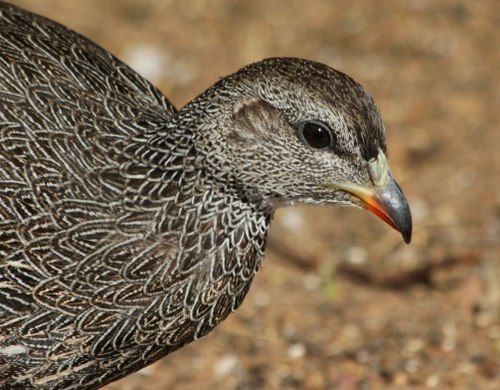
(c) Alan Manson, some rights reserved (CC BY-SA) · cc-by-sa
Pternistis
Sign in to savePternistis is a genus of galliform birds formerly classified in the spurfowl group of the partridge subfamily of the pheasant family. They are described as "partridge-francolins" in literature establishing their phylogenetic placement outside the monophyletic assemblage of true spurfowls. All species are endemic to Sub-Saharan Africa, excepted the double-spurred spurfowl (also present in Morocco). They are commonly known as spurfowls or francolins, but are closely related to jungle bush quail, Alectoris rock partridges, and Coturnix quail. The species are strictly monogamous, remaining mated i
Species
Cape Spurfowl
GENUS
- KingdomAnimalia
- PhylumChordata
- ClassAves
- OrderGalliformes
- FamilyPhasianidae
via GBIF
Wikidata facts
- Instance of
- taxon
- Parent taxon
- Phasianidae
- Image
- Erckel's Francolin.PNG
Show 5 more facts
- taxon rank
- genus
- taxon name
- Pternistis
- topic's main category
- Category:Pternistis
- Commons category
- Pternistis
- Commons gallery
- Pternistis
Sources (1)
via Wikidata · CC0
~4 min read
Encyclopedic overview
4 sectionsContents
- Taxonomy
- Species
- Notes
- References
Pternistis is a genus of galliform birds formerly classified in the spurfowl group of the partridge subfamily of the pheasant family. They are described as "partridge-francolins" in literature establishing their phylogenetic placement outside the monophyletic assemblage of true spurfowls. All species are endemic to Sub-Saharan Africa, excepted the double-spurred spurfowl (also present in Morocco). They are commonly known as spurfowls or francolins, but are closely related to jungle bush quail, Alectoris rock partridges, and Coturnix quail. The species are strictly monogamous, remaining mated indefinitely. They procure most of their food by digging. Spurfowls subsist almost entirely on roots, beans of leguminous shrubs and trees, tubers, and seeds, and feasting opportunistically on termites, ants, locusts, flowers, and fruit. Important predators are jackals, caracals, servals, and birds of prey, as well as herons and marabou storks.
==Taxonomy== The genus Pternistis was introduced by the German naturalist Johann Georg Wagler in 1832. The name is from the Ancient Greek pternistēs meaning "one who strikes with the heel". The type species was designated by the English zoologist George Robert Gray in 1841 as the Cape spurfowl (Pternistis capensis).
Excerpted from Wikipedia’s “Pternistis” article, available under the CC BY-SA 4.0 licence.