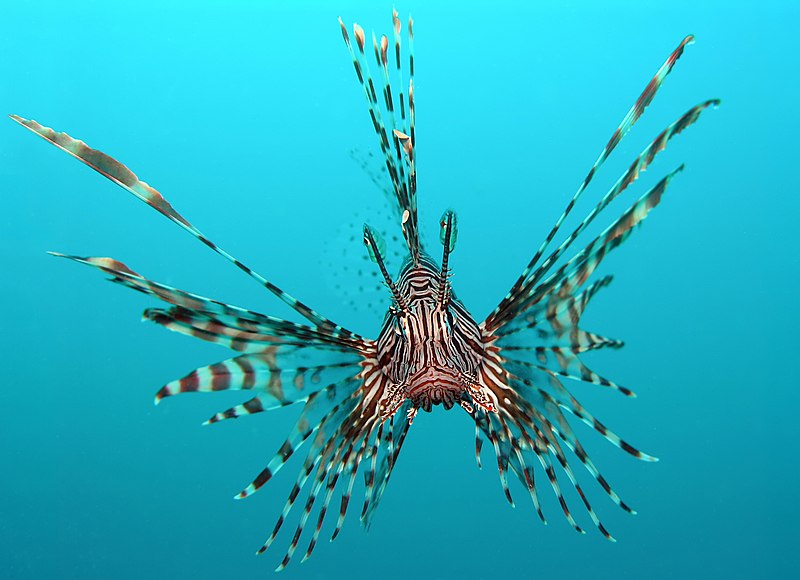
File:Pterois_volitans_Manado-e_edit.jpg · Wikimedia Commons · See Wikimedia Commons
Species
Least Concernlionfish
SPECIES
- KingdomAnimalia
- PhylumChordata
- ClassTeleostei
- OrderScorpaeniformes
- FamilyScorpaenidae
Der Pazifische Rotfeuerfisch (Pterois volitans) gehört zur Unterfamilie der Feuerfische. Er lebt im Pazifischen Ozean zwischen Malaysia und Japan und wird bis zu 38 Zentimeter groß. Sein Lebensraum sind Lagunen und Außenriffe. Wegen seiner Auffälligkeit wird er häufig in Schauaquarien gehalten. Seit Ende des 20. Jahrhunderts wird er als invasive Art auch im westlichen Nordatlantik von der Küste Floridas bis North Carolina beobachtet,[1] wo er durch Aquarianer ausgesetzt wurde. Inhaltsverzeichnis 1 Verhalten 2 Gift 3 Abgrenzung 4 Einzelnachweise 5 Literatur 6 Weblinks Verhalten Der Rotfeuerfisch ist bei Nacht aktiv, am Tag versteckt er sich häufig unter Überhängen. Nachts geht er auf Beutefang, indem er seine Beute (Fische und Krebse) mit seinen Brustflossen treibt und sie dann blitzschnell einsaugt (Saugschnapper). Der Pazifische Feuerfisch ist nicht scheu und schwimmt oft auf Taucher zu, aggressiv ist er jedoch nicht. Gift Die stacheligen Strahlen seiner Rückenflosse enthalten ein starkes Gift, das sich in einem Hautsekret auf den Stacheln befindet. Feuerfische besitzen keine Giftdrüse und die Stacheln keinen Giftkanal. Das Gift verursacht lokal extreme Schmerzen, teilweise mit Au
via GBIF · IUCN
Museum specimens
- Specimen records
- 847
- With media
- 50
- Family
- Scorpaenidae
- Collections
- UWFC, ECOSUR, USNM
- Recorded in
- Philippines, Fiji, Mexico, Marshall Islands, Indonesia, Vanuatu
Wikidata facts
Show 8 more facts
- Commons category
- Pterois volitans
- taxon rank
- species
- taxon name
- Pterois volitans
- taxon common name
- Pazifischer Rotfeuerfisch
- IUCN conservation status
- Least Concern
- Commons gallery
- Pterois volitans
- short name
- P. volitans
- invasive to
- Caribbean Sea
via Wikidata · CC0
~8 min read
Encyclopedic overview
The red lionfish (Pterois volitans) is a venomous coral reef fish in the family Scorpaenidae, order Scorpaeniformes. It is mainly native to the Indo-Pacific region, but has become an invasive species in the Caribbean Sea, as well as along the East Coast of the United States and East Mediterranean and also found in Brazil at Fernando de Noronha.
P. volitans and a similar relative, Pterois miles, have both been deemed invasive species. Red lionfish are clad in white stripes alternated with red, maroon or brown stripes. Adults in this species can grow as large as 47 cm (18.5 in) in length, making it one of the largest species of lionfish in the ocean, while juveniles are typically shorter than 1 inch (2.5 cm). The average red lionfish lives around 10 years. As with many species within the family Scorpaenidae, it has large, venomous spines on its dorsal fin (13) as well as other venomous spines on its pelvic fins (2) and anal fins (3). It is these fins together with the other long non-venomous fins which create an appearance similar to a mane, giving it the common name "lionfish". The dorsal spines deter most potential predators. Lionfish reproduce monthly and are able to quickly disperse during their larval stage for expansion of their invasive region. No definitive predators of the lionfish are known, and many organizations are promoting the harvest and consumption of lionfish in efforts to prevent further increases in the already high population densities.
Excerpted from Wikipedia’s “Pterois volitans” article, available under the CC BY-SA 4.0 licence.