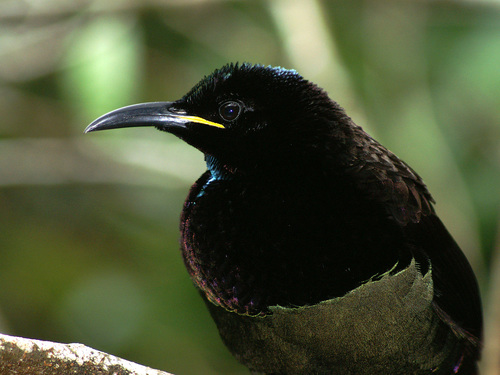
(c) David Cook, some rights reserved (CC BY-NC) · cc-by-nc
Ptiloris
Sign in to saveThe genus Ptiloris consists of four allopatric species of birds in the family Paradisaeidae. These birds of paradise are commonly known as riflebirds, so named for the likeness of their black velvety plumage to the uniform of the Rifle Brigade. Alternatively, the bird's cry is similar to a rifle being fired and hitting its target but a call like this is not commonly reported (see Behaviour and Ecology). They are distributed in the rainforests of New Guinea and Eastern Australia.
Species
Victoria's Riflebird
GENUS
- KingdomAnimalia
- PhylumChordata
- ClassAves
- OrderPasseriformes
- FamilyParadisaeidae
via GBIF
Museum specimens
- Specimen records
- 49
- With media
- 3
- Family
- Paradisaeidae
- Collections
- ANWC, WAM, NHMUK
- Recorded in
- Papua New Guinea, Australia
Wikidata facts
- Instance of
- taxon
- Parent taxon
- birds-of-paradise
- Image
- Ptiloris victoriae by Bowdler Sharpe.jpg
Show 5 more facts
- taxon rank
- genus
- taxon name
- Ptiloris
- Commons category
- Ptiloris
- topic's main category
- Category:Ptiloris
- described by source
- New International Encyclopedia
Sources (1)
via Wikidata · CC0
~12 min read
Encyclopedic overview
10 sectionsContents
- Taxonomy and systematics
- Species
- Description
- Distribution and habitat
- Behavior and ecology
- Diet and feeding
- Breeding
- Relationship with humans
- References
- External links
The genus Ptiloris consists of four allopatric species of birds in the family Paradisaeidae. These birds of paradise are commonly known as riflebirds, so named for the likeness of their black velvety plumage to the uniform of the Rifle Brigade. Alternatively, the bird's cry is similar to a rifle being fired and hitting its target but a call like this is not commonly reported (see Behaviour and Ecology). They are distributed in the rainforests of New Guinea and Eastern Australia.
==Taxonomy and systematics== The genus Ptiloris was introduced in 1825 by the English naturalist William Swainson for a single species, the paradise riflebird. This is now the type species. The genus name, Ptiloris [pronounced TI-lo-ris], means "feather nose" from the Greek (feather or down) and (nostril). It refers to the frontal feathers hiding the nostrils.
Excerpted from Wikipedia’s “Ptiloris” article, available under the CC BY-SA 4.0 licence.