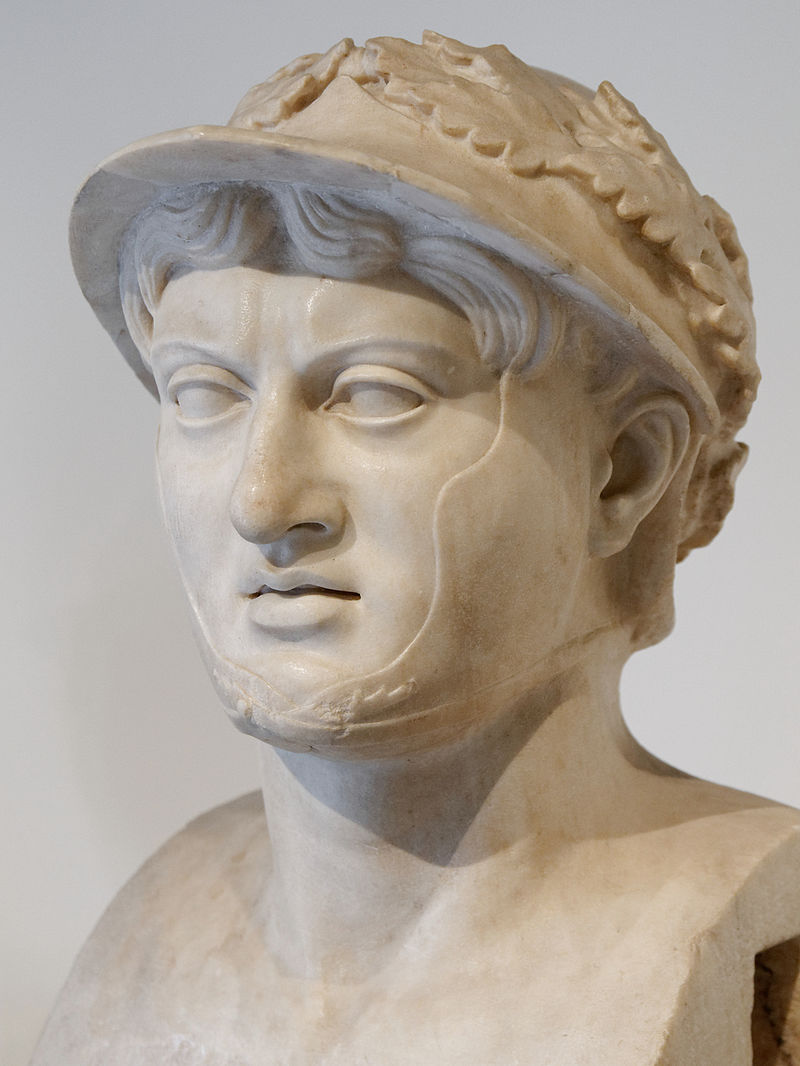
File:Pyrrhus_MAN_Napoli_Inv6150_n03.jpg · Wikimedia Commons · See Wikimedia Commons
Pyrrhus
Sign in to saveAlso known as Pyrrhus of Epirus, Pyrrhus King of Epirus
king of Epirus from 307 to 302 and 297 to 272 BC
Pyrrhus was a king of Epirus (an ancient region in northwestern Greece) who ruled during two separate periods in the late 4th and 3rd centuries BC. He is historically significant as a powerful military leader of his era, though the specific details of his accomplishments and their lasting impact would require further historical sources to fully explain.
AI-generated from the Wikipedia summary — may contain errors.
Wikidata facts
- Instance of
- human
- Gender
- male
- Citizenship
- Epirus
- Place of birth
- Epirus
- Spouse
- Bircenna
- Child
- Ptolemy
- Father
- Aeacides of Epirus
- Mother
- Phthia of Epirus
- Occupation
- military personnel
- Position held
- monarch
- Languages spoken
- Ancient Greek
- Family
- Aeacidae
- Image
- Pyrrhus MAN Napoli Inv6150 n03.jpg
Show 8 more facts
- on focus list of Wikimedia project
- Wikipedia:Vital articles/Level/4
- relative
- Ptolemy Ceraunus
- Commons category
- Pyrrhus
- date of birth
- 0318-01-01
- date of death
- 0272-01-01
- topic's main category
- Category:Pyrrhus of Epirus
- described by source
- New International Encyclopedia
- name in native language
- Πύρρος
via Wikidata · CC0
~29 min read
Encyclopedic overview
Pyrrhus (/ˈpɪrəs/ PIRR-əss; Ancient Greek: Πύρρος Pýrrhos; 319/318–272 BC) was a Greek king and statesman of the Hellenistic period. He was king of the Molossians, of the royal Aeacid house, and later he became king (Malalas also called him toparch) of Epirus. He was one of the strongest opponents of early Rome, and had been regarded as one of the greatest generals of antiquity. Several of his victorious battles caused him unacceptably heavy losses, from which the phrase "Pyrrhic victory" was coined.
Pyrrhus became king of Epirus in 306 BC at the age of 13, but was dethroned by Cassander four years later. He saw action during the Wars of the Diadochi and regained his throne in 297 BC with the support of Ptolemy I Soter. He co-ruled Macedon together with Lysimachus after driving out Demetrius in 288 BC. In 284 BC, he was driven out of Macedon by Lysimachus. During the eponymous Pyrrhic War of 280–275 BC, Pyrrhus fought Rome at the behest of Tarentum, scoring costly victories at Heraclea and Asculum. He proceeded to take over Sicily from Carthage, but after some initial success, he was soon driven out and returned to Italy where he lost all his gains after the Battle of Beneventum in 275 BC.
Excerpted from Wikipedia’s “Pyrrhus” article, available under the CC BY-SA 4.0 licence.
Gallery (12)
Available in 75 languages
- Español
- Français
- Deutsch
- 中文
- 日本語
- Русский
- Português
- Italiano
- العربية
- Albanian
- Armenian
- Asturian
- azb
- Azerbaijani
- Bahasa Indonesia
- Balinese
- Basque
- Belarusian
Show 56 more
- Bosnian
- Breton
- Bulgarian
- Catalan
- Chuvash
- Croatian
- Czech
- Danish
- Egyptian Arabic
- Esperanto
- Estonian
- Filipino
- Finnish
- Galician
- Georgian
- Greek
- Hebrew
- Hungarian
- Icelandic
- Ido
- Interlingua
- Kazakh
- Latin
- Latvian
- Lithuanian
- Macedonian
- Malagasy
- Mazanderani
- Mingrelian
- Mongolian
- Nederlands
- Norwegian
- Occitan
- Polski
- roa_tara
- Romanian
- Scots
- Serbian
- Serbian (Latin)
- Sicilian
- simple
- Slovak
- Slovenian
- Svenska
- Swahili
- Tiếng Việt
- Türkçe
- Ukrainian
- Urdu
- Uzbek
- Waray
- Welsh
- Wu Chinese
- zh_yue
- فارسی
- 한국어
via Wikidata sitelinks · CC0