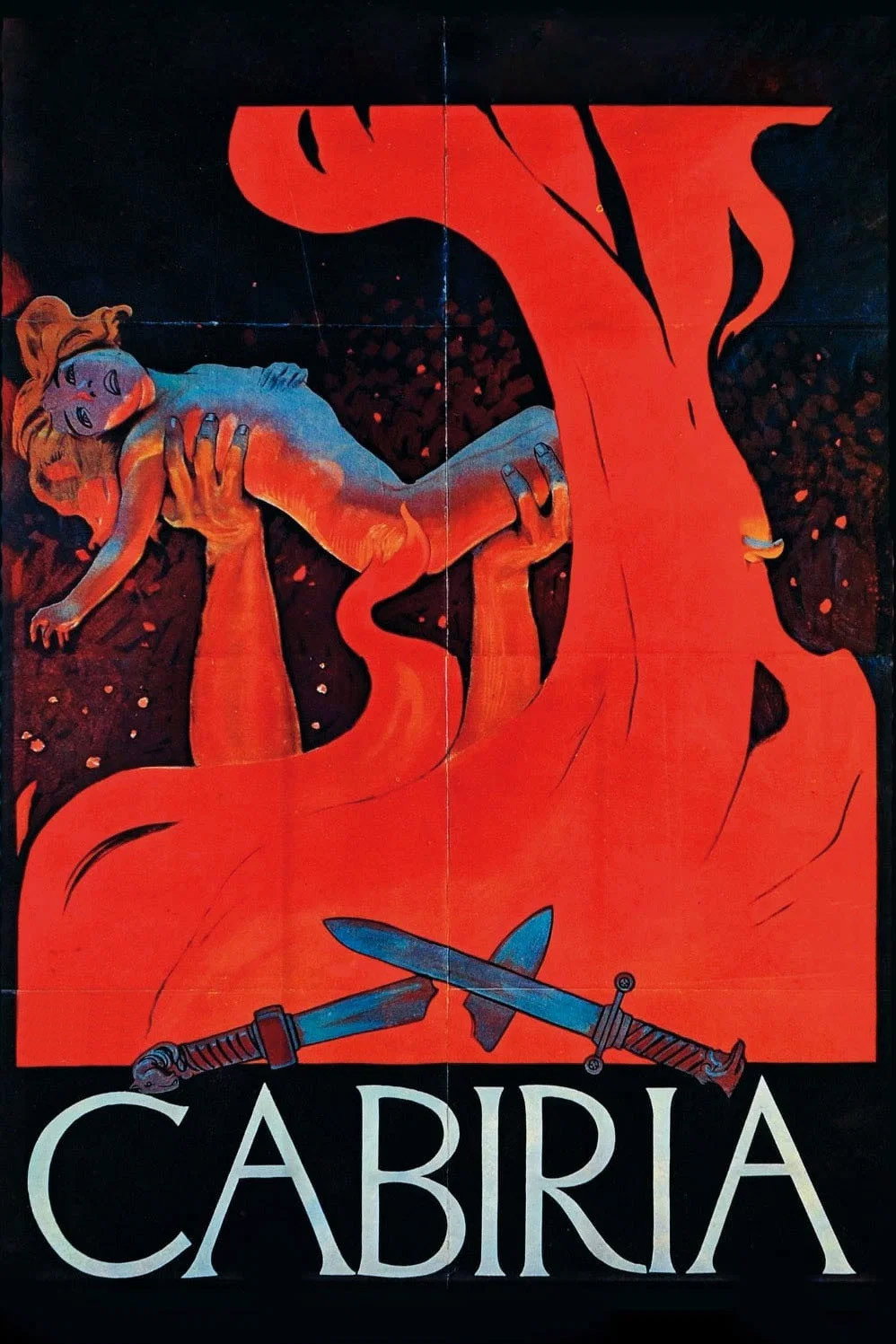
Poster from TMDB
Cabiria
Sign in to savethumb|thumbtime=12|Cabiria (full video) Cabiria is a 1914 Italian epic silent film, directed by Giovanni Pastrone and shot in Turin. The film is set in ancient Sicily, Carthage, and Cirta during the period of the Second Punic War (218–202 BC). It follows the story of an abducted little girl, Cabiria, and features an eruption of Mount Etna, religious rituals in Carthage, the alpine trek of Hannibal, Archimedes' defeat of the Roman fleet at the Siege of Syracuse and Scipio maneuvering in North Africa. Apart from being a classic on its own terms, the film is also notable for being the first film
OverviewAI-generated
Cabiria is a 1914 Italian silent drama, war, and adventure film produced by Itala Film. Giovanni Pastrone directed, produced, and edited the work, while Gabriele D'Annunzio, Pastrone, and Emilio Salgari served as screenwriters. The cast includes Bartolomeo Pagano, Lidia Quaranta, Italia Almirante Manzini, and Dante Testa. The film is based on History of Rome and Salammbô, after works by Titus Livius and Gustave Flaubert.
Ildebrando Pizzetti composed the score, with Eugenio Bava and Segundo de Chomón handling cinematography. The narrative is set in Algeria and features characters such as Maciste, Hasdrubal Gisco, Sophonisba, and Scipio Africanus. It is a black-and-white film with a runtime of 148 minutes and an aspect ratio of 4:3. The work is in the public domain and is distributed on video on demand by Netflix.
The film holds an IMDb rating of 7.1 from 4,056 votes and a Rotten Tomatoes rating of 93%.
Synthesized by Vinony from 40 facts across 4 sources: Wikidata, TMDb, OMDb, IMDb. Generated from structured data (not the Wikipedia text) and checked against those facts — may still contain errors.
Film · TMDB
7.2Young Cabiria is kidnapped by pirates and sold as a slave in Carthage. Just as she's to be sacrificed to Moloch, Cabiria is rescued by Fulvius Axilla, a good-hearted Roman spy, and his powerful slave, Maciste. The trio are broken up as Cabiria is entrusted to a woman of noble birth. With Cabiria's fate unknown, Maciste punished for his heroism, and Fulvius sent away to fight for Rome, is there any hope of our heroes reuniting?
Cast
- Carolina Catena as Cabiria (Chlld)
- Lidia Quaranta as Cabiria (Adult)
- Gina Marangoni as Croessa
- Dante Testa as Karthalo
- Umberto Mozzato as Fulvio Axilla
- Bartolomeo Pagano as Maciste
Themes
- princess
- elephant
- roman empire
- roman
- carthage
- fleet
- pirate
- battle
- silent film
- alps mountains
This product uses the TMDB API but is not endorsed or certified by TMDB.
Ratings
IMDb
7.1/10
4,056 votes
Rotten Tomatoes
93%
- Year
- 1914
- Runtime
- 148 min
- Genres
- Adventure, Drama, History
- Rated
- Not Rated
via OMDb · IMDb
Key facts
- Film.name
- Cabiria
- Film.image
- Cabiria Poster Metlicovitz.jpg
- Film.caption
- 1914 poster, designed by Leopoldo Metlicovitz
- Film.director
- Giovanni Pastrone
- Film.producer
- Giovanni Pastrone
- Film.based_on
- A book by Titus Livius and a novel by Emilio Salgari
- Film.starring
- Lidia QuarantaUmberto MozzatoBartolomeo Pagano
- Film.music
- Manlio MazzaIldebrando Pizzetti
- Film.studio
- Itala Film<!-- or:
- Film.production_companies
- -->
- Film.distributor
- <!-- or:
- Film.distributors
- -->
- Film.country
- Italy
- Film.language
- SilentItalian Intertitles
- Film.budget
- £50,000
- Film.gross
- ₤1 million
via Wikipedia infobox
Wikidata facts
- Instance of
- film
- Country of origin
- Kingdom of Italy
- Original language
- Italian
- Based on
- Salammbô
- Director
- Giovanni Pastrone
- Screenwriter
- Emilio Salgari
- Composer
- Ildebrando Pizzetti
- Producer
- Giovanni Pastrone
- Production company
- Itala Film
- Narrative location
- Algeria
- Duration
- 210
- FilmAffinity ID
- 368644
- Distribution format
- video on demand
- Image
- Cabiria (screenshot with Cabiria).jpg
Show 11 more facts
- Commons category
- Cabiria
- publication date
- 1914-04-18
- film editor
- Giovanni Pastrone
- title
- Cabiria
- after a work by
- Titus Livius
- aspect ratio (W:H)
- 4:3
- characters
- Archimedes
- color
- black-and-white
- copyright status
- public domain
- distributed by
- Netflix
- review score
- 96%
Sources (9)
via Wikidata · CC0
~18 min read
Encyclopedic overview
15 sectionsContents
- Plot summary
- First episode
- Second episode
- Third episode
- Fourth episode
- Fifth episode
- Cast and characters
- Production
- Music
- Distribution, remake and restorations
- See also
- References
- Footnotes
- Sources
- External links
thumb|thumbtime=12|Cabiria (full video) Cabiria is a 1914 Italian epic silent film, directed by Giovanni Pastrone and shot in Turin. The film is set in ancient Sicily, Carthage, and Cirta during the period of the Second Punic War (218–202 BC). It follows the story of an abducted little girl, Cabiria, and features an eruption of Mount Etna, religious rituals in Carthage, the alpine trek of Hannibal, Archimedes' defeat of the Roman fleet at the Siege of Syracuse and Scipio maneuvering in North Africa. Apart from being a classic on its own terms, the film is also notable for being the first film in which the long-running film character Maciste makes his debut. According to Martin Scorsese, in this work Pastrone invented the epic movie and deserves credit for many of the innovations often attributed to D.W. Griffith and Cecil B. DeMille. Among those was the extensive use of a moving camera, thus freeing the feature-length narrative film from "static gaze".
The historical background and characters in the story are taken from Livy's Ab Urbe Condita (written ca. 27–25 BC). In addition, the script of Cabiria was partially based on Gustave Flaubert's 1862 novel Salammbô and Emilio Salgari's 1908 novel Cartagine in fiamme (Carthage in Flames). It was the first film shown at the White House, having been viewed on the South Lawn, by the President, First Lady, Vice President, his wife, members of the Cabinet and their wives, due to the summer heat in June 1914.
Excerpted from Wikipedia’s “Cabiria” article, available under the CC BY-SA 4.0 licence.