Picture of the Day · NASA
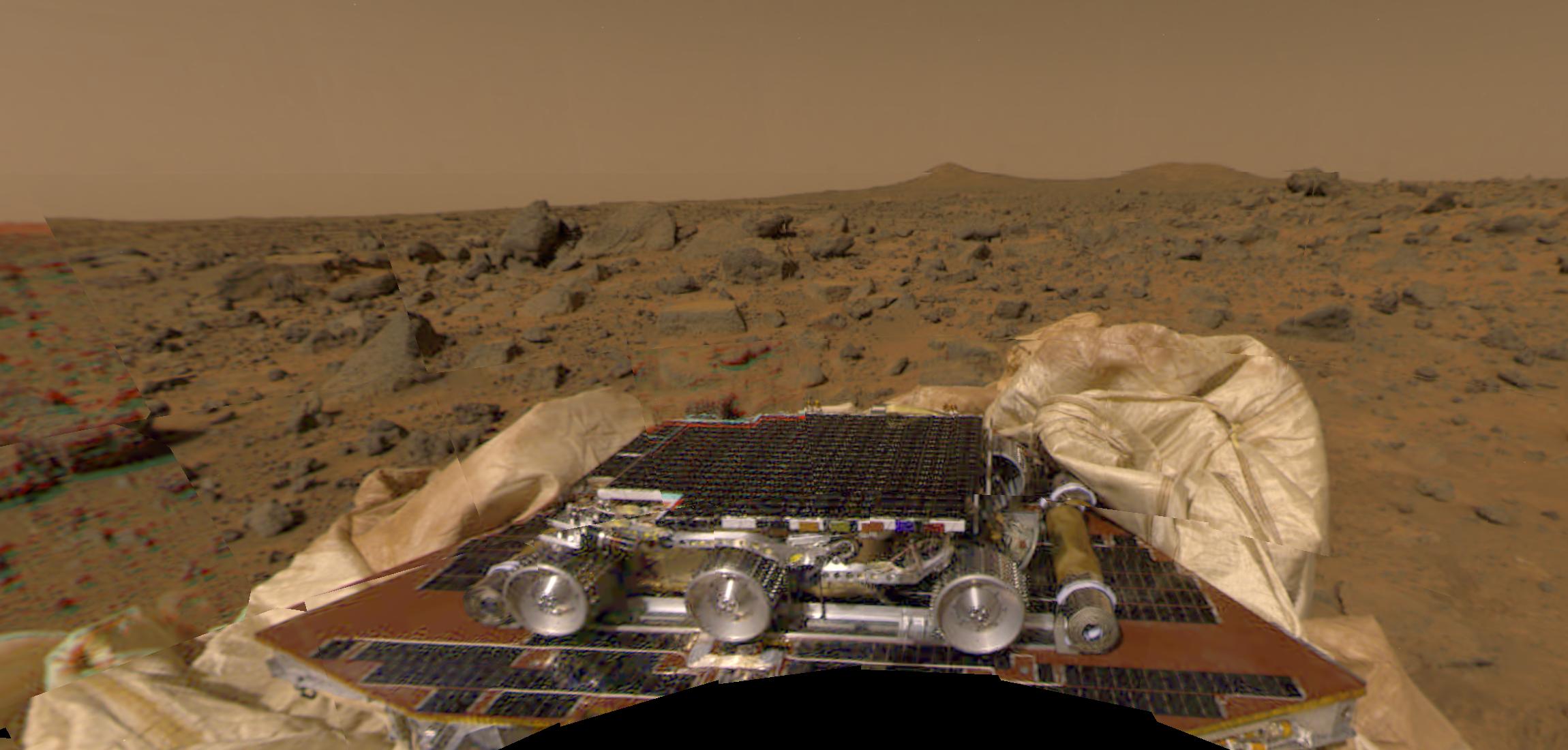
Pathfinder on Mars
2026-07-04
On July 4th, 1997, using its own array of fireworks, a parachute, and a cocoon of airbags, the Mars Pathfinder spacecraft bounced like a giant beach ball at least 15 times before it came to rest on the surface of Mars at 10:07 AM Pacific Daylight Time. After its then novel airbag-assisted landing sequence was completed, Pathfinder transmitted this color mosaic to mission operators on Earth. In the scene from another world, the Mars Sojourner robot rover is visible in the foreground, crouched on top of the unfolded Pathfinder. About the size of a large house cat, the six-wheeled, solar-powered Sojourner became the first successful Martian rover. Surrounding Pathfinder are deflated airbags and the rock-strewn terrain of the Ares Vallis floodplain. In the distance Martian hills appear against a dusty brownish sky. The Pathfinder lander was subsequently renamed the Carl Sagan Memorial Station.
via NASA APOD
Wikidata facts
- Diameter
- 13.552
- Orbital period
- 2447.442601674088
Show 13 more facts
- provisional designation
- 1993 RW7
- time of discovery or invention
- 1989-02-04
Article · Deutsch
(17427) Poe ist ein im äußeren Hauptgürtel gelegener Asteroid. Er wurde am 4. Februar 1989 von dem belgischen Astronomen Eric Walter Elst am La-Silla-Observatorium der Europäischen Südsternwarte in Chile (IAU-Code 809) entdeckt. Der mittlere Durchmesser des Asteroiden wurde mit 13,552 (±0,210) Kilometer berechnet, die Albedo mit 0,067 (±0,011). Sie lässt auf eine dunkle Oberfläche schließen. (17427) Poe wurde am 30. Juli 2007 nach dem US-amerikanischen Schriftsteller Edgar Allan Poe (1809–1849) benannt. Im Benennungstext besonders hervorgehoben wurden seine Sammlung von Erzählungen Tales of the Grotesque and Arabesque (1839) und sein Gedicht Der Rabe (1845). Ein Jahr später, am 20. November 2018, wurde ebenfalls nach Edgar Allan Poe ein Einschlagkrater auf der nördlichen Hemisphäre des Planeten Merkur benannt: .
Abstract from DBpedia / Wikipedia · CC BY-SA