
File:83_Beatrix.png · Wikimedia Commons · See Wikimedia Commons
Picture of the Day · NASA
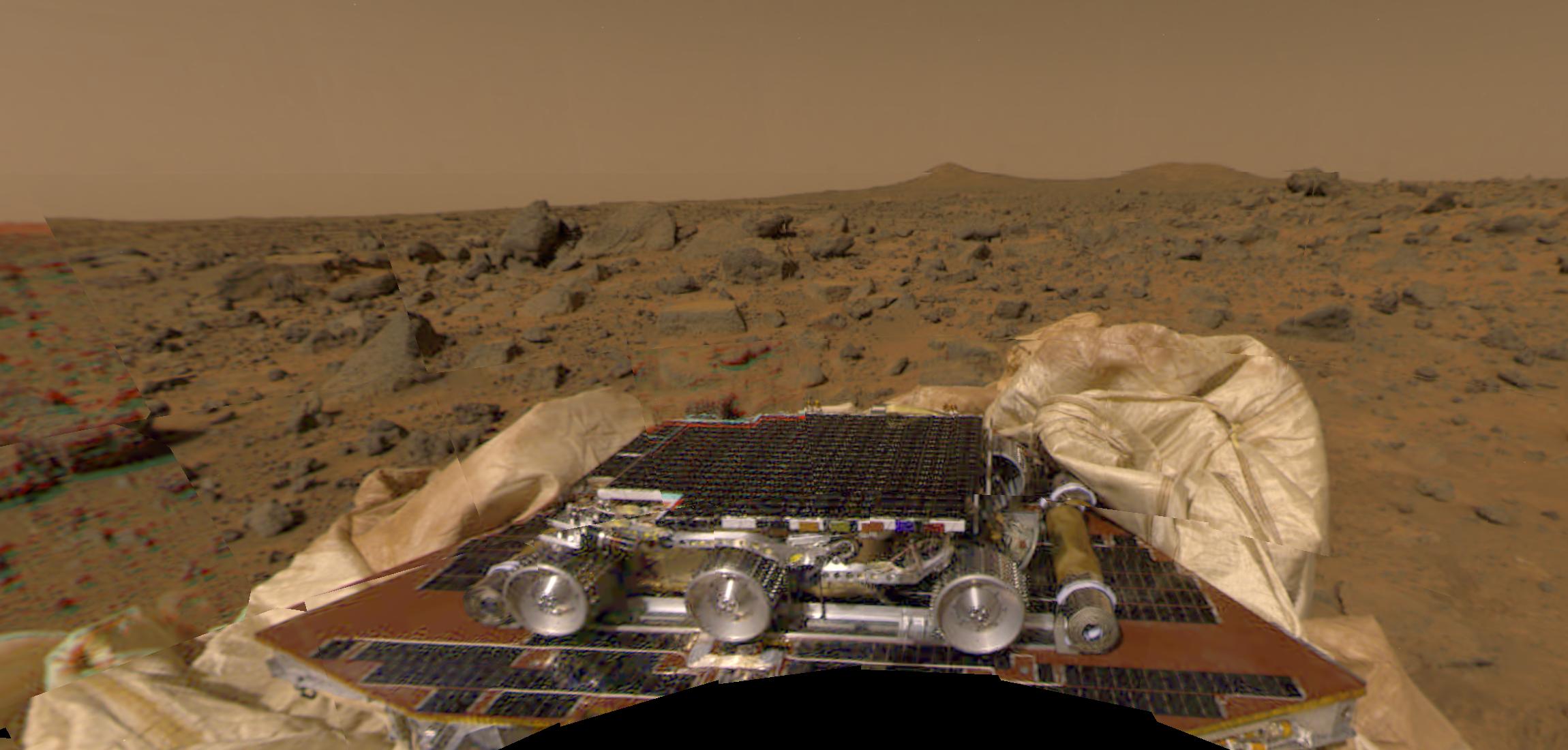
Pathfinder on Mars
2026-07-04
On July 4th, 1997, using its own array of fireworks, a parachute, and a cocoon of airbags, the Mars Pathfinder spacecraft bounced like a giant beach ball at least 15 times before it came to rest on the surface of Mars at 10:07 AM Pacific Daylight Time. After its then novel airbag-assisted landing sequence was completed, Pathfinder transmitted this color mosaic to mission operators on Earth. In the scene from another world, the Mars Sojourner robot rover is visible in the foreground, crouched on top of the unfolded Pathfinder. About the size of a large house cat, the six-wheeled, solar-powered Sojourner became the first successful Martian rover. Surrounding Pathfinder are deflated airbags and the rock-strewn terrain of the Ares Vallis floodplain. In the distance Martian hills appear against a dusty brownish sky. The Pathfinder lander was subsequently renamed the Carl Sagan Memorial Station.
via NASA APOD
Key facts
- Discovered by
- Annibale de Gasparis
- Discovery date
- April 26, 1865
- Pronunciation
- / ˈ b iː ə t r ɪ k s / BEE -ə-triks
- Named after
- Beatrice Portinari
- Minor planet category
- Main belt
- Adjectives
- Beatrician ( / ˌ b iː ə ˈ t r ɪ ʃ ə n / BEE -ə- TRISH -ən )
- Aphelion
- 393.528 million km (2.631 AU)
- Perihelion
- 334.023 million km (2.233 AU)
- Semi major axis
- 363.776 million km (2.432 AU )
- Orbital period sidereal
- 1385.035 d (3.79 a )
- Average orbital speed
- 19.07 km/s
- Mean anomaly
- 141.862°
- Inclination
- 4.966°
- Longitude of ascending node
- 27.800°
- Argument of perihelion
- 167.170°
- Dimensions
- 81.4 km
- Mass
- 5.6 × 10 kg
- Synodic rotation period
- 10.11 hours
via Wikipedia infobox
Wikidata facts
- Instance of
- asteroid
- Followed by
- 84 Klio
- Follows
- 82 Alkmene
- Parent body
- Sun
- Minor-planet group
- asteroid belt
- Diameter
- 110.503
- Mass
- 5600000000000000000
- Orbital period
- 1384.987736981946
Show 22 more facts
- discoverer or inventor
- Annibale de Gasparis
- site of astronomical discovery
- Astronomical Observatory of Capodimonte
- provisional designation
- A865 HA
- time of discovery or invention
- 1865-04-26
- asteroid spectral type
- X-type asteroid
- orbital inclination
- 4.966657448307255
- density
- 2
- rotation period
- 10.111
- apparent magnitude
- 13.5
- albedo
- 0.05
- described by source
- Brockhaus and Efron Encyclopedic Dictionary
- Commons category
- 83 Beatrix
- absolute magnitude
- 8.74
- orbital eccentricity
- 0.08302451054869023
- semi-major axis of an orbit
- 2.431634710585277
- periapsis
- 2.229749428905729
- apoapsis
- 2.633519992264826
- longitude of ascending node
- 27.65756237443614
- argument of periapsis
- 169.8924872194091
- mean anomaly
- 131.9650094337743
- time of periapsis
- 2460492.8057783986
- epoch
- November 21, 2025
Sources (2)
via Wikidata · CC0
~1 min read
Encyclopedic overview
83 Beatrix is a fairly large asteroid orbiting in the inner part of the main asteroid belt. It was discovered by Annibale de Gasparis on April 26, 1865. It was his last asteroid discovery. A diameter of at least 68 kilometres (42 mi) was determined from the Beatrician stellar occultation observed on June 15, 1983. It is named for Beatrice Portinari, beloved of Dante Alighieri and immortalized by him in La Vita Nuova and The Divine Comedy.
On February 16, 2001, an occultation of a magnitude +9.09 star by this asteroid was observed from three locations. The resulting chords matched an elliptical profile with a mean radius of 35.9 km. The observers noted some dimming and flickering at the beginning of the event, which may indicate the star was binary or the asteroid has an irregular shape. Previous occultations had been observed in 1983 and 1990, which produced a much larger size estimate of 81.4 km.
Excerpted from Wikipedia’s “83 Beatrix” article, available under the CC BY-SA 4.0 licence.