Picture of the Day · NASA
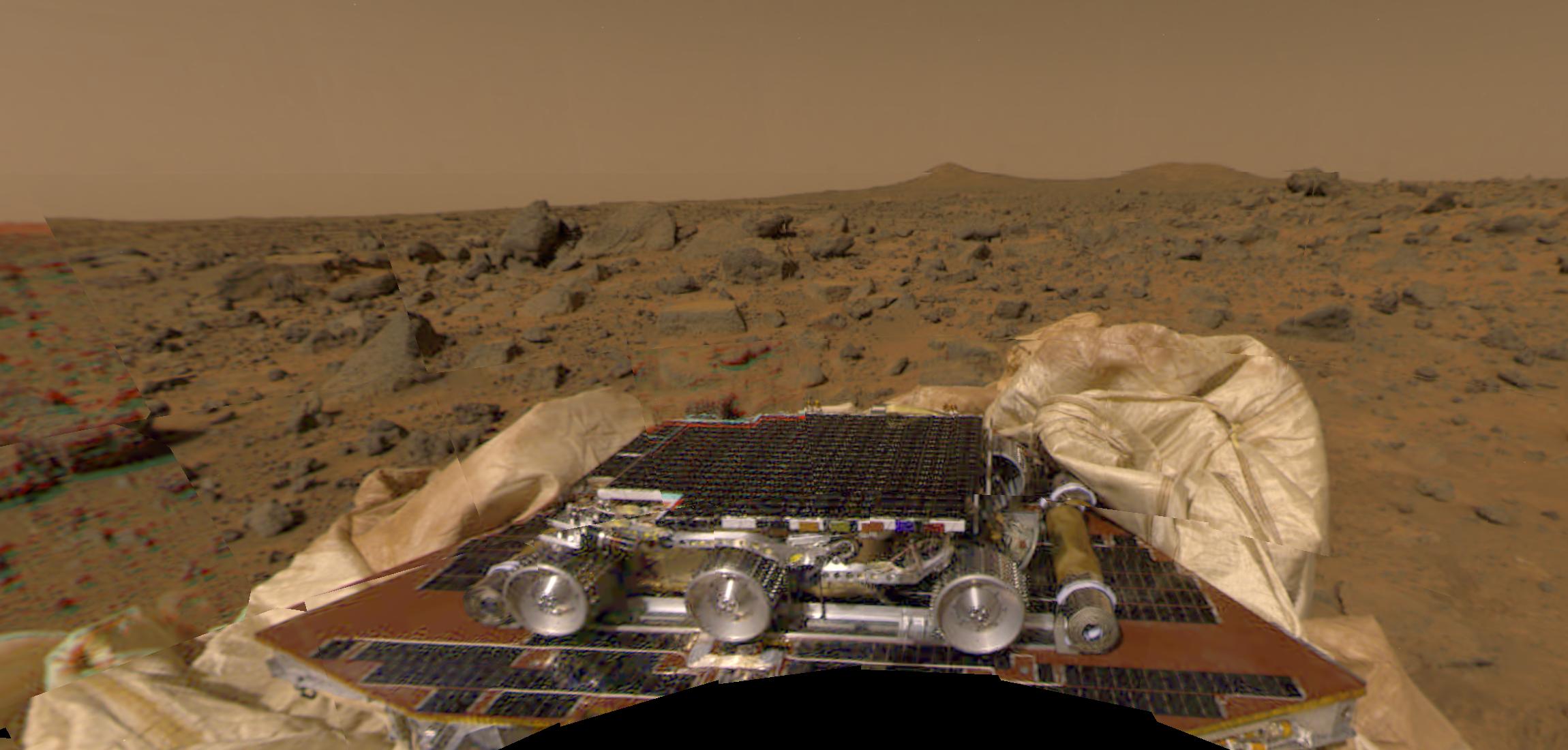
Pathfinder on Mars
2026-07-04
On July 4th, 1997, using its own array of fireworks, a parachute, and a cocoon of airbags, the Mars Pathfinder spacecraft bounced like a giant beach ball at least 15 times before it came to rest on the surface of Mars at 10:07 AM Pacific Daylight Time. After its then novel airbag-assisted landing sequence was completed, Pathfinder transmitted this color mosaic to mission operators on Earth. In the scene from another world, the Mars Sojourner robot rover is visible in the foreground, crouched on top of the unfolded Pathfinder. About the size of a large house cat, the six-wheeled, solar-powered Sojourner became the first successful Martian rover. Surrounding Pathfinder are deflated airbags and the rock-strewn terrain of the Ares Vallis floodplain. In the distance Martian hills appear against a dusty brownish sky. The Pathfinder lander was subsequently renamed the Carl Sagan Memorial Station.
via NASA APOD
Key facts
- Discovered by
- J. Palisa
- Discovery site
- Vienna Obs.
- Discovery date
- 1 March 1911
- Pronunciation
- / m ɑːr ˈ m ʌ l ə /
- Alternative designations
- 1911 LN; 1927 AB
- Observation arc
- 102.99 yr (37,618 d)
- Aphelion
- 2.6745 AU (400.10 Gm )
- Perihelion
- 1.8003 AU (269.32 Gm)
- Semi major axis
- 2.2374 AU (334.71 Gm)
- Orbital period sidereal
- 3.35 yr (1,222.4 d)
- Mean anomaly
- 65.0629 °
- Mean motion
- 0° 17 40.2 / day
- Inclination
- 6.0917°
- Longitude of ascending node
- 357.091°
- Argument of perihelion
- 300.339°
- Earth moid
- 0.793851 AU (118.7584 Gm)
- Jupiter moid
- 2.55306 AU (381.932 Gm)
- Synodic rotation period
- 2.88 ± 0.12 h (0.120 ± 0.00500 d )
via Wikipedia infobox
Wikidata facts
- Instance of
- asteroid
- Followed by
- 712 Boliviana
- Follows
- 710 Gertrud
- Parent body
- Sun
- Minor-planet group
- asteroid belt
- Diameter
- 9.026
- Orbital period
- 1222.090540346534
Show 17 more facts
- discoverer or inventor
- Johann Palisa
- site of astronomical discovery
- Vienna Observatory
- provisional designation
- A911 EA
- time of discovery or invention
- 1911-03-01
- orbital inclination
- 6.086553122360898
- albedo
- 0.453
- rotation period
- 2.721
- absolute magnitude
- 11.77
- orbital eccentricity
- 0.1961965698731679
- semi-major axis of an orbit
- 2.237020532948101
- periapsis
- 1.798124777647837
- apoapsis
- 2.675916288248364
- longitude of ascending node
- 356.9977276067827
- argument of periapsis
- 300.2165301488823
- mean anomaly
- 346.6497326581326
- time of periapsis
- 2461045.8200984155
- epoch
- November 21, 2025
Sources (2)
via Wikidata · CC0
~1 min read
Encyclopedic overview
711 Marmulla is an asteroid belonging to the Flora family in the Main Belt. It was discovered 1 March 1911 by Austrian astronomer Johann Palisa. The asteroid name may be derived from the Old High German word 'marmul', which means 'marble'. This asteroid is orbiting 2.24 AU from the Sun with a period of 3.35 yr and an eccentricity (ovalness) of 0.195. The orbital plane of 711 Marmulla is inclined at an angle of 6.1° to the plane of the ecliptic.
Photometric observations of this asteroid in 2019 resulted in a light curve showing a rotation period of 2.721±0.003 h with a brightness variation of 0.06 in magnitude. This result is consistent with a similar study earlier in the year. A. Kryszczynska and associates had found a slightly longer rotation period of 2.88 hours in 2012. The low amplitude of the variation suggests a nearly spherical shape. The spectrum of 711 Marmulla most closely matches an A-type asteroid.
Excerpted from Wikipedia’s “711 Marmulla” article, available under the CC BY-SA 4.0 licence.