Picture of the Day · NASA
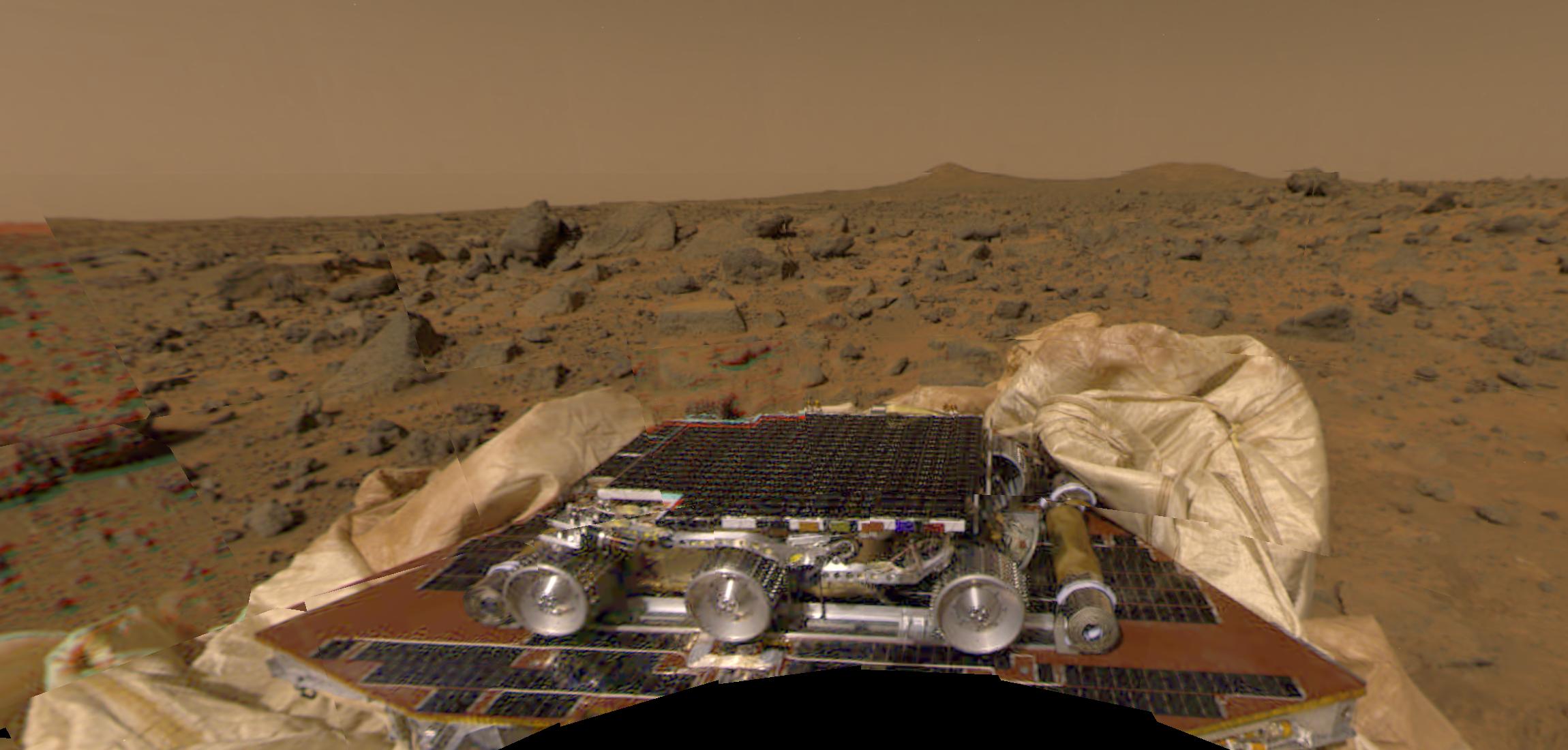
Pathfinder on Mars
2026-07-04
On July 4th, 1997, using its own array of fireworks, a parachute, and a cocoon of airbags, the Mars Pathfinder spacecraft bounced like a giant beach ball at least 15 times before it came to rest on the surface of Mars at 10:07 AM Pacific Daylight Time. After its then novel airbag-assisted landing sequence was completed, Pathfinder transmitted this color mosaic to mission operators on Earth. In the scene from another world, the Mars Sojourner robot rover is visible in the foreground, crouched on top of the unfolded Pathfinder. About the size of a large house cat, the six-wheeled, solar-powered Sojourner became the first successful Martian rover. Surrounding Pathfinder are deflated airbags and the rock-strewn terrain of the Ares Vallis floodplain. In the distance Martian hills appear against a dusty brownish sky. The Pathfinder lander was subsequently renamed the Carl Sagan Memorial Station.
via NASA APOD
Small body data
(969) Leocadia
- Orbit class
- Main-belt
- Semi-major axis
- 2.463 AU
- Eccentricity
- 0.205
- Inclination
- 2.291 °
- Absolute magnitude
- 12.770 H
via Minor Planet Center
Key facts
- Discovery site
- Simeiz Obs.
- Discovery date
- 5 November 1921
- Pronunciation
- / l iː oʊ ˈ k eɪ d i ə /
- Named after
- unknown
- Alternative designations
- A921 VC · 1940 RV, 1944 SB · 1948 UG, 1963 PA · 1921 KZ
- Minor planet category
- main-belt · ( inner ) , background
- Observation arc
- 98.12 yr (35,837 d)
- Aphelion
- 2.9694 AU
- Perihelion
- 1.9537 AU
- Semi major axis
- 2.4615 AU
- Orbital period sidereal
- 3.86 yr (1,411 d)
- Mean anomaly
- 199.53 °
- Mean motion
- 0° 15 18.72 / day
- Inclination
- 2.2928°
- Longitude of ascending node
- 287.76°
- Argument of perihelion
- 91.332°
- Mean diameter
- 17.321 ± 0.218 km 19.37 ± 0.22 km 19.51 ± 0.7 km
- Synodic rotation period
- 6.87 ± 0.01 h
via Wikipedia infobox
Wikidata facts
- Instance of
- asteroid
- Followed by
- 970 Primula
- Follows
- 968 Petunia
- Parent body
- Sun
- Minor-planet group
- asteroid belt
- Diameter
- 17.321
- Orbital period
- 1411.557930175083
Show 18 more facts
- discoverer or inventor
- Sergey Belyavsky
- site of astronomical discovery
- Simeiz Observatory
- provisional designation
- A921 VC
- time of discovery or invention
- 1921-11-05
- orbital inclination
- 2.290665688964971
- albedo
- 0.019
- rotation period
- 6.87
- asteroid spectral type
- F-type asteroid
- absolute magnitude
- 12.77
- orbital eccentricity
- 0.2051785414447611
- semi-major axis of an orbit
- 2.462635786455575
- periapsis
- 1.957355767680948
- apoapsis
- 2.967915805230202
- longitude of ascending node
- 287.6866670839161
- argument of periapsis
- 91.34161990325225
- mean anomaly
- 349.6240183721459
- time of periapsis
- 2461041.184164306
- epoch
- November 21, 2025
Sources (2)
via Wikidata · CC0
~4 min read
Encyclopedic overview
969 Leocadia (prov. designation: A921 VC or 1921 KZ) is a very dark background asteroid from the inner regions of the asteroid belt, approximately 19 kilometers (12 miles) in diameter. It was discovered on 5 November 1921, by Russian astronomer Sergey Belyavsky at the Simeiz Observatory on the Crimean peninsula. The uncommon F-type asteroid (FX) has a rotation period of 6.9 hours and is likely regular in shape. Any reference of the asteroid's name to a person is unknown.
Orbit and classification
Excerpted from Wikipedia’s “969 Leocadia” article, available under the CC BY-SA 4.0 licence.