Picture of the Day · NASA
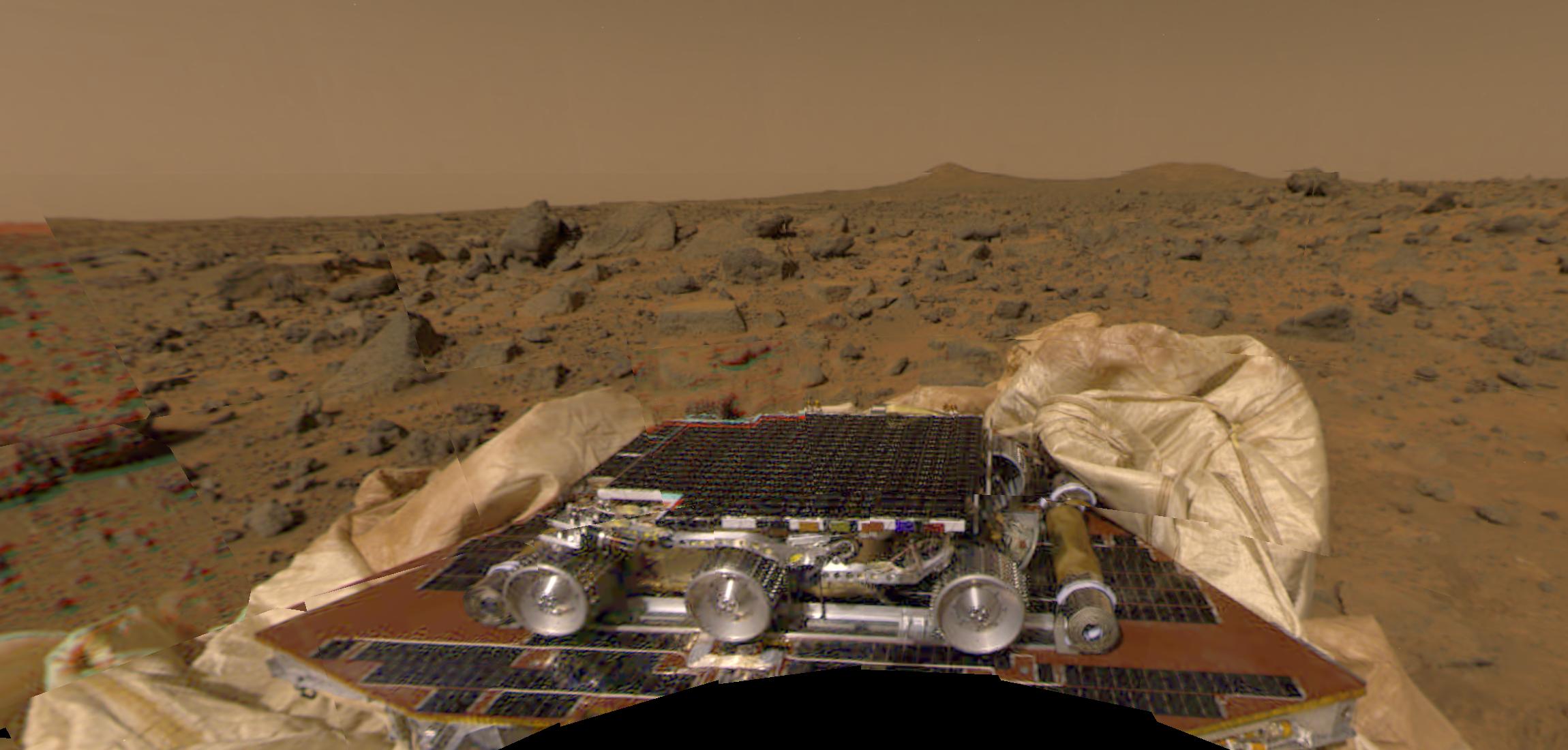
Pathfinder on Mars
2026-07-04
On July 4th, 1997, using its own array of fireworks, a parachute, and a cocoon of airbags, the Mars Pathfinder spacecraft bounced like a giant beach ball at least 15 times before it came to rest on the surface of Mars at 10:07 AM Pacific Daylight Time. After its then novel airbag-assisted landing sequence was completed, Pathfinder transmitted this color mosaic to mission operators on Earth. In the scene from another world, the Mars Sojourner robot rover is visible in the foreground, crouched on top of the unfolded Pathfinder. About the size of a large house cat, the six-wheeled, solar-powered Sojourner became the first successful Martian rover. Surrounding Pathfinder are deflated airbags and the rock-strewn terrain of the Ares Vallis floodplain. In the distance Martian hills appear against a dusty brownish sky. The Pathfinder lander was subsequently renamed the Carl Sagan Memorial Station.
via NASA APOD
Wikidata facts
- Instance of
- asteroid
- Named after
- Zsa Zsa Gabor
- Parent body
- Sun
- Minor-planet group
- asteroid belt
- Orbital period
- 1564.858047118895
Show 15 more facts
- discoverer or inventor
- Near-Earth Asteroid Tracking
- site of astronomical discovery
- Palomar Observatory
- time of discovery or invention
- 2002-09-01
- provisional designation
- 2002 RG250
- orbital eccentricity
- 0.01441370287383935
- absolute magnitude
- 16.37
- mean anomaly
- 20.31581458696812
- argument of periapsis
- 68.24062592651931
- longitude of ascending node
- 31.52198035200525
- orbital inclination
- 0.856461266261454
- semi-major axis of an orbit
- 2.637855574611156
- periapsis
- 2.599834308134611
- apoapsis
- 2.675876841087702
- time of periapsis
- 2460912.190650166
- epoch
- November 21, 2025
Sources (2)
via Wikidata · CC0
Article · Deutsch
(166614) Zsazsa ist ein Asteroid des mittleren Hauptgürtels, der im Januar 2006 vom ungarischen Amateurastronomen Krisztián Sárneczky entdeckt wurde, auf Aufnahmen, die am 1. September 2002 im Rahmen des Projektes Near Earth Asteroid Tracking (NEAT) mit dem 120-cm-Oschin-Schmidt-Teleskop des Palomar-Observatoriums (IAU-Code 644) in Kalifornien gemacht worden waren. Die Umlaufbahn des Asteroiden um die Sonne hat mit 0,0122 eine niedrigere Exzentrizität als diejenige der Erde, die bei 0,0167 liegt. Die Bahnneigung von (166614) Zsazsa ist mit knapp 0,9° ebenfalls gering. Der Asteroid wurde am 15. Juni 2011 nach der US-amerikanisch-ungarischen Gesellschaftsdame und Schauspielerin Zsa Zsa Gabor benannt. Auf NEAT-Aufnahmen durch Krisztián Sárneczky identifizierte Asteroiden hat er nach Ungarn benannt, die in den Vereinigten Staaten berühmt sind.
Abstract from DBpedia / Wikipedia · CC BY-SA