Picture of the Day · NASA
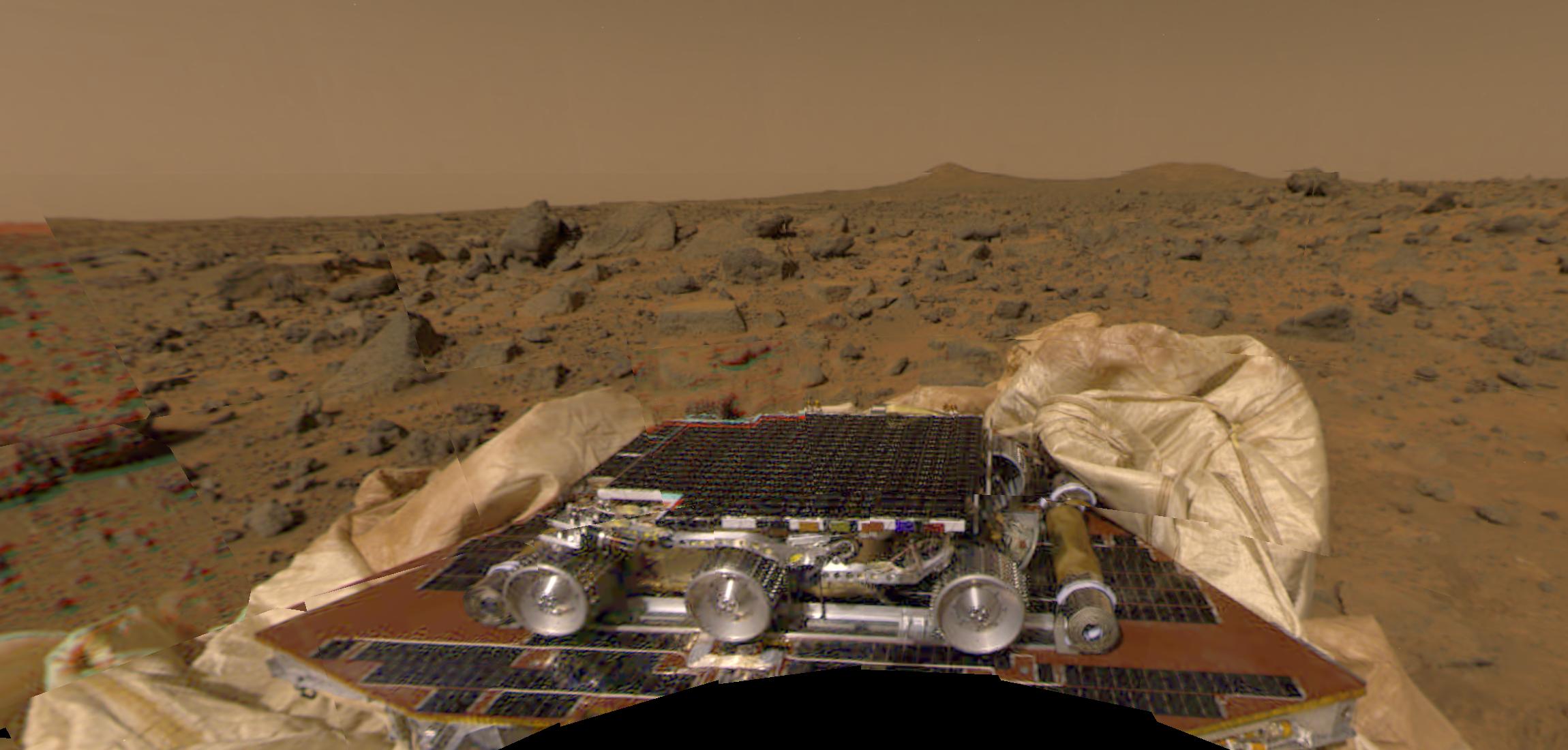
Pathfinder on Mars
2026-07-04
On July 4th, 1997, using its own array of fireworks, a parachute, and a cocoon of airbags, the Mars Pathfinder spacecraft bounced like a giant beach ball at least 15 times before it came to rest on the surface of Mars at 10:07 AM Pacific Daylight Time. After its then novel airbag-assisted landing sequence was completed, Pathfinder transmitted this color mosaic to mission operators on Earth. In the scene from another world, the Mars Sojourner robot rover is visible in the foreground, crouched on top of the unfolded Pathfinder. About the size of a large house cat, the six-wheeled, solar-powered Sojourner became the first successful Martian rover. Surrounding Pathfinder are deflated airbags and the rock-strewn terrain of the Ares Vallis floodplain. In the distance Martian hills appear against a dusty brownish sky. The Pathfinder lander was subsequently renamed the Carl Sagan Memorial Station.
via NASA APOD
Key facts
- Discovered by
- N. Chernykh
- Discovery site
- Crimean Astrophysical Obs.
- Discovery date
- 11 September 1977
- Named after
- Arkady and Boris Strugatsky , (Russian sci-fi authors)
- Alternative designations
- 1977 RE 7 · 1928 UC, 1959 JQ · 1960 OE, 1961 VG
- Minor planet category
- main-belt · ( outer ) , Themis
- Observation arc
- 89.36 yr (32,640 d)
- Aphelion
- 3.7446 AU
- Perihelion
- 2.4399 AU
- Semi major axis
- 3.0923 AU
- Orbital period sidereal
- 5.44 yr (1,986 d)
- Mean anomaly
- 176.03 °
- Mean motion
- 0° 10 52.68 / day
- Inclination
- 2.0802°
- Longitude of ascending node
- 146.26°
- Argument of perihelion
- 187.49°
- Mean diameter
- 26.921 ± 0.205 km
- Geometric albedo
- 0.056 ± 0.009
via Wikipedia infobox
Wikidata facts
- Instance of
- asteroid
- Named after
- Arkady and Boris Strugatsky
- Followed by
- 3055 Annapavlova
- Follows
- 3053 Dresden
- Parent body
- Sun
- Minor-planet group
- asteroid belt
- Diameter
- 26.921
- Orbital period
- 1991.441900146583
Show 16 more facts
- discoverer or inventor
- Nikolai Chernykh
- site of astronomical discovery
- Crimean Astrophysical Observatory
- provisional designation
- 1977 RE7
- time of discovery or invention
- 1977-09-11
- orbital eccentricity
- 0.2084940219429315
- absolute magnitude
- 11.9
- orbital inclination
- 2.081641360827704
- periapsis
- 2.451886383199916
- apoapsis
- 3.74361043217128
- semi-major axis of an orbit
- 3.097748407685598
- mean anomaly
- 323.4020900547163
- longitude of ascending node
- 146.1762348722883
- argument of periapsis
- 186.9809484661124
- albedo
- 0.056
- time of periapsis
- 2461202.951698119
- epoch
- November 21, 2025
Sources (2)
via Wikidata · CC0
Article · Deutsch
(3054) Strugatskia ist ein Asteroid des äußeren Hauptgürtels. Er wurde am 11. September 1977 von dem sowjetischen Astronomen Nikolai Tschernych am Krim-Observatorium in Nautschnyj (IAU-Code 095) entdeckt. Sichtungen des Asteroiden hatte es vorher schon gegeben: am 16. Oktober 1928 unter der vorläufigen Bezeichnung 1928 UC an der Landessternwarte Heidelberg-Königstuhl sowie am 2. Mai 1959 (1959 JQ), 21. Juli 1960 (1960 OE) und 4. April 1961 (1961 VG) am Goethe-Link-Observatorium in Indiana. Der mittlere Durchmesser des Asteroiden wurde mit 26,921 (±0,205) km berechnet. Die Albedo von 0,056 (±0,009) lässt auf eine dunkle Oberfläche schließen. Nach der SMASS-Klassifikation (Small Main-Belt Asteroid Spectroscopic Survey) wurde bei einer spektroskopischen Untersuchung von Gianluca Masi, Sergio Foglia und Richard P. Binzel bei einer Unterteilung aller untersuchten Asteroiden in C-, S- und V-Typen (3054) Strugatskia den C-Asteroiden zugeordnet. Der Asteroid gehört zur Themis-Familie, einer Gruppe von Asteroiden, die nach (24) Themis benannt wurde. Die zeitlosen (nichtoskulierenden) Bahnelemente von (3054) Strugatzski sind fast identisch mit denjenigen von fünf kleineren Asteroiden: , , , und . (3054) Strugatskia wurde am 2. Juli 1985 nach den sowjetischen Science-Fiction-Autoren Arkadi und Boris Strugazki benannt.
Abstract from DBpedia / Wikipedia · CC BY-SA