File:P0321a.jpg · Wikimedia Commons · See Wikimedia Commons
NGC 6397
Sign in to saveAlso known as New General Catalogue 6397, Caldwell 86, C 86
globular cluster of stars in the Milky Way
Key facts
- Class
- IX
- Constellation
- Ara
- Right ascension
- 17 40 42.09
- Declination
- –53 ° 40 ′ 27.6 ″
- Distance
- 7.8 kly (2.4 kpc )
- Apparent magnitude v
- +6.68
- Apparent dimensions v
- 32.0 ′
- Mass
- 1.14 × 10 M ☉
- Radius
- 36 ly
- Metallicity
- [ Fe/H ] = –1.76 dex
- Estimated age
- 13.4 ± 0.8 Gyr
- Notable features
- Second closest globular cluster
- Other designations
- GCl 74, Lacaille III.11, Dunlop 366, Bennett 98, Caldwell 86
via Wikipedia infobox
Wikidata facts
- Instance of
- globular cluster
- Part of
- Milky Way
- Constellation
- Ara
- Distance from Earth
- 7800
- Image
- P0321a.jpg
Show 12 more facts
- Commons category
- NGC 6397
- catalog code
- GCl 74
- discoverer or inventor
- Nicolas Louis de Lacaille
- time of discovery or invention
- 1751-00-00
- apparent magnitude
- 5.450
- right ascension
- 265.175375
- declination
- -53.674333
- epoch
- J2000.0
- radial velocity
- 18.9
- metallicity
- -1.99
- right ascension component of proper motion
- 3.690
- declination component of proper motion
- -14.8800
Sources (1)
via Wikidata · CC0
~4 min read
Encyclopedic overview
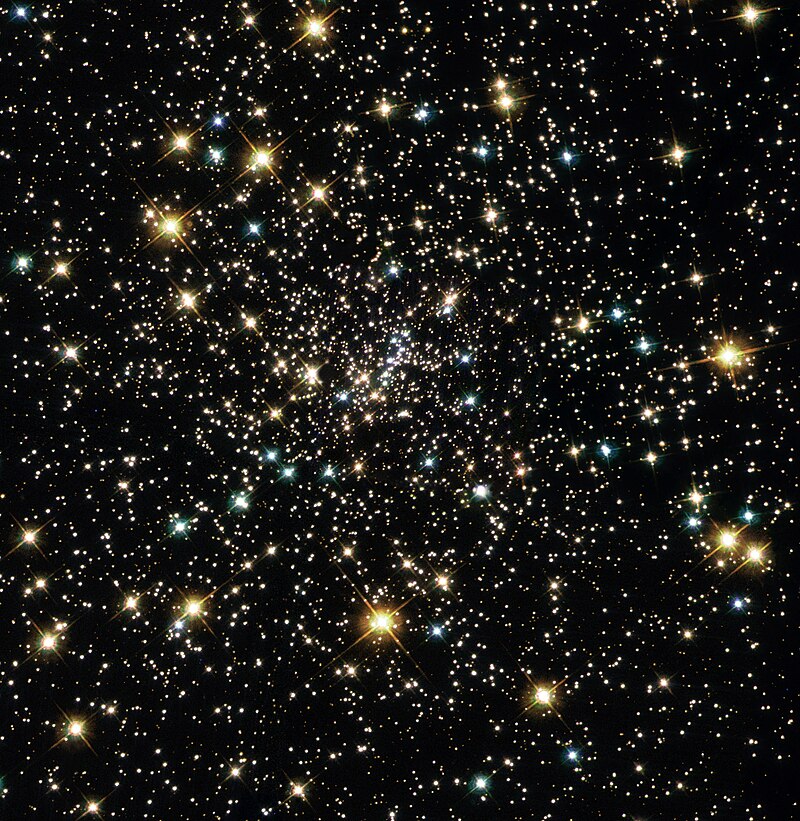
NGC 6397 (also known as Caldwell 86) is a globular cluster in the constellation Ara that was discovered by French astronomer Nicolas-Louis de Lacaille in 1752. It is located about 7,800 light-years from Earth, making it one of the two nearest globular clusters to Earth (the other one being Messier 4). The cluster contains around 400,000 stars, and can be seen with the naked eye under good observing conditions.
NGC 6397 is one of at least 20 globular clusters of the Milky Way Galaxy that have undergone a core collapse, meaning that the core has contracted to a very dense stellar agglomeration.
Excerpted from Wikipedia’s “NGC 6397” article, available under the CC BY-SA 4.0 licence.