File:Cayley_Q8_multiplication_graph.svg · Wikimedia Commons · See Wikimedia Commons
quaternion
Sign in to saveAlso known as Hamilton number
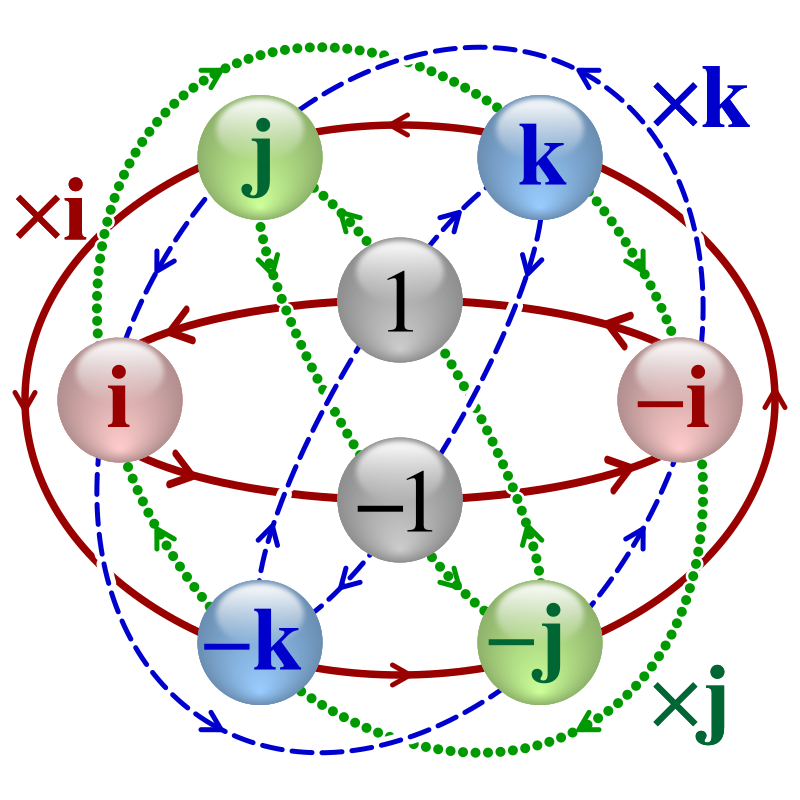
{| class="wikitable" align="right" style="text-align:center; margin-left:0.5em; max-width: 230px;" |+ Quaternion multiplication table |- |width=15| !width=15| !width=15| !width=15| !width=15| |- ! | | | | |- ! | | | | |- ! | | | | |- ! | | | | |- |colspan=5| Left column shows the left factor, top row shows the right factor. Also, a\mathbf{b}=\mathbf{b}a and -\mathbf{b} = (-1)\mathbf{b} for a\in \mathbb{R} , \mathbf{b} = \mathbf{i}, \mathbf{j}, \mathbf{k} . |} thumb|Cayley graph of the [[quaternion group showing the six cycles of multiplication by , and . (If the image
I cannot write an accurate overview based solely on this context. The provided material is only a quaternion multiplication table with technical notation—it shows *how* quaternions multiply but contains no information about what quaternions are, their definition, or why they matter. To write a responsible overview for a general reader, I would need contextual material that explains quaternions' nature and significance.
AI-generated from the Wikipedia summary — may contain errors.
Described at

Quaternione - Enciclopedia - Treccani
Nell'Enciclopedia Treccani troverai tutto quello che devi sapere su quaternione. Entra subito su Treccani.it, il portale del sapere.
treccani.it →Link to a page describing this subject · 7,235 chars · not written by Vinony
Wikidata facts
- Has part
- real number
- Followed by
- octonion
- Follows
- complex number
Show 9 more facts
- topic's main category
- Category:Quaternions
- described by source
- Granat Encyclopedic Dictionary
- discoverer or inventor
- William Rowan Hamilton
- maintained by WikiProject
- WikiProject Mathematics
- Commons category
- Quaternions
- inception
- 1843-00-00
- time of discovery or invention
- 1843-00-00
- described at URL
- getpocket.com/explore/item/the-strange-numbers-that-birthed-modern-algebra?utm_source=pocket-newtab-global-en-GB
- Stack Exchange tag
- blender.stackexchange.com/tags/quaternion
via Wikidata · CC0
~52 min read
Encyclopedic overview
36 sectionsContents
- History
- Quaternions in physics
- Definition
- Multiplication of basis elements
- Center
- Hamilton product
- Scalar and vector parts
- Conjugation, the norm, and reciprocal
- Unit quaternion
- Algebraic properties
- Quaternions and three-dimensional geometry
- Matrix representations
- Representation as complex 2 × 2 matrices
- Representation as real 4 × 4 matrices
- Lagrange's four-square theorem
- Quaternions as pairs of complex numbers
- Square roots
- Square roots of −1
- As a union of complex planes
- Commutative subrings
- Square roots of arbitrary quaternions
- Functions of a quaternion variable
- Exponential, logarithm, and power functions
- Geodesic norm
- Three-dimensional and four-dimensional rotation groups
- Quaternion algebras
- Quaternions as the even part of {{math|Cl<sub>3,0</sub>(ℝ)}}
- Brauer group
- Quotations
- See also
- Notes
- References
- Further reading
- Books and publications
- Links and monographs
- External links
{| class="wikitable" align="right" style="text-align:center; margin-left:0.5em; max-width: 230px;" |+ Quaternion multiplication table |- |width=15| !width=15| !width=15| !width=15| !width=15| |- ! | | | | |- ! | | | | |- ! | | | | |- ! | | | | |- |colspan=5| Left column shows the left factor, top row shows the right factor. Also, a\mathbf{b}=\mathbf{b}a and -\mathbf{b} = (-1)\mathbf{b} for a\in \mathbb{R} , \mathbf{b} = \mathbf{i}, \mathbf{j}, \mathbf{k} . |} thumb|Cayley graph of the [[quaternion group showing the six cycles of multiplication by , and . (If the image is opened in the Wikimedia Commons by clicking twice on it, cycles can be highlighted by hovering over or clicking on them.)]]
In mathematics, the quaternion number system extends the complex numbers. Quaternions were first described by the Irish mathematician William Rowan Hamilton in 1843 and applied to mechanics in three-dimensional space. The set of all quaternions is conventionally denoted by \ \mathbb H\ ('H' for Hamilton) or by Quaternions are not a field because multiplication of quaternions is not commutative. Quaternions provide a definition of the quotient of two vectors in a three-dimensional space. Quaternions are generally represented in the form
Excerpted from Wikipedia’s “quaternion” article, available under the CC BY-SA 4.0 licence.
Gallery (18)
Available in 69 languages
- Español
- Français
- Deutsch
- 中文
- 日本語
- Русский
- Português
- Italiano
- العربية
- Afrikaans
- Albanian
- Albanian
- Armenian
- Bahasa Indonesia
- Basque
- Bulgarian
- Catalan
- Chuvash
Show 50 more
- Croatian
- Czech
- Danish
- Esperanto
- Estonian
- Finnish
- Galician
- Georgian
- Greek
- Hebrew
- Hungarian
- Icelandic
- Interlingua
- Irish
- Kazakh
- Latin
- Latvian
- Lithuanian
- Lojban
- Lombard
- Macedonian
- Malay
- Mongolian
- Nederlands
- Norwegian
- Norwegian Nynorsk
- Piedmontese
- Polski
- Punjabi
- Romanian
- Scots
- Serbian
- Serbian (Latin)
- Sicilian
- simple
- Slovak
- Slovenian
- Svenska
- Tiếng Việt
- Türkçe
- Ukrainian
- Uzbek
- West Flemish
- Wu Chinese
- Yiddish
- zh_classical
- zh_yue
- فارسی
- ไทย
- 한국어
via Wikidata sitelinks · CC0