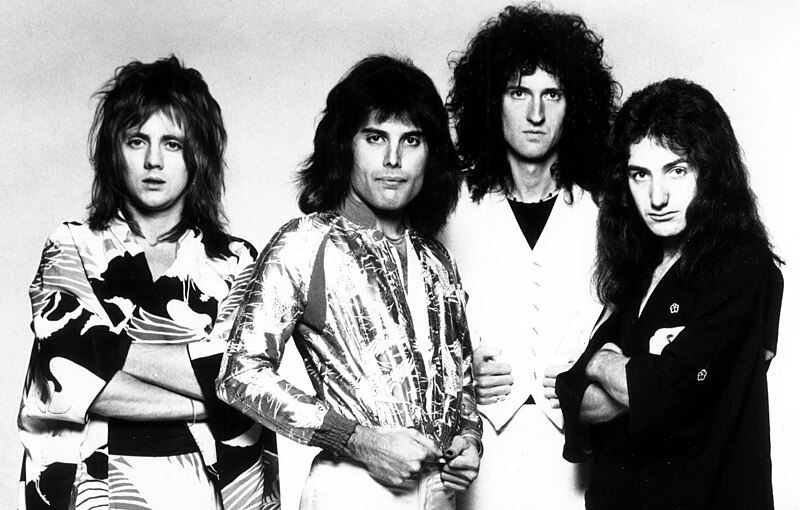
File:Queen_promo_1970s.jpg · Wikimedia Commons · See Wikimedia Commons
Queen
Sign in to saveBritish musical group; rock band
OverviewAI-generated
Queen is a musical group that began its work period in 1970. The band maintains an official website at queenonline.com and has a presence on social media with 18,200,000 followers. Their activities are documented in the Commons category and gallery titled "Queen (musical group)."
The group is recognized in the Rock And Roll Hall Of Fame collection and the Hollywood Walk Of Fame collection. Additionally, Queen is referenced by 5,185 other encyclopedia articles.
Synthesized by Vinony from 9 facts across 3 sources: Wikidata, Vinony collections, Vinony graph. Generated from structured data (not the Wikipedia text) and checked against those facts — may still contain errors.
Wikidata facts
- Instance of
- musical group
- Has part
- John Deacon
- Participant in
- Live Aid
- Genre
- heavy metal music
- Country of origin
- United Kingdom
- Record label
- EMI
- Discography
- Queen discography
- Official website
- queenonline.com
- Image
- Queen A Night At The Opera (1975 Elektra publicity photo 02).jpg
- Represented by
- Jim Beach
Show 16 more facts
- influenced by
- Pink Floyd
- Commons category
- Queen (musical group)
- topic's main category
- Category:Queen (band)
- location of formation
- London
- Commons gallery
- Queen (musical group)
- topic has template
- Template:Queen
- inception
- 1970-01-01
- start of work period
- 1970-00-00
- member category
- Category:Queen (band) members
- social media followers
- 18200000
- topic's main Wikimedia portal
- Portal:Queen
- on focus list of Wikimedia project
- Wikipedia:Vital articles/Level/4
- different from
- queen
- has characteristic
- rock band
- name
- Queen
Sources (9)
via Wikidata · CC0
~40 min read
Encyclopedic overview
Queen are a British rock band formed in London in 1970 by Freddie Mercury (lead vocals, piano), Brian May (guitar, vocals), and Roger Taylor (drums, vocals), later joined by John Deacon (bass). Their earliest works were influenced by progressive rock, hard rock and heavy metal, but the band gradually ventured into more conventional and radio-friendly works by incorporating further styles, such as arena rock and pop rock.
Before forming Queen, May and Taylor had played together in the band Smile. Mercury was a fan of Smile and encouraged them to experiment with more elaborate stage and recording techniques. He joined in 1970 and suggested the name "Queen". Deacon was recruited in February 1971, before the band released their self-titled debut album in 1973. Queen first charted in the UK with their second album, Queen II, in 1974. Sheer Heart Attack later that year and A Night at the Opera in 1975 brought them international success. The latter featured "Bohemian Rhapsody", which topped the UK singles chart for nine weeks and helped popularise the music video format. The band's 1977 album News of the World contained "We Will Rock You" and "We Are the Champions", which have become anthems at sporting events. By the early 1980s, Queen were one of the biggest stadium rock bands in the world. "Another One Bites the Dust" from The Game (1980) became their best-selling single, and their 1981 compilation album Greatest Hits is the best-selling album in the UK and has been certified 9× Platinum in the US by the Recording Industry Association of America (RIAA). Their performance at the 1985 Live Aid concert is ranked among the greatest in rock history by various publications. In August 1986, Mercury gave his last performance with Queen at Knebworth, England.
Excerpted from Wikipedia’s “Queen” article, available under the CC BY-SA 4.0 licence.
Gallery (12)
Available in 179 languages
- Español
- Français
- Deutsch
- 中文
- 日本語
- Русский
- Português
- Italiano
- العربية
- हिन्दी
- Abkhazian
- Achinese
- Afrikaans
- Albanian
- Albanian
- Amharic
- Aragonese
- Armenian
Show 160 more
- Arpitan
- Asturian
- Aymara
- azb
- Azerbaijani
- Bahasa Indonesia
- Bangla
- Bashkir
- Basque
- bat_smg
- Bavarian
- be_x_old
- Belarusian
- Bikol
- Bosnian
- Breton
- Buginese
- Bulgarian
- Burmese
- Catalan
- cbk_zam
- Cebuano
- Cherokee
- Chuvash
- Colognian
- Cornish
- Corsican
- Crimean Tatar
- Croatian
- Czech
- Danish
- Egyptian Arabic
- eml
- Esperanto
- Estonian
- Extremaduran
- Faroese
- Fiji Hindi
- Fijian
- Filipino
- Finnish
- fiu_vro
- Friulian
- Galician
- Georgian
- Greek
- Haitian Creole
- Hebrew
- Hungarian
- Icelandic
- Ido
- Igbo
- Iloko
- Inari Sami
- Interlingua
- Interlingue
- Irish
- Javanese
- Kabyle
- Kara-Kalpak
- Kashubian
- Kazakh
- Khmer
- Kurdish
- Kyrgyz
- Ladino
- Latgalian
- Latin
- Latvian
- Lezghian
- Ligurian
- Limburgish
- Lithuanian
- Lojban
- Lombard
- Low German
- Lower Sorbian
- Luxembourgish
- Macedonian
- Malagasy
- Malay
- Malayalam
- Maltese
- Manx
- Marathi
- Mari
- Mingrelian
- Mirandese
- Mongolian
- nds_nl
- Neapolitan
- Nederlands
- Nepali
- Northern Sami
- Norwegian
- Norwegian Nynorsk
- Occitan
- Old English
- Ossetic
- Pampanga
- Pangasinan
- Papiamento
- Pennsylvania German
- Picard
- Piedmontese
- Polski
- Punjabi
- Quechua
- roa_tara
- Romanian
- Romansh
- Samoan
- Sardinian
- Saterland Frisian
- Scots
- Scottish Gaelic
- Serbian
- Serbian (Latin)
- Sicilian
- Silesian
- simple
- Slovak
- Slovenian
- Somali
- Sundanese
- Svenska
- Swahili
- Tajik
- Tamil
- Tatar
- Tetum
- Tiếng Việt
- Tok Pisin
- Toki Pona
- Türkçe
- Ukrainian
- Upper Sorbian
- Urdu
- Uzbek
- Venetian
- Veps
- Volapük
- Walloon
- Waray
- Welsh
- West Flemish
- Western Frisian
- Wolof
- Wu Chinese
- Yakut
- Yiddish
- Yoruba
- Zaza
- Zeelandic
- zh_min_nan
- zh_yue
- Zulu
- فارسی
- ไทย
- 한국어
via Wikidata sitelinks · CC0