Encyclopedia of Life · EOL (see source)
Red hartebeest
Sign in to saveAlso known as Alcelaphus buselaphus caama
subspecies of African grassland antelope
Species
Least Concernvia IUCN
Wikidata facts
- Instance of
- taxon
- Parent taxon
- Alcelaphus
- Image
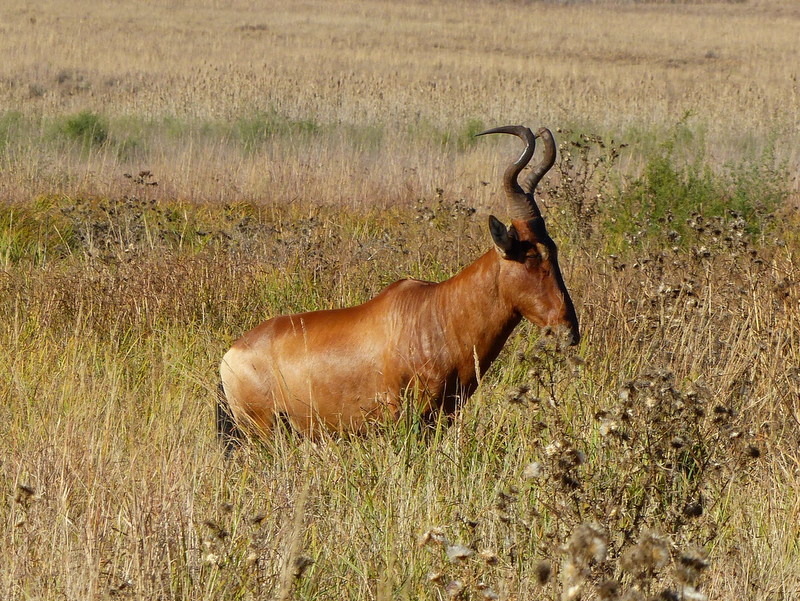
- South Africa-Krugersdorp Nature Reserve-Red Hartebeest01.jpg
Show 7 more facts
- IUCN conservation status
- Least Concern
- Commons category
- Alcelaphus caama
- taxon name
- Alcelaphus buselaphus caama
- taxon rank
- subspecies
- Commons gallery
- Alcelaphus caama
- taxon common name
- Red Hartebeest
- described by source
- Granat Encyclopedic Dictionary
Sources (1)
via Wikidata · CC0
~7 min read
Encyclopedic overview
The red hartebeest (Alcelaphus buselaphus caama), also called the Cape hartebeest or Caama, is a subspecies of the hartebeest found in Southern Africa. More than 130,000 individuals live in the wild. The red hartebeest is closely related to the tsessebe and the topi.
Alcelaphus buselaphus caama is a large African antelope of the family Bovidae, one of ten subspecies; it is sometimes treated as a separate species, A. caama. Commonly known as the red hartebeest, it is the most colorful hartebeest, with black markings contrasting against its white abdomen and behind. It has a longer face that other subspecies, with complex curving horns joined at the base. The average weight of a male is about 150 kg, and female is 120 kg. Their average shoulder height is 135 cm, and horns are 60 cm long. The life expectancy of a red hartebeest is around 19 years. Little sexual dimorphism is noted between males and females, showing no distinct identifiable physical features, but body size is slightly affected. Horn size, however, expresses more dimorphism between males and females, as males fight and defend themselves for sexual selection. Thus, male skull weight and circumference is slightly greater than that of the female. Hartebeests have an excellent sense of hearing and smell, although their sense of sight is poor. When alarmed, hartebeests flee, reaching a maximum speed of 55 km/h. Their evasion tactic is to induce confusion by running in a zigzag pattern, making it difficult for predators to catch them.
Excerpted from Wikipedia’s “Red hartebeest” article, available under the CC BY-SA 4.0 licence.