Encyclopedia of Life · EOL (see source)
OverviewAI-generated
The redhead (Aythya americana) is a species of bird in the family Anatidae, order Anseriformes, class Aves, and phylum Chordata. It was described by Eyton in 1838. The taxon is accepted within the genus Aythya. Common names for this organism include hwyaden bengoch America, Rotkopfente, and Porrón americano.
Redheads inhabit freshwater environments. They have a wingspan of 79.5 and a mass of 990. The litter size for this species is 9. The International Union for Conservation of Nature lists the conservation status as Least Concern, with an assessment year of 2021.
Synthesized by Vinony from 24 facts across 4 sources: Wikidata, IUCN Red List, WoRMS, Vinony graph. Generated from structured data (not the Wikipedia text) and checked against those facts — may still contain errors.
Species
Least Concernredhead
Species
- PhylumChordata
- ClassAves
- OrderAnseriformes
- FamilyAnatidae
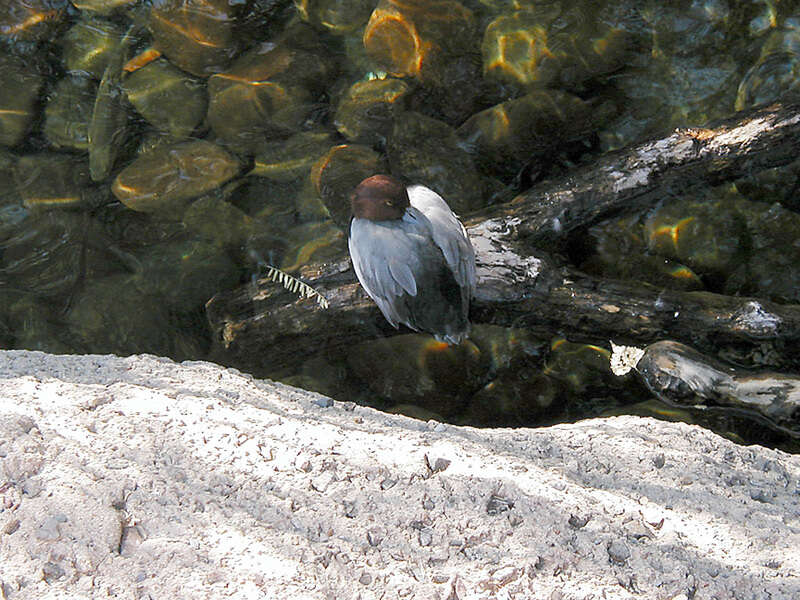
Ironically, the Redhead is not the only duck in North America with a red head. In many parts of its range, this species occurs side by side with another redheaded duck, the Canvasback (Aythya valisineria), and a couple field marks must be noted in order to distinguish the two. The Redhead is slightly smaller (19-20 inches), has a shorter bill, and is darker on the back and flanks. Males have a red head and grey body, while females are mostly dark brown. The Redhead breeds primarily in the northern Great Plains, with smaller breeding populations in the southern Plains, the Rockies, and Alaska. Although some western areas see Redheads all year, most Redhead populations migrate south to the southern two-thirds of the United States and into Mexico in winter. Despite this vast winter range, much higher concentrations of wintering Redheads may be found along the coast than in the interior. Redheads breed in freshwater wetlands. In winter, this species primarily inhabits coastal areas with plentiful seagrasses. Redheads predominantly eat aquatic plants in summer; in winter, their diet includes seagrasses and mollusks. One of several species of “diving ducks” in North America, Redheads may
via IUCN
Wikidata facts
Show 9 more facts
- taxon rank
- species
- IUCN conservation status
- Least Concern
- Commons category
- Aythya americana
- taxon name
- Aythya americana
- Commons gallery
- Aythya americana
- taxon common name
- crvenoglava patka
- wingspan
- 79.5
- litter size
- 9
- short name
- A. americana
Sources (2)
via Wikidata · CC0
~11 min read
Encyclopedic overview
The redhead (Aythya americana) is a medium-sized diving duck. The scientific name is derived from Greek aithuia, an unidentified seabird mentioned by authors including Hesychius and Aristotle, and Latin americana, of America. The redhead is 40–56 cm (16–22 in) long with an 74–84 cm (29–33 in) wingspan; the weight ranges from 1,030–1,080 g (36–38 oz), with males weighing an average of 1,080 g (38 oz) and females an average of 1,030 g (36 oz). It belongs to the genus Aythya, together with 11 other described species. The redhead and the common pochard form a sister group which together is sister to the canvasback. This waterfowl is easily distinguished from most other ducks by the male's copper colored head and pale blue bill during the breeding season; from its close relative canvasback it is distinguished by the more rounded head, shorter bill, and (in the males) yellow, not red, eye. The Eurasian common pochard is even more similar, but very rarely overlaps in range; it also differs in having a red eye, and a more acute, less rounded head shape.
Other names that have been used for the redhead include red-headed duck and the red-headed pochard.
Excerpted from Wikipedia’s “Redhead” article, available under the CC BY-SA 4.0 licence.