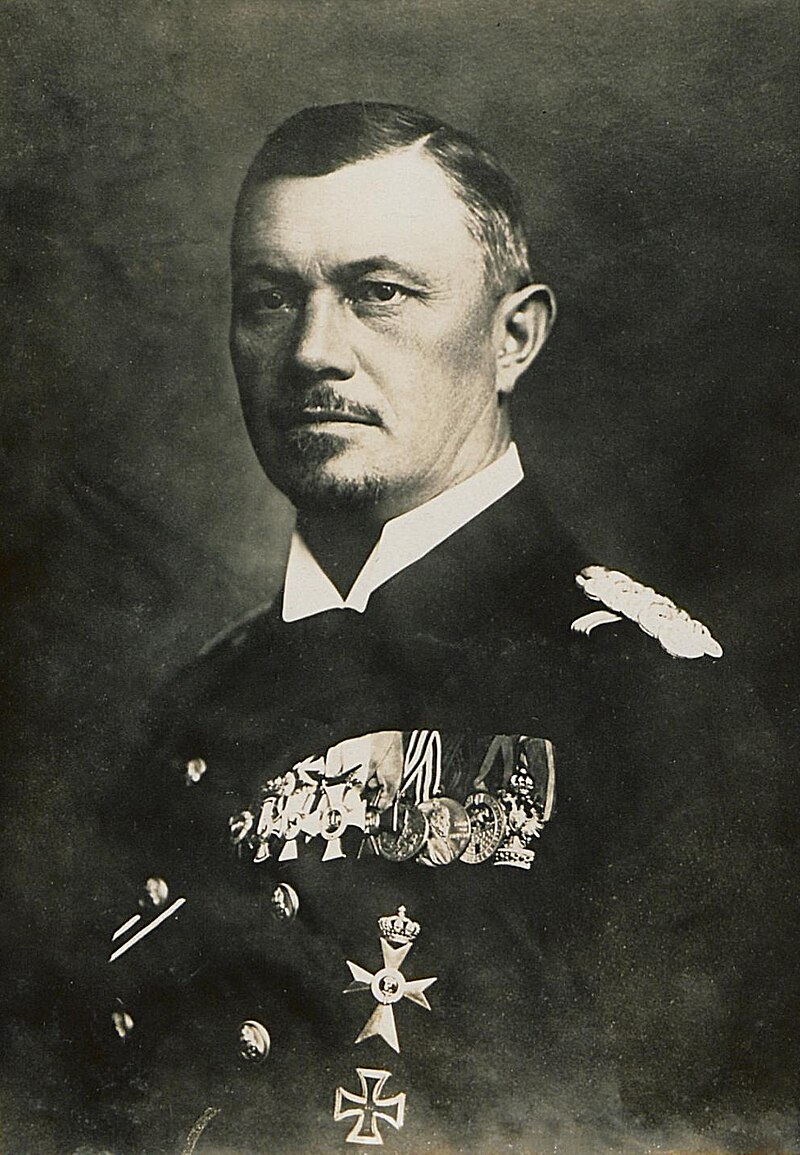
File:Almirante_Reinhard_Scheer.jpg · Wikimedia Commons · See Wikimedia Commons
Reinhard Scheer
Sign in to saveAlso known as Carl Friedrich Heinrich Reinhard Scheer
German admiral (1863-1928)
Key facts
- Born
- ( 1863-09-30 ) 30 September 1863, Obernkirchen , Electorate of Hesse
- Died
- 26 November 1928 (1928-11-26) (aged 65), Marktredwitz , Weimar Republic
- Allegiance
- German Empire
- Branch
- Imperial German Navy
- Service years
- 1879–1918
- Rank
- Admiral
- Commands
- SMS Gazelle , SMS Elsass , II Battle Squadron , III Battle Squadron , High Seas Fleet , Chief of Naval Staff
- Conflicts
- World War I Lowestoft raid Battle of Jutland
- Awards
- See below
via Wikipedia infobox
Wikidata facts
- Instance of
- human
- Given name
- Reinhard
- Gender
- male
- Citizenship
- Schaumburg-Lippe
- Place of birth
- Obernkirchen
- Place of death
- Marktredwitz
- Occupation
- soldier
- Educated at
- German Imperial Naval Academy
- Employer
- German Imperial Naval Office
- Languages spoken
- German
- Religion
- Lutheranism
- Field of work
- navy
- Conflict
- World War I
- Military branch
- Imperial German Navy
- Military rank
- captain lieutenant
- Image
- Almirante Reinhard Scheer.jpg
- Number of children
- 3
Show 9 more facts
- Commons category
- Reinhard Scheer
- date of death
- 1928-11-26
- date of birth
- 1863-09-30
- place of burial
- Historical Cemetery, Weimar
- member of the crew of
- SMS Niobe
- archives at
- German Federal Archives
- start of work period
- 1879-00-00
- birth name
- Carl Friedrich Heinrich Reinhard Scheer
- name in native language
- Reinhard Scheer
via Wikidata · CC0
~20 min read
Encyclopedic overview
Carl Friedrich Heinrich Reinhard Scheer (30 September 1863 – 26 November 1928) was an admiral in the Imperial German Navy (Kaiserliche Marine). Scheer joined the navy in 1879 as an officer cadet and progressed through the ranks, commanding cruisers and battleships, as well as senior staff positions on land. At the outbreak of World War I, Scheer was the commander of the II Battle Squadron of the High Seas Fleet. He then took command of the III Battle Squadron, which consisted of the newest and most powerful battleships in the navy. In January 1916, he was promoted to admiral and given control of the High Seas Fleet. Scheer led the German fleet at the Battle of Jutland on 31 May – 1 June 1916, one of the largest naval battles in history.
Following the battle, Scheer joined those calling for unrestricted submarine warfare against the Allies, a move the Kaiser eventually permitted. In August 1918, Scheer was promoted to the chief of Naval Staff; Admiral Franz von Hipper replaced him as commander of the fleet. Together they planned a final battle against the British Grand Fleet, but war-weary sailors mutinied at the news and the operation was abandoned. Scheer retired after the end of the war.
Excerpted from Wikipedia’s “Reinhard Scheer” article, available under the CC BY-SA 4.0 licence.