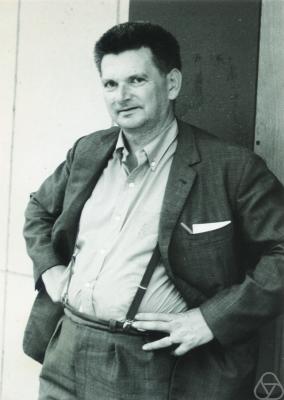
File:René_Thom.jpeg · Wikimedia Commons · See Wikimedia Commons
Key facts
- Born
- ( 1923-09-02 ) 2 September 1923, Montbéliard , France
- Died
- 25 October 2002 (2002-10-25) (aged 79), Bures-sur-Yvette , France
- Alma mater
- École Normale Supérieure , University of Paris
- Known for
- Catastrophe theory , Cobordism , Gradient conjecture , Quasi-fibration , Splitting lemma , Thom conjecture , Thom isomorphism , Thom space , Thom transversality theorem , Thom's first isotopy lemma , Thom–Porteous formula , Thom–Sebastiani Theorem , Dold–Thom theorem
- Children
- Françoise Thom
- Awards
- Fields Medal (1958) , Brouwer Medal (1970), John von Neumann Lecture Prize (1976)
- Fields
- Mathematics
- Institutions
- University of Strasbourg , Université Joseph Fourier , Institut des Hautes Études Scientifiques
- Thesis
- Espaces fibrés en sphères et carrés de Steenrod (1951)
- Doctoral advisor
- Henri Cartan
- Doctoral students
- David Trotman
via Wikipedia infobox
Wikidata facts
- Instance of
- human
- Given name
- René
- Gender
- male
- Citizenship
- France
- Place of birth
- Montbéliard
- Place of death
- Bures-sur-Yvette
- Child
- Françoise Thom
- Occupation
- university teacher
- Position held
- chairperson
- Educated at
- University of Paris
- Languages spoken
- French
- Notable work
- cobordism
- Academic degree
- professor
- Doctoral advisor
- Henri Cartan
- Student of
- Henri Cartan
- Doctoral student
- Joséphine Guidy Wandja
- Field of work
- topology
- Image
- René Thom.jpeg
Show 9 more facts
- date of birth
- 1923-09-02
- date of death
- 2002-10-25
- member of
- Polish Academy of Sciences
- Commons category
- René Thom
- Erdős number
- 4
- name in native language
- René Thom
- birth name
- René Frédéric Thom
- maintained by WikiProject
- WikiProject Mathematics
via Wikidata · CC0
~7 min read
Encyclopedic overview
René Frédéric Thom ( French: [ʁəne tɔm]; 2 September 1923 – 25 October 2002) was a French mathematician, who received the Fields Medal in 1958.
He made his reputation as a topologist, moving on to aspects of what would be called singularity theory; he became world-famous among the wider academic community and the educated general public for one aspect of this latter interest, his work as the founder of catastrophe theory (later developed by Christopher Zeeman).
Excerpted from Wikipedia’s “René Thom” article, available under the CC BY-SA 4.0 licence.