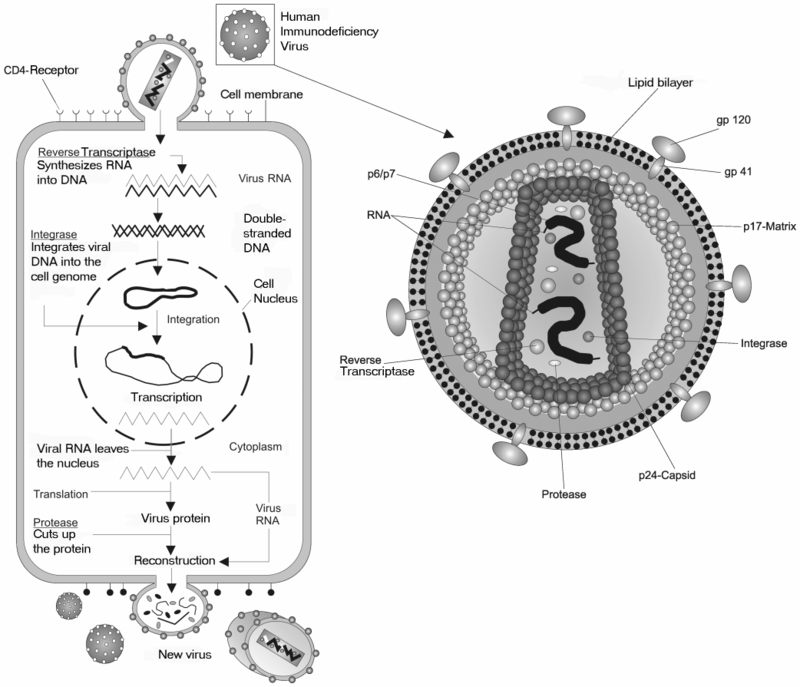
File:Hiv_gross.png · Wikimedia Commons · See Wikimedia Commons
retrovirus
Sign in to saveAlso known as Retroviridae
A retrovirus is a virus that inserts a DNA copy of its RNA genome into the DNA of a host cell that it invades, thus changing the genome of that cell. After invading a host cell's cytoplasm, the virus uses its own reverse transcriptase enzyme to produce DNA from its RNA genome, the reverse of the usual pattern, thus retro (backward). The new DNA is then incorporated into the host cell genome by an integrase enzyme, at which point the retroviral DNA is referred to as a provirus. The host cell then treats the viral DNA as part of its own genome, transcribing and translating the viral genes along
OverviewAI-generated
Retroviridae is a taxon classified at the family rank. The name Retroviridae is accepted as the valid designation for this group. It is categorized within the biological classification system as a family of organisms.
The subject has been the focus of extensive scientific literature, with 193,014 related records identified in PubMed. Additionally, the topic is referenced by 1,262 other encyclopedia articles, indicating its presence across various informational sources.
Synthesized by Vinony from 8 facts across 4 sources: Wikidata, PubMed, WoRMS, Vinony graph. Generated from structured data (not the Wikipedia text) and checked against those facts — may still contain errors.
Species
Family
- FamilyRetroviridae
Retroviren (Retroviridae) sind eine große Familie behüllter Viren mit Einzel(+)-strängigem-RNA-Genom, deren Erbinformation (ss(+)-RNA) dementsprechend in Form von Ribonukleinsäure vorliegt. Anders als bei „normalen“ RNA-Viren aber muss die RNA von Retroviren zunächst einmal mittels reverser Transkription in ein DNA-Molekül umgeschrieben werden, bevor sie als solches in das Genom der Wirtszelle eingebaut und dort aktiv werden kann. Retroviren können grob in einfache und komplexe Retroviren unterteilt werden. Des Weiteren unterscheidet man zwischen infektiösen exogenen Retroviren (teilweise mit XRV abgekürzt) und den endogenen Retroviren (ERV), die vertikal über die Keimbahn vererbt werden und auf diese Weise Bestandteil des Wirtszell-Genoms werden. Retroviren infizieren vornehmlich tierische Zellen und sind bei Wirbeltieren allgegenwärtig: Sie infizieren Säugetiere, Vögel, Amphibien, Reptilien und Fische, sind dabei aber meist sehr wirtsspezifisch. Zu ihnen gehören die Erreger einiger weit verbreiteter Infektionskrankheiten, die sowohl bei Menschen als auch bei Tieren pandemisch bzw. epidemisch auftreten. Als Auslöser von Krankheiten beim Menschen sind unter anderem HIV und HTLV-1 b
via
Research
193,014 papers- Human endogenous retrovirus-K (HML-2): a comprehensive review.ReviewCritical reviews in microbiology · 2018Garcia-Montojo M, Doucet-O'Hare T, Henderson L et al.DOI: 10.1080/1040841X.2018.1501345
- Human Retrovirus Genomic RNA Packaging.ReviewViruses · 2022Hanson HM, Willkomm NA, Yang H et al.DOI: 10.3390/v14051094
- Retrovirus budding.ReviewVirus research · 2004Demirov DG, Freed EODOI: 10.1016/j.virusres.2004.08.007
- The Retrovirus Capsid Core.ReviewSub-cellular biochemistry · 2018Zhang W, Mendonça LM, Mansky LMDOI: 10.1007/978-981-10-8456-0_8
- Koala retrovirus and neoplasia: correlation and underlying mechanisms.ReviewCurrent opinion in virology · 2024Tarlinton R, Greenwood ADDOI: 10.1016/j.coviro.2024.101427
- Interferon-Stimulated Genes that Target Retrovirus Translation.ReviewViruses · 2024Jäger N, Pöhlmann S, Rodnina MV et al.DOI: 10.3390/v16060933
- Retrovirus receptors.ReviewThe Journal of general virology · 1999Sommerfelt MADOI: 10.1099/0022-1317-80-12-3049
- Retrovirus receptors.ReviewCell · 1995Weiss RA, Tailor CSDOI: 10.1016/0092-8674(95)90024-1
via PubMed
Wikidata facts
- Instance of
- taxon
- Subclass of
- virus
- Parent taxon
- Ortervirales
- Image
- HIV-budding.jpg
Show 8 more facts
- studied by
- wastewater surveillance
- topic has template
- Template:Retroviruses
- taxon common name
- retrovirus
- taxon name
- Retroviridae
- taxon rank
- family
- Commons category
- Retroviridae
- topic's main category
- Category:Retroviridae
Sources (3)
via Wikidata · CC0
~24 min read
Encyclopedic overview
19 sectionsContents
- Structure
- <span class="anchor" id="Genes"></span> Genomic structure
- Multiplication
- Recombination
- Transmission
- Provirus
- Early evolution
- Gene therapy
- Cancer
- Classification
- Exogenous
- Group VI viruses
- Group VII viruses
- Endogenous
- Treatment
- Treatment of veterinary retroviruses
- References
- Further reading
- External links
A retrovirus is a virus that inserts a DNA copy of its RNA genome into the DNA of a host cell that it invades, thus changing the genome of that cell. After invading a host cell's cytoplasm, the virus uses its own reverse transcriptase enzyme to produce DNA from its RNA genome, the reverse of the usual pattern, thus retro (backward). The new DNA is then incorporated into the host cell genome by an integrase enzyme, at which point the retroviral DNA is referred to as a provirus. The host cell then treats the viral DNA as part of its own genome, transcribing and translating the viral genes along with the cell's own genes, producing the proteins required to assemble new copies of the virus. Many retroviruses cause serious diseases in humans, other mammals, and birds.
Retroviruses have many subfamilies in three basic groups. Oncoretroviruses (cancer-causing retroviruses) include human T-lymphotropic virus (HTLV), causing a type of leukemia in humans, and murine leukemia viruses (MLVs) in mice. Lentiviruses (slow viruses) include HIV-1 and HIV-2, the cause of acquired immune deficiency syndrome (AIDS) in humans. Spumaviruses (foamy viruses) are benign and not linked to any disease in humans or animals.
Excerpted from Wikipedia’s “retrovirus” article, available under the CC BY-SA 4.0 licence.
Gallery (11)
Available in 64 languages
- Español
- Français
- Deutsch
- 中文
- 日本語
- Русский
- Português
- Italiano
- العربية
- हिन्दी
- Afrikaans
- Armenian
- Bahasa Indonesia
- Basque
- Belarusian
- Bosnian
- Bulgarian
- Catalan
Show 45 more
- Czech
- Danish
- Egyptian Arabic
- Esperanto
- Estonian
- Finnish
- Galician
- Ganda
- Georgian
- Greek
- Hebrew
- Hungarian
- Ido
- Irish
- Kazakh
- Latin
- Latvian
- Lombard
- Macedonian
- Malay
- Mongolian
- Nederlands
- Northern Frisian
- Norwegian
- Norwegian Nynorsk
- Occitan
- Polski
- Romanian
- Scots
- Serbian
- Serbian (Latin)
- simple
- Slovak
- Slovenian
- Svenska
- Tamil
- Tiếng Việt
- Türkçe
- Ukrainian
- Urdu
- Uzbek
- Waray
- zh_yue
- فارسی
- 한국어
via Wikidata sitelinks · CC0