Rhabdothamnus · Kew POWO · Kew Plants of the World Online
Rhabdothamnus
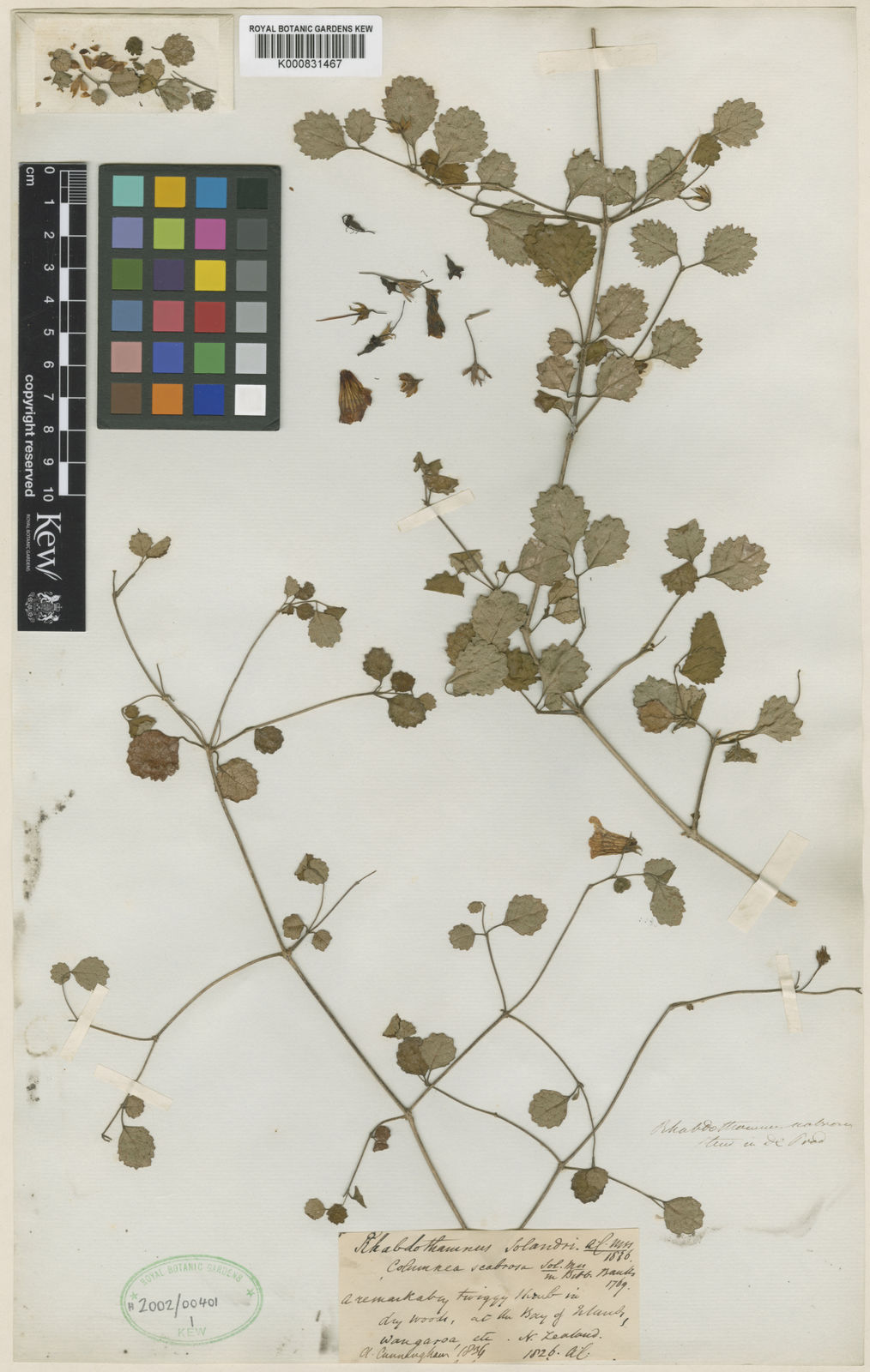
Sign in to savethumb|left|Flower Rhabdothamnus solandri is a small shrub of the family Gesneriaceae endemic to New Zealand. It is the only plant of the genus Rhabdothamnus, and the only member of Gesneriaceae native to New Zealand. Its common names are New Zealand gloxinia and, in the Māori language, , , and .
Species
GENUS
- KingdomPlantae
- PhylumTracheophyta
- ClassMagnoliopsida
- OrderLamiales
- FamilyGesneriaceae
via GBIF · Kew POWO
Wikidata facts
- Instance of
- taxon
- Parent taxon
- Gesneriaceae
- Image
- Rhabdothamnus solandri 11.JPG
Show 4 more facts
- taxon name
- Rhabdothamnus
- taxon rank
- genus
- Commons category
- Rhabdothamnus
Sources (1)
via Wikidata · CC0
~2 min read
Encyclopedic overview
2 sectionsContents
- See also
- References
thumb|left|Flower Rhabdothamnus solandri is a small shrub of the family Gesneriaceae endemic to New Zealand. It is the only plant of the genus Rhabdothamnus, and the only member of Gesneriaceae native to New Zealand. Its common names are New Zealand gloxinia and, in the Māori language, , , and .
The species is found throughout the North Island, less commonly in the southern part of the island, and its offshore islands, in a variety of locations such as forests, near streams, or on banks. It grows as a shrub up to 2 metres tall. It has distinctive trumpet-shaped flowers that are modest-sized at 2–2.5, and up to 4, centimetres long. The flowers are usually orange, but sometimes brick-red, yellow, purple or pink, and are longitudinally striped by 12–14, even up to 20, red or dark orange veins. It flowers year-round, peaking between October and February.
Excerpted from Wikipedia’s “Rhabdothamnus” article, available under the CC BY-SA 4.0 licence.