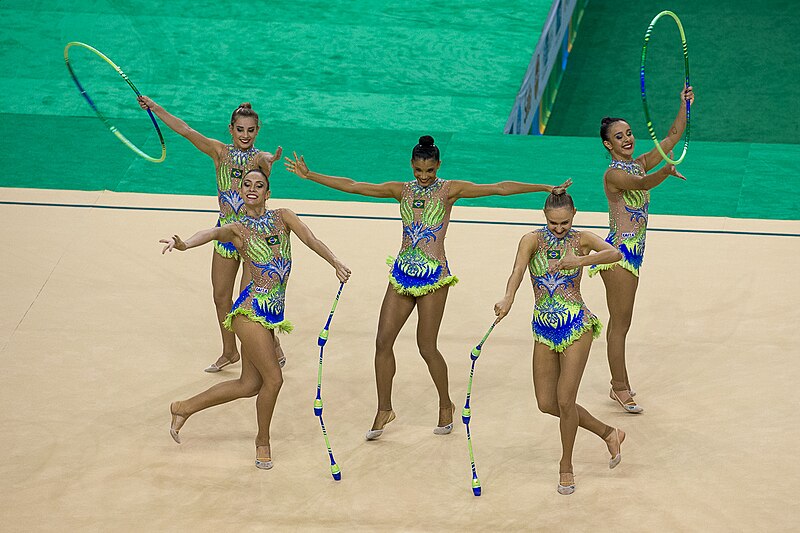
File:Brazil_Group_2016_Olympics_Test_Event_1.jpg · Wikimedia Commons · See Wikimedia Commons
rhythmic gymnastics
Sign in to saveAlso known as rhythmic sportive gymnastics, modern gymnastics
gymnastics discipline in which gymnasts perform on a floor with an apparatus (hoop, ball etc.) accompanied by music
Rhythmic gymnastics is a sport where gymnasts perform acrobatic movements and dance on a floor while manipulating handheld apparatus like hoops and balls, all synchronized to music. It combines elements of dance, gymnastics, and coordination, requiring both physical skill and artistic expression.
AI-generated from the Wikipedia summary — may contain errors.
Wikidata facts
- Instance of
- Olympic sport
- Sport
- gymnastics
- Image
- Evgenia Kanaeva RUS Olympiasiegerin.JPG
Show 5 more facts
- different from
- artistic gymnastics
- Commons category
- Rhythmic gymnastics
- topic's main category
- Category:Rhythmic gymnastics
- uses
- ball
- on focus list of Wikimedia project
- Wikipedia:Vital articles/Level/4
via Wikidata · CC0
~40 min read
Encyclopedic overview
Rhythmic gymnastics is a sport in which gymnasts perform individually or in groups on a floor with an apparatus: hoop, ball, clubs, ribbon and rope. The sport combines elements of gymnastics, dance and calisthenics; gymnasts must be strong, flexible, agile, dexterous and coordinated. Rhythmic gymnastics is governed by World Gymnastics, which first recognized it as a sport in 1963. At the international level, rhythmic gymnastics is a women-only sport.
Rhythmic gymnastics became an Olympic sport in 1984, when the individual all-around event was first competed, and the group competition was added to the Olympics in 1996. World Gymnastics-recognized competitions, besides the Olympic Games, include the World Championships, continental championships (European Championships, Asian Championships, Pan American Championships, African Championships, and Oceanian Championships), and the World Cup series. At competitions, gymnasts are judged on their artistry, execution of skills, and difficulty of skills. They perform leaps, balances, and rotations (spins) along with handling the apparatus.
Excerpted from Wikipedia’s “rhythmic gymnastics” article, available under the CC BY-SA 4.0 licence.
Gallery (12)
Available in 63 languages
- Español
- Français
- Deutsch
- 中文
- 日本語
- Русский
- Português
- Italiano
- العربية
- Armenian
- Azerbaijani
- Bahasa Indonesia
- Basque
- be_x_old
- Belarusian
- Bosnian
- Bulgarian
- Catalan
Show 44 more
- Croatian
- Czech
- Danish
- Esperanto
- Estonian
- Finnish
- Galician
- Georgian
- Greek
- Hebrew
- Hungarian
- hyw
- Ido
- Interlingua
- Interlingue
- Javanese
- Kara-Kalpak
- Kashubian
- Kazakh
- Latvian
- Lithuanian
- Macedonian
- Malay
- Nederlands
- Norwegian
- Polski
- Romanian
- Serbian
- simple
- Sinhala
- Slovak
- Slovenian
- Sundanese
- Svenska
- Tamil
- Tatar
- Tiếng Việt
- Türkçe
- Ukrainian
- Uzbek
- Wu Chinese
- zh_yue
- فارسی
- 한국어
via Wikidata sitelinks · CC0