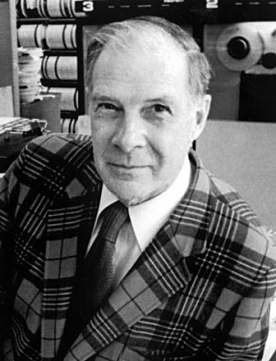
File:Richard_Hamming.jpg · Wikimedia Commons · See Wikimedia Commons
Richard Hamming
Sign in to saveAlso known as Richard Wesley Hamming, Richard W. Hamming
American mathematician and information theorist (1915–1998)
OverviewAI-generated
Richard Wesley Hamming (1915–1998) was an American mathematician, computer scientist, engineer, and university teacher. Born in Chicago and a citizen of the United States, he worked in mathematics, information theory, informatics, and telecommunications. He participated in the Manhattan Project and held positions at Bell Labs, the University of Louisville, and the Naval Postgraduate School. He also served as a chairperson.
Hamming was educated at the University of Chicago, the University of Illinois Urbana–Champaign, and the University of Nebraska–Lincoln. He was a member of the Institute of Electrical and Electronics Engineers and the Association for Computing Machinery. His notable works include the Hamming code, Hamming distance, Hamming weight, and Hamming bound. He also authored *Calculus and the Computer Revolution* and *The Art of Probability*.
He received the Turing Award, the Harold Pender Award, the IEEE Richard W. Hamming Medal, and the IEEE Emanuel R. Piore Award. Hamming died of a myocardial infarction in Monterey. He spoke English and had an Erdős number of 7.
Synthesized by Vinony from 28 facts across 3 sources: Wikidata, Open Library, Vinony collections. Generated from structured data (not the Wikipedia text) and checked against those facts — may still contain errors.
Person · Open Library
- Born
- 1915
- Died
- 1998
- Works
- 10
Top works
- Calculus and the Computer Revolution
- The art of doing science and engineering
- The Art of Probability
- Some problems in the boundary value theory of linear differential equations
- Coding and information theory
via Open Library + Wikidata
Key facts
- Born
- Richard Wesley Hamming , ( 1915-02-11 ) February 11, 1915, Chicago, Illinois, U.S.
- Died
- January 7, 1998 (1998-01-07) (aged 82), Monterey, California , U.S.
- Education
- University of Chicago ( BS ), University of Nebraska ( MA ), University of Illinois, Urbana-Champaign ( PhD )
- Known for
- Hamming code Hamming window Hamming numbers Hamming distance Hamming weight Association for Computing Machinery
- Awards
- Turing Award (1968) , IEEE Emanuel R. Piore Award (1979) , Harold Pender Award (1981) , IEEE Hamming Medal (1988)
- Fields
- Mathematics
- Institutions
- University of Louisville Manhattan Project (Los Alamos Laboratory, (1945-1946) ) Bell Labs (1946–1976) Naval Postgraduate School (1976–1998)
- Thesis
- Some Problems in the Boundary Value Theory of Linear Differential Equations (1942)
- Doctoral advisor
- Waldemar Trjitzinsky
via Wikipedia infobox
Wikidata facts
- Instance of
- human
- Given name
- Richard
- Gender
- male
- Citizenship
- United States
- Place of birth
- Chicago
- Place of death
- Monterey
- Occupation
- university teacher
- Position held
- chairperson
- Employer
- University of Illinois system
- Languages spoken
- English language
- Award
- prize
- Notable work
- Hamming bound
- Participant in
- Manhattan Project
- Field of work
- telecommunications
Show 8 more facts
- date of birth
- 1915-02-11
- date of death
- 1998-01-07
- member of
- Association for Computing Machinery
- Erdős number
- 7
- manner of death
- natural causes
- cause of death
- myocardial infarction
- name in native language
- Richard Wesley Hamming
- maintained by WikiProject
- WikiProject Mathematics
Sources (8)
via Wikidata · CC0
~17 min read
Encyclopedic overview
Richard Wesley Hamming (February 11, 1915 – January 7, 1998) was an American mathematician whose work had many implications for computer engineering and telecommunications. His contributions include the Hamming code (which makes use of a Hamming matrix), the Hamming window, Hamming numbers, the sphere-packing or Hamming bound, Hamming graph concepts, and the Hamming distance.
Born in Chicago, Hamming attended the University of Chicago, the University of Nebraska and the University of Illinois at Urbana–Champaign, where he wrote his doctoral thesis in mathematics under the supervision of Waldemar Trjitzinsky (1901–1973). In April 1945, he joined the Manhattan Project at the Los Alamos Laboratory, where he programmed the IBM calculating machines that computed the solution to equations provided by the project's physicists. He left to join the Bell Telephone Laboratories in 1946. Over the next fifteen years, he was involved in nearly all of the laboratories' most prominent achievements. For his work, he received the ACM Turing Award in 1968, being its third recipient.
Excerpted from Wikipedia’s “Richard Hamming” article, available under the CC BY-SA 4.0 licence.