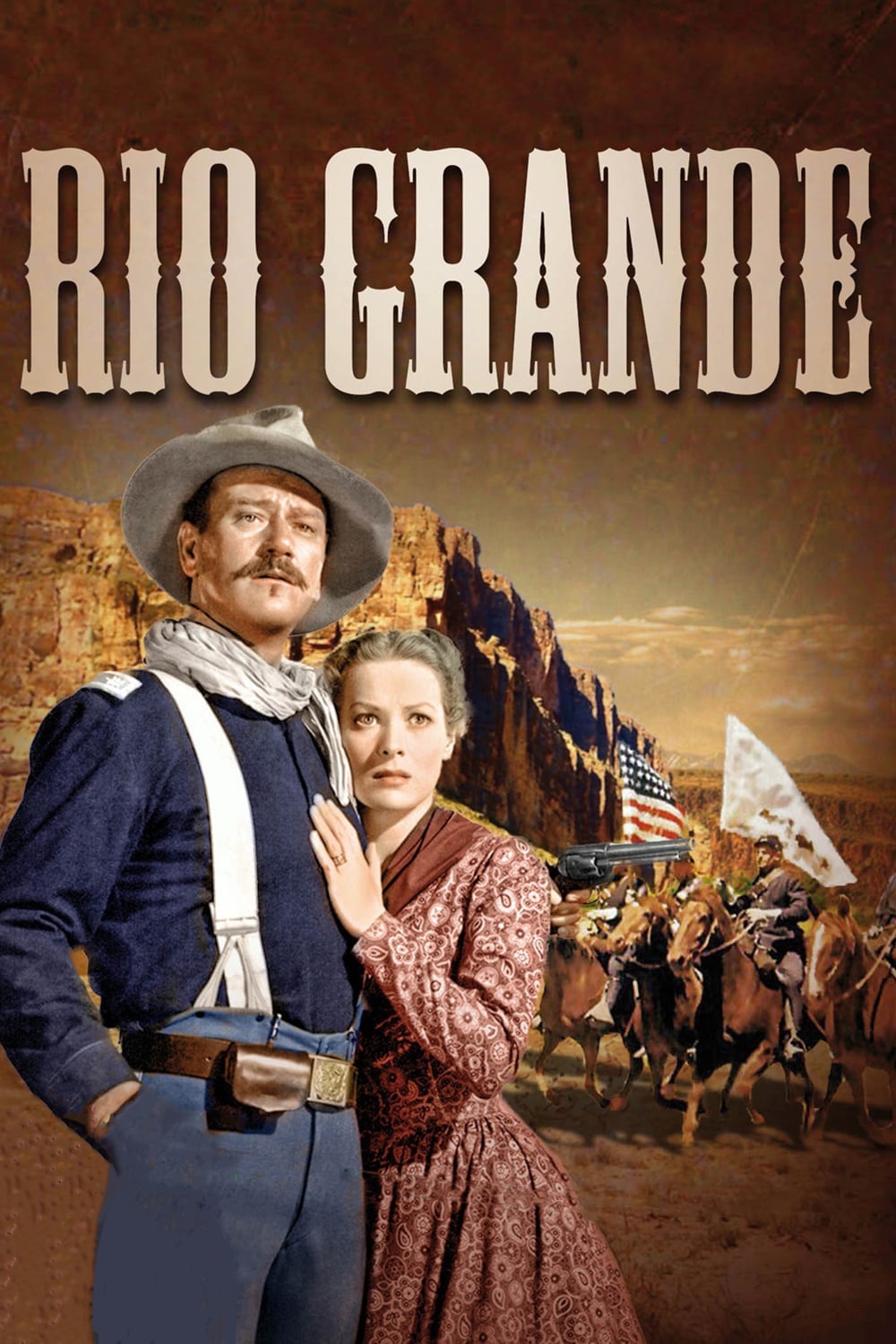
Poster from TMDB
OverviewAI-generated
Rio Grande is a 1950 American Western and war film directed by John Ford, produced by Merian C. Cooper, and written by James Kevin McGuinness. Its cast includes John Wayne, Maureen O'Hara, Ben Johnson, and Claude Jarman Jr., with cinematography by Bert Glennon and Archie Stout, editing by Jack Murray, costumes by Adele Palmer, and a score by Victor Young. Set in Texas and filmed in black-and-white in Utah, it was produced by Republic Pictures and Argosy Pictures and runs 105 minutes.
Synthesized by Vinony from 36 facts across 3 sources: Wikidata, TMDb, IMDb. Generated from structured data (not the Wikipedia text) and checked against those facts — may still contain errors.
Film · TMDB
6.8Lt. Col. Kirby Yorke is posted on the Texas frontier to defend settlers against depredations of marauding Apaches. Col. Yorke is under considerable stress by a serious shortage of troops of his command. Tension is added when Yorke's son (whom he hasn't seen in fifteen years), Trooper Jeff Yorke, is one of 18 recruits sent to the regiment.
Cast
- John Wayne as Lt. Col. Kirby Yorke
- Maureen O'Hara as Mrs. Kathleen Yorke
- Ben Johnson as Trooper Travis Tyree
- Claude Jarman Jr. as Trooper Jefferson 'Jeff' Yorke
- Harry Carey, Jr. as Trooper Daniel 'Sandy' Boone
- Chill Wills as Dr. Wilkins
Themes
- texas
- settler
- apache nation
- usa–mexico border
- black and white
- father son relationship
This product uses the TMDB API but is not endorsed or certified by TMDB.
Key facts
- Directed by
- John Ford
- Screenplay by
- James Kevin McGuinness
- Based on
- Mission With No Record , 1947 story The Saturday Evening Post , by James Warner Bellah
- Produced by
- Uncredited: , Merian C. Cooper , John Ford
- Starring
- John Wayne Maureen O'Hara Ben Johnson Claude Jarman Jr. Harry Carey Jr. Chill Wills J. Carrol Naish Victor McLaglenn Grant Withers Sons of the Pioneers
- Cinematography
- Bert Glennon
- Edited by
- Jack Murray
- Music by
- Victor Young
- Production companies
- Republic Pictures Argosy Pictures
- Distributed by
- Republic Pictures
- Release date
- November 15, 1950 ( 1950-11-15 )
- Running time
- 105 minutes
- Country
- United States
- Language
- English
- Budget
- $1,214,899 or $1,511,043
- Box office
- $2.25 million (US rentals)
via Wikipedia infobox
Wikidata facts
- Instance of
- film
- Genre
- war film
- Country of origin
- United States
- Original language
- English language
- Director
- John Ford
- Screenwriter
- James Kevin McGuinness
- Cast member
- Peter J. Ortiz
- Composer
- Victor Young
- Producer
- Merian C. Cooper
- Production company
- Republic Pictures
- Cinematographer
- Archie Stout
- Narrative location
- Texas
- Filming location
- Utah
- Duration
- 103
- FilmAffinity ID
- 137454
- Distribution format
- video on demand
- Image
- Rio Grande (1950) trailer 1.jpg
Show 8 more facts
- Commons category
- Rio Grande (film)
- publication date
- 1950-01-01
- title
- Rio Grande
- distributed by
- Netflix
- color
- black-and-white
- costume designer
- Adele Palmer
- film editor
- Jack Murray
- review score
- 7.0/10
Sources (10)
via Wikidata · CC0
~21 min read
Encyclopedic overview
Rio Grande is a 1950 American romantic Western film directed by John Ford and starring John Wayne and Maureen O'Hara. It is the third installment of Ford's "Cavalry Trilogy", following two RKO Pictures releases: Fort Apache (1948) and She Wore a Yellow Ribbon (1949). Wayne plays the lead in all three films, as Captain Kirby York in Fort Apache, then as Captain Nathan Brittles in She Wore a Yellow Ribbon, and finally as a promoted Lieutenant Colonel Kirby Yorke in Rio Grande. Rio Grande's supporting cast features Ben Johnson, Claude Jarman Jr., Harry Carey Jr., Chill Wills, J. Carrol Naish, Victor McLaglen, Grant Withers, the Western singing group the Sons of the Pioneers and Stan Jones.
Wayne, O'Hara and McLaglen While originally Ford was uninterested in directing another Western, his studio wouldn't permit him to start The Quiet Man until he directed Rio Grande. The script was based on a short story by James Warner Bellah, which was inspired by historical events. The film was shot in only 32 days in Monument Valley, Utah. After its release, it made a modest profit, with reviewers praising the music and the action, but noting that the themes were well-worn. Later reviews praised the natural beauty of the shooting location, but were mixed about its efficacy. The film can be read as anticipating the frustration with international borders the US military would experience in the Vietnam War, with the solution to ignore international borders reflecting the conservative politics of Bellah and scriptwriter James Kevin McGuinness. The film is one of the least sympathetic of Ford's Westerns to Native Americans, depicting them as bloodthirsty and villainous. In contrast to its one-sided portrayal of Native Americans, its treatment of the reconciliation of an estranged couple and their son is emotionally complex. Rio Grande also addresses issues of class, showing a rejection of class privilege common in Ford's work.
Excerpted from Wikipedia’s “Rio Grande” article, available under the CC BY-SA 4.0 licence.