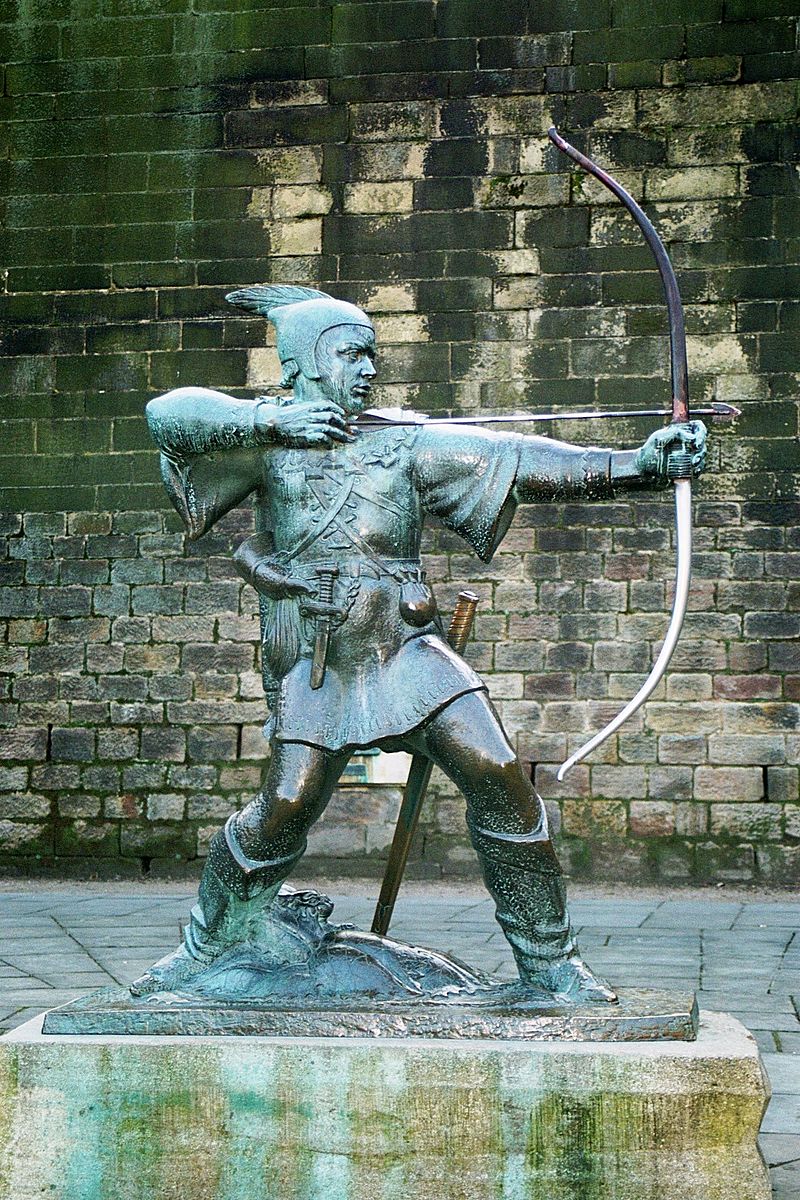
File:Robin_Hood_Memorial.jpg · Wikimedia Commons · See Wikimedia Commons
Robin Hood
Sign in to saveAlso known as Robyn Hode, Robyn Hod, Robin of Sherwood, Robin of Loxley, Robin of Locksley, Robert Fitzooth, Robin de Courtenay, Robert Hode
heroic outlaw in English folklore, a highly skilled archer and swordsman
Robin Hood is a legendary outlaw from English folklore known for his exceptional skills with a bow and sword. He remains culturally significant as a classic figure of adventure and rebellion in storytelling traditions.
AI-generated from the Wikipedia summary — may contain errors.
Wikidata facts
- Given name
- Robin
- Gender
- male
- Citizenship
- Kingdom of England
- Spouse
- Maid Marian
- Country of origin
- England
- Creator
- anonymous
- Performer
- Tom Ellis
- Image
- Robin shoots with sir Guy by Louis Rhead 1912.png
Show 8 more facts
- inception
- 1370-00-00
- character type
- swashbuckler
- Commons category
- Robin Hood
- Commons gallery
- Robin Hood
- unmarried partner
- Maid Marian
- name in native language
- Robin Hood
- social classification
- outlaw
- enemy
- Guy of Gisbourne
Sources (8)
via Wikidata · CC0
~40 min read
Encyclopedic overview
15th-century print of Robin Hood on horseback Robin Hood is a legendary heroic outlaw originally depicted in English folklore and subsequently featured in literature, theatre, and cinema. According to legend, he was a highly skilled archer and swordsman. In some versions of the legend, he is depicted as being of noble birth, and in modern retellings he is sometimes depicted as having fought in the Crusades before returning to England to find his lands taken by the Sheriff of Nottingham. In the oldest known versions, he is instead a member of the yeoman class. He is traditionally depicted dressed in Lincoln green. Today, he is most closely associated with his stance of "robbing the rich to give to the poor".
Through retellings, additions, and variations, a body of familiar characters associated with Robin Hood has been created. These include his lover, Maid Marian; his band of outlaws, the Merry Men; and his chief opponent, the Sheriff of Nottingham. The Sheriff is often depicted as assisting Prince John in usurping the rightful but absent King Richard, to whom Robin Hood remains loyal. He became a popular folk figure in the Late Middle Ages, and his partisanship of the common people and opposition to the Sheriff are some of the earliest-recorded features of the legend, whereas his political interests and setting during the Angevin era developed in later centuries. The earliest known ballads featuring him are from the 15th century.
Excerpted from Wikipedia’s “Robin Hood” article, available under the CC BY-SA 4.0 licence.
Gallery (12)
Available in 90 languages
- Español
- Français
- Deutsch
- 中文
- 日本語
- Русский
- Português
- Italiano
- العربية
- हिन्दी
- Albanian
- Amharic
- Armenian
- Azerbaijani
- Bahasa Indonesia
- Balinese
- Bangla
- Basque
Show 71 more
- be_x_old
- Belarusian
- Betawi
- Bosnian
- Breton
- Bulgarian
- Burmese
- Catalan
- Cebuano
- Central Kurdish
- Croatian
- Czech
- Danish
- Egyptian Arabic
- Esperanto
- Estonian
- Faroese
- Filipino
- Finnish
- Galician
- Georgian
- Greek
- Hebrew
- Hungarian
- Icelandic
- Ido
- Irish
- Javanese
- Kazakh
- Latin
- Latvian
- Lithuanian
- Macedonian
- Malay
- Malayalam
- Mazanderani
- Mongolian
- Nederlands
- Nepali
- Norwegian
- Norwegian Nynorsk
- Pashto
- Polski
- Punjabi
- Romanian
- Serbian
- Serbian (Latin)
- Silesian
- simple
- Sinhala
- Slovak
- Svenska
- szy
- Tamil
- Tatar
- Tiếng Việt
- Türkçe
- Ukrainian
- Urdu
- Uzbek
- Venetian
- Waray
- Welsh
- Western Mari
- Western Panjabi
- Wu Chinese
- zh_classical
- zh_yue
- فارسی
- ไทย
- 한국어
via Wikidata sitelinks · CC0