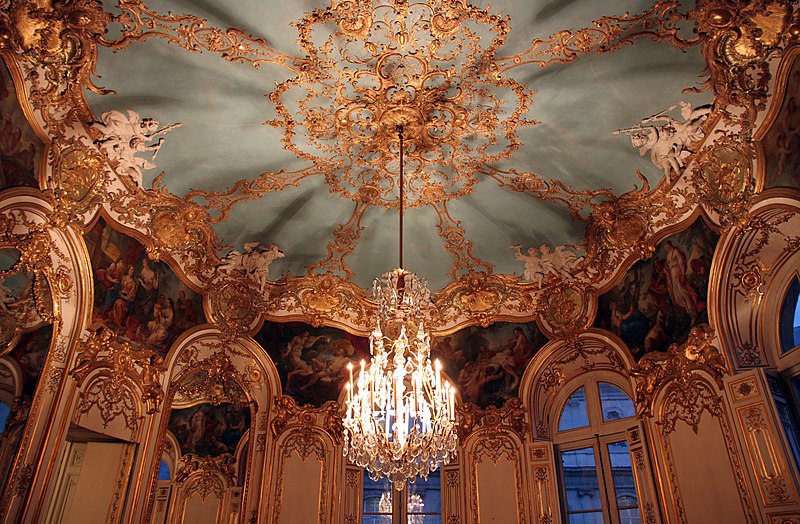
File:Salon_de_la_princesse_hotel_de_soubise.jpg · Wikimedia Commons · See Wikimedia Commons
Rokoko
Sign in to saveEpoche der europäischen Kunst (ca. 1720–1780)
Rococo is an ornamental style of architecture, art, and decoration that emerged in the late Baroque period, characterized by asymmetrical designs, curved forms, gilding, pastel colors, and decorative elements meant to create surprise and visual drama. It matters as a significant artistic movement that represents the final and most elaborate expression of the Baroque era.
AI-generated from the Wikipedia summary — may contain errors.
Key facts
- Art movement.caption
- Ballroom ceiling of the Ca Rezzonico in Venice with illusionistic quadratura painting by Giovanni Battista Crosato (1753); Chest of drawers by Charles Cressent (1730); Kaisersaal of Würzburg Residence by Balthasar Neumann (1749–1751)
- Art movement.yearsactive
- 1730s to 1760s
- Art movement.country
- France, Italy, Central Europe
- Art movement.commons
- yes
- Art movement.name
- Rococo
via Wikipedia infobox
Wikidata facts
- Field of work
- costume
- Image
- JAMeissonnierTable.jpg
Show 12 more facts
- described by source
- Encyclopædia Britannica 11th edition
- Commons category
- Rococo art
- topic's main category
- Category:Rococo art
- Commons gallery
- Rococo
- OpenStreetMap tag
- building:architecture=rococo
- manner of
- color
- on focus list of Wikimedia project
- Wikipedia:Vital articles/Level/4
- start time
- 1730-00-00
- end time
- 1780-00-00
- subject named as
- Rokoko
- influenced by
- Classicism
- significant person
- François Boucher
via Wikidata · CC0
Article · Deutsch
Das Rokoko ist eine Stilrichtung der europäischen Kunst von etwa 1730 bis etwa 1780 und entwickelte sich aus dem Régence, das im Spätbarock (ca. 1700–1720) ankert. Ausgangspunkt ist Frankreich. Der Name entstammt dem französischen Wort Rocaille (Muschelwerk) und bezeichnet ein immer wieder auftretendes Ornamentmotiv, das sich durch Asymmetrie von barocken Formen unterscheidet. Der Begriff Rokoko wurde 1797 von dem Maler Pierre Maurice Quays geprägt. Das Rokoko wurde ungefähr ab ca. 1770 langsam vom Klassizismus abgelöst. Einen Übergangsstil nennt man im Deutschen Zopfstil.
Abstract from DBpedia / Wikipedia · CC BY-SA
Gallery (22)
Available in 80 languages
- Español
- Français
- Deutsch
- 中文
- 日本語
- Русский
- Português
- Italiano
- العربية
- Afrikaans
- Albanian
- Armenian
- Arpitan
- Asturian
- Azerbaijani
- Bahasa Indonesia
- Basque
- be_x_old
Show 61 more
- Belarusian
- Bosnian
- Bulgarian
- Catalan
- Chuvash
- Croatian
- Czech
- Danish
- Egyptian Arabic
- Esperanto
- Estonian
- Filipino
- Finnish
- Galician
- Georgian
- Goan Konkani
- Greek
- Hebrew
- Hungarian
- hyw
- Icelandic
- Ido
- Irish
- Javanese
- Kazakh
- Kyrgyz
- Latgalian
- Latin
- Latvian
- Limburgish
- Lithuanian
- Luxembourgish
- Macedonian
- nds_nl
- Nederlands
- Norwegian
- Norwegian Nynorsk
- Occitan
- Pashto
- Polski
- Punjabi
- Romanian
- Saterland Frisian
- Serbian
- Serbian (Latin)
- simple
- Slovak
- Slovenian
- Svenska
- Tiếng Việt
- Türkçe
- Ukrainian
- Walloon
- Waray
- Western Frisian
- Western Panjabi
- Wu Chinese
- zh_yue
- فارسی
- ไทย
- 한국어
via Wikidata sitelinks · CC0