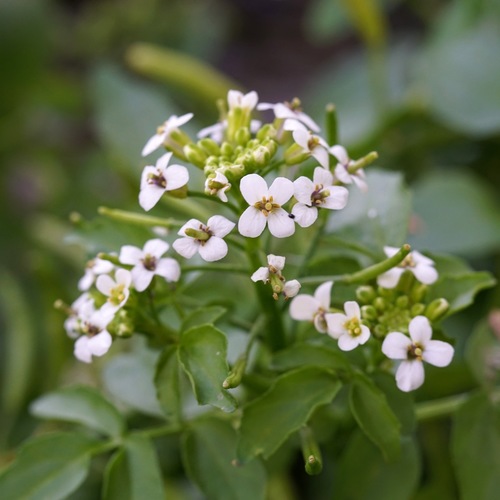
(c) Andrew Tree, some rights reserved (CC BY), uploaded by Andrew Tree · cc-by
Rorippa
Sign in to saveAlso known as yellowcress
Rorippa is a globally distributed genus in the family Brassicaceae, with species occurring on all continents except for Antarctica. Rorippa species are natively distributed in the Northern Hemisphere through Eurasia and North America, and dispersed into the Southern Hemisphere through long-distance dispersal. Rorippa species are annual to perennial herbs, usually with yellow flowers and a peppery flavour. They are known commonly as yellowcresses.
Species
watercress
GENUS
- KingdomPlantae
- PhylumTracheophyta
- ClassMagnoliopsida
- OrderBrassicales
- FamilyBrassicaceae
Der Titel dieses Artikels ist mehrdeutig. Eine Beschreibung des botanischen Begriffs befindet sich unter Embryo (Botanik) Radicula ist eine Gattung gehäusetragender, meeresbewohnender Einzeller aus der Gruppe der Foraminiferen.
via GBIF · Kew POWO
Museum specimens
- Specimen records
- 2,931
- With media
- 2,019
- Family
- Brassicaceae
- Collections
- UNIVERSITY OF ALBERTA MUSEUMS, GH, IIB-UV, INECOL, FCF-UANL, TENN
- Recorded in
- Canada, United States, Mexico, Papua New Guinea
Research
100 papers- The complete plastome of Rorippa palustris Besser 1821 and its phylogenetic analysis.Mitochondrial DNA. Part B, Resources · 2024
- Extreme flooding tolerance in Rorippa.Plant signaling & behavior · 2014
- Root transcript profiling of two Rorippa species reveals gene clusters associated with extreme submergence tolerance.Plant physiology · 2013
- Anti-Inflammatory and Antiatopic Effects of Rorippa cantoniensis (Lour.) Ohwi in RAW 264.7 and HaCaT Cells.Molecules (Basel, Switzerland) · 2023
- Different flooding responses in Rorippa amphibia and Rorippa sylvestris, and their modes of expression in F1 hybrids.The New phytologist · 2008
via PubMed
Wikidata facts
- Instance of
- taxon
- Parent taxon
- Cardamineae
- Image
- Nasturtium amphibium Rob. Brown - Flora regni Borussici vol. 9 - t. 625.png
Show 8 more facts
- taxon common name
- 蔊菜属
- Commons category
- Rorippa
- taxon rank
- genus
- taxon name
- Rorippa
- topic's main category
- Category:Rorippa
- has fruit type
- silicle
- different from
- Rzepicha
Sources (3)
via Wikidata · CC0
~9 min read
Encyclopedic overview
6 sectionsContents
- Description
- Ecology
- Example
- List of species
- References
- External links
Rorippa is a globally distributed genus in the family Brassicaceae, with species occurring on all continents except for Antarctica. Rorippa species are natively distributed in the Northern Hemisphere through Eurasia and North America, and dispersed into the Southern Hemisphere through long-distance dispersal. Rorippa species are annual to perennial herbs, usually with yellow flowers and a peppery flavour. They are known commonly as yellowcresses.
== Description == As a close relative of Arabidopsis, Rorippa has emerged as a group of valuable model organisms for investigating various biological processes. Researchers have utilized Rorippa to study developmental phenomena such as heterophylly, weediness, and vegetative regeneration. For example, heterophylly is the ability of plants to produce different leaf forms in response to contrasting environments, such as aerial or submerged conditions. This may incur anatomical or physiological changes and facilitate adaptation to the amphibious lifestyle in Rorippa,
Excerpted from Wikipedia’s “Rorippa” article, available under the CC BY-SA 4.0 licence.