
File:Rosa_Bonheur_agee.jpg · Wikimedia Commons · See Wikimedia Commons
Rosa Bonheur
Sign in to saveAlso known as Marie Rosalie Bonheur, Rosalie Bonheur, Marie Rosa Bonheur, Marie-Rosalie Bonheur, Rosa Bohneur, M^Telle^R Rosa Bonheur, Bonheur, bonheur r.
French artist (1822-1899)
Key facts
- Born
- Marie-Rosalie Bonheur , ( 1822-03-16 ) 16 March 1822, Bordeaux , France
- Died
- 25 May 1899 (1899-05-25) (aged 77), Thomery , France
- Known for
- Painting, sculpture
- Notable work
- Ploughing in the Nivernais , The Horse Fair
- Movement
- Realism
- Father
- Oscar-Raymond Bonheur
via Wikipedia infobox
Described at
Fait partie d’un numéro thématique : Pouvoirs, puissances : qu'en pensents les femmes? Sous sa forme définitive, Rosa Bonheur, sa vie, son œuvre est divisé en trois grandes parties. Du point de vue formel, la première partie de l'œuvre constitue une biographie classique. Dans une narration écrite à la première personne Anna Klumpke raconte ses premières entrevues avec Rosa Bonheur, la naissance de leur amour, leur décision de vivre ensemble et l'organisation de leur ménage; La troisième partie procède également de la biographie. Après avoir présenté un petit sommaire des opinions de Rosa Bonheur sur les animaux, le féminisme, la religion et l'art, Anna Klumpke raconte leurs précieux mois de bonheur partagé, puis la mort de Rosa Bonheur en mai 1899 et les difficultés afférentes à l'exécution de son testament. La deuxième partie du livre est complètement différente. Comme elle l'explique brièvement (303-4), Anna Klumpke abolit ici l'espace intersubjectif entre la rédactrice et son modèle, distance qui constitue pourtant le fondement du discours biographique ; elle évite soigneusement d'intervenir dans la narration, sauf par quelques petits commentaires en bas de page. A partir de notes copieuses prises au cours de ses conversations avec Rosa Bonheur, elle suscite une voix à la première personne qui raconte sans pauses ni interruptions la vie de Rosa Bonheur, depuis ses premiers souvenirs d'enfance jusqu'à l'été de 1898, date où Anna Klumpke entra dans sa vie. Comme le désirait la signataire du livre, cette deuxième partie crée l'illusion irrésistible d'entendre les mots tombés des lèvres mêmes de Rosa Bonheur. Cette voix est, bien sûr, une création d'Anna Klumpke, un pastiche amoureux des paroles de la défunte. Ici comme dans l'exécution du dernier testament de Rosa Bonheur, Anna Klumpke s'évertua à remplir la mission que son amie lui avait confiée : celle d'être son porte- parole, voire d'incarner sa voix d'outre-tombe (406).
Excerpt from a page describing this subject · 16,506 chars · not written by Vinony
Wikidata facts
- Instance of
- human
- Gender
- female
- Citizenship
- France
- Place of birth
- Bordeaux
- Place of death
- Thomery
- Father
- Raymond Bonheur
- Sibling
- Juliette Bonheur
- Occupation
- head teacher
- Languages spoken
- French
- Native language
- French
- Notable work
- The Horse Fair
- Student of
- Raymond Bonheur
- Genre
- animal art
- Movement
- French Realism
- Image
- André Adolphe-Eugène Disdéri (French - (Rosa Bonheur) - Google Art Project.jpg
- Work location
- Paris
- Significant event
- funeral
Show 19 more facts
- place of burial
- Père Lachaise Cemetery
- Commons category
- Rosa Bonheur
- date of birth
- 1822-03-16
- date of death
- 1899-05-25
- unmarried partner
- Anna Elizabeth Klumpke
- Commons gallery
- Rosa Bonheur
- Commons Creator page
- Rosa Bonheur
- birth name
- Marie-Rosalie Bonheur Juana Maria Maribel
- on focus list of Wikimedia project
- WikiProject LGBTQ+ studies
- has works in the collection
- Van Gogh Museum
- writing language
- French
- sexual orientation
- lesbianism
- catalog code
- 86
- start of work period
- 1835-01-01
- influenced by
- Saint-Simonianism
- significant person
- Buffalo Bill
- described at URL
- www.persee.fr/doc/roman_0048-8593_1994_num_24_85_6229
- end of work period
- 1899-01-01
- topic has template
- Template:Rosa Bonheur
Sources (15)
via Wikidata · CC0
Works in European collections
10 objects attributed to Rosa Bonheur, held across European museums, libraries & archives · via Europeana




~17 min read
Encyclopedic overview
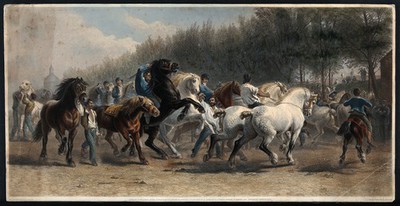
Rosa Bonheur (born Marie-Rosalie Bonheur; 16 March 1822 – 25 May 1899) was a French artist known best as a painter of animals (animalière). She also made sculptures in a realist style. Her paintings include Ploughing in the Nivernais, first exhibited at the Salon of 1849, and now in the Musée d'Orsay in Paris, and The Horse Fair (in French: Le marché aux chevaux), which was exhibited at the Salon of 1853 (finished in 1855) and is now in the Metropolitan Museum of Art in New York City. Bonheur was widely considered to be the most famous female painter of the nineteenth century.
It has been said that Bonheur was openly lesbian, as she lived with her partner Nathalie Micas for over 40 years until Micas's death. After that she lived with American painter Anna Elizabeth Klumpke. However, others assert that nothing supports this speculation.
Excerpted from Wikipedia’s “Rosa Bonheur” article, available under the CC BY-SA 4.0 licence.