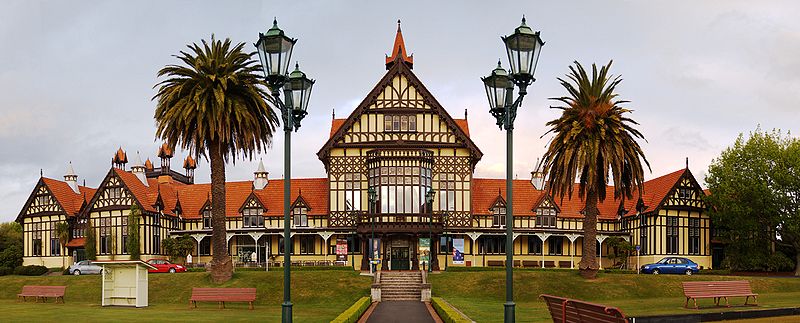
File:Rotorua_museum.jpg · Wikimedia Commons · See Wikimedia Commons
Rotorua
Sign in to saveAlso known as Rotorua, Bay of Plenty, Rotorua, New Zealand
Rotorua () is a city in the Bay of Plenty region of New Zealand's North Island. Situated on the southern shores of Lake Rotorua, from which it takes its name. It is the seat of the Rotorua Lakes District, a territorial authority encompassing Rotorua and several other nearby towns. It has an estimated resident population of , making it the country's 13th largest urban area, and the Bay of Plenty's second-largest urban area behind Tauranga.
OverviewAI-generated
Rotorua is a city in New Zealand, situated in the Bay of Plenty region. It was established in 1883 and has an area of 2,614.9 square kilometers. The city is located next to Lake Rotorua, also known as Te Rotorua nui ā Kahumatamomoe. Its elevation above sea level is recorded as 280 meters in some sources and 287 meters in others.
The population of Rotorua is listed as 58,500 in one dataset and 65,901 in another. The city uses postal codes 3010 and 3015. Rotorua is twinned with Klamath Falls, Beppu, the City of Lake Macquarie, and Wuzhong District. It is described in the Encyclopædia Britannica 11th edition.
Synthesized by Vinony from 44 facts across 7 sources: Wikidata, Openweathermap, OpenStreetMap, GeoNames, Open Meteo, Vinony graph, Geo. Generated from structured data (not the Wikipedia text) and checked against those facts — may still contain errors.
In the Vinony graph
The entry is geolocated on the map in NZ, across 3 mapped points.
Vinony's link graph records 1,707 inbound references to Rotorua, and connects out to The New Zealand Herald, Rotorua Museum and United States.
It sits within the topics Populated places in the Bay of Plenty Region, Populated places on Lake Rotorua and Rotorua.
Vinony links it to 56 Wikipedia language editions.
Weather now
cached 22h ago7-day forecast
via Open-Meteo
Place details
- Locality
- Rotorua
- Region
- Bay of Plenty
- Country
- New Zealand / Aotearoa
- Population
- 65,901
- Timezone
- Pacific/Auckland
via OpenStreetMap · GeoNames
Key facts
- Settlement.name
- Rotorua
- Settlement.nicknames
- Sulphur City, Roto-Vegas
- Settlement.settlement_type
- City
- Settlement.total_type
- Territorial
- Settlement.image_shield
- File:Rotorua Coat of Arms.jpg
- Settlement.pushpin_map
- New Zealand
- Settlement.pushpin_label_position
- bottom
- Settlement.subdivision_type
- Country
- Settlement.subdivision_name
- New Zealand
- Settlement.subdivision_type1
- Region
- Settlement.subdivision_name1
- Bay of Plenty
- Settlement.subdivision_type2
- Territorial authority
- Settlement.subdivision_name2
- Rotorua Lakes Council
- Settlement.established_title
- Settled by Māori
- Settlement.established_title1
- Founded
- Settlement.established_title2
- Borough status
- Settlement.established_date2
- 1922
- Settlement.established_title3
- City status
via Wikipedia infobox
Wikidata facts
- Instance of
- city
- Official name
- Rotorua
- Country
- New Zealand
- Population
- 58500
- Area
- 2614.9
- Elevation
- 280
- Body of water
- Lake Rotorua / Te Rotorua nui ā Kahumatamomoe
- Official website
- www.rotoruanz.com
- Image
- Rotorua from gondola.jpg
Show 11 more facts
- twinned administrative body
- Wuzhong District
- Commons category
- Rotorua
- topic's main category
- Category:Rotorua
- category for people born here
- Category:Births in Rotorua
- category of associated people
- Category:People from Rotorua
- different from
- Rotorua
- inception
- 1883-00-00
- postal code
- 3015
- described by source
- Encyclopædia Britannica 11th edition
Sources (6)
via Wikidata · CC0
Travel guide
Understand
The name Rotorua comes from the Māori language and means "two lakes" or "second lake" (roto = lake, rua = two). Its full name is Te Rotorua-nui-a-Kahumatamomoe, meaning "the second great lake of Kahumatamomoe". The city sits on the southern shores of Lake Rotorua, and there are several other lakes nearby. So along with the geothermal wonders, many water-based activities such as fishing, boating and white water rafting are available.
Rotorua is built over a geothermal hot spot. There are numerous natural vents, hot pools and other geothermal features in and around the city. Many of these are in parks and reserves. Natural eruptions of steam, hot water and mud occasionally occur in new locations. Many places have their own private geothermal bores for heating and water for bathing although the private use of naturally occurring geothermal water and steam is controlled.
Geologically, Rotorua is in the middle of the Taupo Volcanic Zone, named after Lake Taupo, the largest volcano in the area. This geologically active zone produces the heat that is needed to drive all the geothermal activity. Along with many volcanic hills and mountains, the zone contains several major volcanic calderas (large subsidence craters). These are important for tourism because they host the region's largest lakes (including Lake Taupo and Lake Rotorua), and because geothermal activity tends to occur around their edges. Rotorua caldera, some 22 km (14 mi) across, contains the city and Mount Ngongotahā a…
See
As one of New Zealand's busiest tourist centres there are a variety of attractions ranging from free to more expensive.
Do
Your best bet is to expend some energy taking in some of the many day-time activities such as land-sledding down Mt Ngongotahā at Skyline Skyrides Luge Ride, heli-touring or hiking through the abundance of parks often alongside thermal vents. Nearby is the curious forest of California Redwoods that was planted last century and has thrived in the ideal climate so that it appears to have been there for many centuries. The forest in this area has been developed to provide world-class mountain biking tracks, some of which were used for the 2006 World Championships. Rotorua hosts several other adventure activities such as ZORB, indoor rock-climbing and whitewater rafting or sledging.
One activity that is unique is the ability to play a round of golf amongst the mud pools. The Rotorua golf course has a public course where you can play 9 holes and attempt to avoid the mud pool hazards, a unique experience. The course is at the top of Fenton Street opposite Te Puia, the Māori Arts and Craft Institute.
Rafting. The Kaituna river might not be the biggest and wildest river in New Zealand, but it certainly offers a great opportunity for filling a morning or afternoon with adrenaline and fun: by going rafting, with world's highest commercially rafted waterfall (7 m / 23 ft) being the major draw. In summer, the lush jungle alongside the banks is most beautiful, and as the weather can get hot, a dip in the cool river (voluntarily or not) is often welcome. Rafting trips take around 2 ½ ho…
Buy
There are numerous Māori arts and crafts on sale in the city centre and at the various tourist attractions. The quality varies from extremely professional contemporary artwork to cheap nick-nacks. Popular items include pounamu/greenstone (jade) or bone jewellery, traditional weapons and statues. This selection is accompanied by sheepskins and the normal tourist giftware of t-shirts, caps, mugs and pens plastered with "Rotorua", other words and pictures. More attractive and practical gifts can be found such as simple clothing (jackets, shirts, ties, caps) with abstract Maori designs on them.
Eat
There are numerous places to try the traditional Māori feast, the hangi. This "earthen oven" technique is similar to the Hawaiian umu and results in a very distinctive smoky, earthy flavour - well worth trying. Due to Rotorua's geothermally active ground, the local Maori tribes often make use of the geothermal heat for their hangi, instead of burying the food with heated rocks as is the standard practice elsewhere.
Rotorua has some nice cafes - good options include: Woollen Mill Cafe at Agrodome, Capers, Zippy's or Fat Dog. The usual chains for pizzas and burgers can be found: they're generally on Amohau Street (SH 30A in the central city) and on Fairy Springs Road (SH 5 heading north out of the city).
Restaurants are slightly more scarce but several of the major hotels have good eating establishments (Novotel or Ridges on the raceway). The main centre for eating is the end of Tutanekai Street nearest the lake (known as Eat Street), but beware, even after 9PM you may find little left on the menu. Popular restaurants on Tutanekai Street include: Triple 1 Five, Indian Star, Wild Rice, Ambrosia and Atticus Finch.
Drink
Rotorua is sometimes referred to as Roto-Vegas because of the many neon-lit hotels along the main street, the numerous venues for gambling and the few brothels. Strangely though, there isn't much nightlife to speak of. The Lava Bar is a good bet, alternatively try the Pig & Whistle or the Fat Dog Cafe. Heaven & Hell is the only nightclub in Rotorua and is popular with local adults.
Sleep
There are many hotels, rental homes, backpackers, motor homes, camp grounds, motels and bed and breakfasts around Rotorua.
Stay safe
This geothermal wonderland has some hazards. Respect safety signs and barriers around active geothermal locations - they are there for good reasons. The hot water and mud from geothermal springs can be boiling hot. Superheated steam may cause eruptions - after all it is steam that makes the geysers spout.
The sulphurous smell (that rotten eggs smell) in the air means that some toxic gases may also be present. Take care in confined and unventilated spaces, particularly those below ground level or around geothermal pools. Toxic geothermal gases have been known to asphyxiate people.
Avoid bathing in geothermal pools where the water has been in contact with the ground. At the very least do not put your head underwater. Geothermal ground water can carry the bacteria and/or amoebae that cause meningitis - a disease which can be fatal. If you develop flu-like symptoms after coming into contact with geothermal water, immediately contact a doctor.
While New Zealand is a tourist paradise it should be remembered that as with most countries petty theft is a common occurrence, and Rotorua is said to have a higher rate of petty crime than some other areas. With so many of Rotorua's thermal wonders being in isolated areas it pays to take notice of the warning signs and to keep cars locked with valuables hidden from view so as not to have your visit ruined by petty opportunistic crime. In particular Kuirau Park after dark and Okere Falls are well known for car thefts and muggings. Expensi…
Go next
Heading south from Rotorua on SH 5 takes you to Taupo, a similar town on the side of New Zealand's largest lake, and Tongariro National Park. Around 15 km south of Rotorua, SH 38 branches off to the southeast, leading into the sparsely populated and ruggedly beautiful Urewera National Park.
Heading east on SH 30 leads you to Whakatane, a coastal town in the eastern Bay of Plenty with empty beaches and one of the North Island's sunniest climates. Beyond lies the remote East Cape.
North takes you to Te Puke, Tauranga and the western Bay of Plenty coastline, also a nice place to soak up the sun. There are two routes; via Te Puke and SH 33 brings you into Tauranga via Mount Maunganui. The SH 36 is a shorter inland route that climbs to around 610 m (2000 ft) before dropping to the coast. This is the route most locals would use and avoids Tauranga CBD traffic if heading for the Coromandel.
The Waikato region, including Hamilton, Waitomo and Raglan, lies to the west.
Travel guide from Wikivoyage (CC BY-SA 4.0)
~25 min read
Encyclopedic overview
38 sectionsContents
- Toponymy
- History
- Geography
- Setting
- Climate
- Lakes
- Suburbs
- Demography
- Ethnic group
- Languages
- Religion
- Education
- Government
- Local
- National
- Economy
- Geothermal attractions
- Other attractions
- Te Puia
- Lakeland Queen
- Wingspan National Bird of Prey Centre
- Sport and outdoor activities
- Transport
- Road
- Bus
- History
- Air
- Rail
- Education
- Tertiary
- Secondary
- Kura Kaupapa Māori (Māori language immersion schools)
- Media
- Sister cities
- Notable people
- Notes
- References
- External links
Rotorua () is a city in the Bay of Plenty region of New Zealand's North Island. Situated on the southern shores of Lake Rotorua, from which it takes its name. It is the seat of the Rotorua Lakes District, a territorial authority encompassing Rotorua and several other nearby towns. It has an estimated resident population of , making it the country's 13th largest urban area, and the Bay of Plenty's second-largest urban area behind Tauranga.
Te Arawa Māori first settled in Rotorua in the 14th century, and a thriving pā was established at Ohinemutu by the people who would become Ngāti Whakaue. The city became closely associated with conflict during the Musket Wars of the 1820s. Ohinemutu was invaded by a Ngāpuhi-led coalition in 1823, commanded by Hongi Hika and Pōmare I. In the 19th century early European settlers had an interest in developing Rotorua, due to its unique geothermal activity and the surrounding area. Then, efforts by Māori and Europeans alike to establish Rotorua as a spa town led to a 99-year lease of land from Ngāti Whakaue to the Government. The city became a major site of tourism due to the Rotorua's close proximity to the Pink and White Terraces, until they were destroyed by the 1886 eruption of Mount Tarawera. Rotorua was elevated to borough status in 1922 and to city status 40 years later.
Excerpted from Wikipedia’s “Rotorua” article, available under the CC BY-SA 4.0 licence.
Gallery (34)
On the map
3 mapped locations