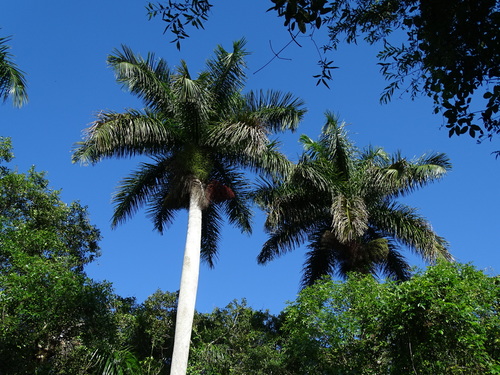
(c) Bruce Holst, some rights reserved (CC BY-NC), uploaded by Bruce Holst · cc-by-nc
Roystonea regia
Sign in to saveAlso known as Cuban royal palm, Florida royal palm, Royal palm
species of plant
OverviewAI-generated
Roystonea regia, commonly known as the Cuban Royal Palm or Royal Palm, is a species of plant in the family Arecaceae. It belongs to the genus Roystonea and is classified within the order Arecales, class Liliopsida, and phylum Tracheophyta. The taxon was described by (Kunth) O. F. Cook.
The species has a native range that includes the Bahamas, Belize, the Cayman Islands, Cuba, the Dominican Republic, Florida, Haiti, Honduras, and parts of Mexico. It has also been introduced to Assam, El Salvador, the Leeward Islands, Panama, Puerto Rico, and Trinidad and Tobago. Additionally, records indicate its presence in Fujian and Guangdong.
Roystonea regia is listed as Least Concern on the IUCN Red List, a status assigned in 2021. The plant produces white flowers and has uses as fodder.
Synthesized by Vinony from 50 facts across 9 sources: Wikidata, GBIF, iNaturalist, Gbif Occ, IUCN Red List, Plants of the World, iDigBio, WoRMS, Vinony graph. Generated from structured data (not the Wikipedia text) and checked against those facts — may still contain errors.
Species
Least ConcernCuban royal palm
SPECIES
- KingdomPlantae
- PhylumTracheophyta
- ClassLiliopsida
- OrderArecales
- FamilyArecaceae
Königspalme Herabgefallenes Blatt der Roystonea regia Die Königspalme (Roystonea regia) ist eine in der Karibik heimische Pflanzenart aus der Familie der Palmengewächse (Arecaceae). Sie ist in tropischen und subtropischen Gebieten eine weit verbreitete Zierpflanze.
via GBIF · IUCN · Kew POWO
Museum specimens
- Specimen records
- 263
- With media
- 141
- Family
- Arecaceae
- Collections
- CICY, CIHS-UAC, CCBA-FMVZ-UADY, INECOL, IBUNAM
- Recorded in
- Mexico
Wikidata facts
Show 12 more facts
- taxon rank
- species
- taxon name
- Roystonea regia
- Commons category
- Roystonea regia
- Commons gallery
- Roystonea regia
- taxon common name
- 大王椰
- flower color
- white
- IUCN conservation status
- Least Concern
- short name
- R. regia
- taxon author citation
- (Kunth) O. F. Cook
- taxon range
- Cuba
- external data available at URL
- www.gbif.org/dataset/d51a552b-0d2c-4788-a5c9-824b552abbf1
Sources (3)
via Wikidata · CC0
~11 min read
Encyclopedic overview
Roystonea regia, commonly known as the royal palm, Cuban royal palm, or Florida royal palm, is a species of palm native to Mexico, the Caribbean, Florida, and parts of Central America. A large and attractive palm, it has been planted throughout the tropics and subtropics as an ornamental tree. Although it is sometimes called R. elata, the conserved name R. regia is now the correct name for the species. The royal palm reaches heights from 15–24 m (50–80 ft) tall. Populations in Cuba and Florida were long seen as separate species, but are now considered a single species.
Widely planted as an ornamental, R. regia is also used for thatch, construction timber, and in some forms of traditional medicine. The fruit is eaten by birds and bats (which disperse the seeds) and fed to livestock. Its flowers are visited by birds and bats, and it serves as a roosting site and food source for a variety of animals. Roystonea regia is the national tree of Cuba, and has a religious role both in Santería and Christianity, where it is used in Palm Sunday observances.
Excerpted from Wikipedia’s “Roystonea regia” article, available under the CC BY-SA 4.0 licence.