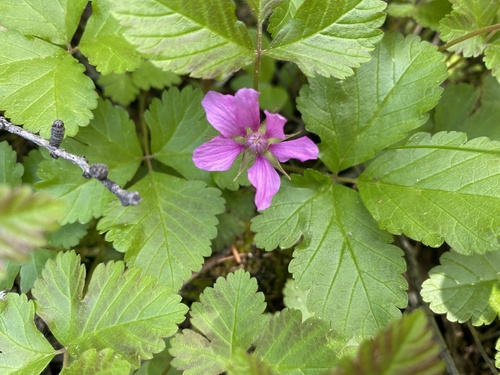
(c) jcarisalyn, some rights reserved (CC BY-NC) · cc-by-nc
OverviewAI-generated
Rubus arcticus is a species of plant in the family Rosaceae, belonging to the genus Rubus. It is classified within the order Rosales, class Magnoliopsida, and phylum Tracheophyta. The species is commonly known as arctic blackberry, arctic raspberry, and llwyn mwyar yr Arctig.
The taxon range for Rubus arcticus is listed as China, though records from Canada are held by institutions such as the University of Alberta Museums. The species has a medicinal plant use. According to the IUCN Red List, its conservation status was assessed as Least Concern in 2016.
Synthesized by Vinony from 36 facts across 8 sources: Wikidata, GBIF, iNaturalist, Gbif Occ, IUCN Red List, Plants of the World, iDigBio, Vinony graph. Generated from structured data (not the Wikipedia text) and checked against those facts — may still contain errors.
Species
Least ConcernArctic raspberry
SPECIES
- KingdomPlantae
- PhylumTracheophyta
- ClassMagnoliopsida
- OrderRosales
- FamilyRosaceae
Herbs dwarf, 10–30 cm tall. Roots creeping, nearly woody. Stems greenish or greenish brown, slender, pilose, unbranched or branched. Leaves compound, 3-foliolate; petiole longer, pilose, petiolule of terminal leaflet to 0.5 cm; lateral leaflets subsessile; stipules free, ovate or oblong, 5–7 × 3–5 mm, herbaceous, pubescent, margin entire, apex acute or obtuse; blade of leaflets rhombic to obovate-rhombic, terminal leaflet 3–5 cm, slightly longer than lateral leaflets, abaxially pilose, adaxially subglabrous, base narrowly cuneate, margin irregularly sharply serrulate or doubly serrate, sometimes shallowly incised, apex acute or obtuse. Inflorescences usually terminal, 1–2 cm in diam., usually 1-flowered, sometimes flowers 1 or 2 in leaf axils, bisexual or incompletely unisexual. Pedicel 2–4 cm, pubescent. Calyx turbinate, abaxially pubescent; tube cupular; sepals 5–10, ovate-lanceolate to narrowly lanceolate, 5–8 × 2–3 mm, apex acuminate. Petals purplish red, broadly obovate, rarely oblong or spatulate, 0.8–1.2 cm × 6–8 mm, base clawed, sometimes apically emarginate. Stamens erect, shorter than petals; filaments linear, inflated basally. Pistils 20, glabrous or pilose abaxially, sh
via GBIF · IUCN · Kew POWO
Museum specimens
- Specimen records
- 3,400
- With media
- 2,231
- Family
- Rosaceae
- Collections
- UNIVERSITY OF ALBERTA MUSEUMS
- Recorded in
- Canada
Wikidata facts
- Instance of
- taxon
- Parent taxon
- Rubus
- Image
- Rubus arcticus.jpg
- Has use
- medicinal plant
Show 9 more facts
- Commons category
- Rubus arcticus
- taxon rank
- species
- taxon name
- Rubus arcticus
- Commons gallery
- Rubus arcticus
- taxon common name
- 北悬钩子
- IUCN conservation status
- Least Concern
- taxon range
- China
- short name
- R. arcticus
Sources (1)
via Wikidata · CC0
~2 min read
Encyclopedic overview
Rubus arcticus, the Arctic bramble or Arctic raspberry, Nagoonberry, or nectarberry is a species of slow-growing bramble belonging to the rose family, found in Arctic and alpine regions in the Northern Hemisphere. It has been used to create hybrid cultivated raspberries, the so-called nectar raspberries.
Description
Excerpted from Wikipedia’s “Rubus arcticus” article, available under the CC BY-SA 4.0 licence.
Gallery (4)
Available in 33 languages
- Español
- Français
- Deutsch
- 中文
- 日本語
- Русский
- Italiano
- Azerbaijani
- Bahasa Indonesia
- Belarusian
- Catalan
- Cebuano
- Esperanto
- Estonian
- Finnish
- Georgian
- Inari Sami
- Lithuanian
Show 14 more
via Wikidata sitelinks · CC0