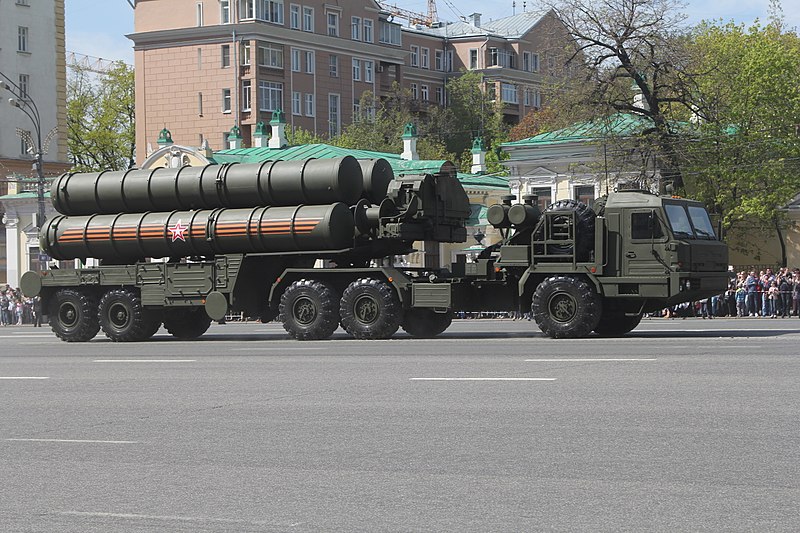
File:С-400_«Триумф».JPG · Wikimedia Commons · See Wikimedia Commons
S-400 Triumf
Sign in to saveAlso known as Triumf, SA-21 Growler, Growler, S-300PMU-3, 40N6, 48N6, 9M96, S-400
Russian developed surface-to-air missile system
The S-400 Triumf is a Russian-made missile system designed to shoot down aircraft, helicopters, and missiles from the ground. It matters because countries around the world want to acquire it for air defense, making it an important factor in international military capabilities and geopolitics.
AI-generated from the Wikipedia summary — may contain errors.
Wikidata facts
- Subclass of
- surface-to-air missile system
- Named after
- Roman triumph
- Operator
- Turkish Armed Forces
- Country of origin
- Russia
- Followed by
- S-500 Prometheus
- Developer
- GSKB Almaz-Antey
- Manufacturer
- Almaz-Antey
- Designed by
- GSKB Almaz-Antey
- Image
- S-400 SAM during the Victory parade 2010.jpg
Show 6 more facts
- Commons category
- S-400 Triumf
- NATO reporting name
- Growler
- guidance system
- command guidance
- service entry
- 2007-04-28
- Commons gallery
- S-400 Triumf
- native label
- С-400
Sources (1)
via Wikidata · CC0
~39 min read
Encyclopedic overview
The S-400 Triumf (Russian: C-400 Триумф – Triumf; translation: Triumph; NATO reporting name: SA-21 Growler), previously known as the S-300 PMU-3, is a mobile surface-to-air missile (SAM) system developed in the 1990s by Russia's NPO Almaz as an upgrade to the S-300 family of missiles. The S-400 was approved for service on 28 April 2007 and the first battalion of the systems assumed combat duty on 6 August 2007. Its longest-ranged interceptor missile, the 40N6, has a purported range of 400 km. The S-400 can be integrated with the shorter-ranged Pantsir missile system, and potentially airborne radars such as of the Beriev A-50U and Sukhoi Su-35S.
The S-400 has been deployed by Russia, including in Belarus and Syria by China since 2018, by Turkey since 2019, and by India since 2021. The S-400 was deployed during Russian intervention in the Syrian civil war from 2015 until the fall of the Assad regime in 2024. China's People's Liberation Army Air Force purchased S-400 systems in 2014, receiving six batteries beginning in 2018, where its range has the potential to affect the Cross-Strait conflict and the Senkaku Islands dispute. The delivery of S-400s to Turkey, which cited US refusal to sell the upgraded MIM-104 Patriot system, trigged Turkey's expulsion from the F-35 fighter aircraft program. Russia has also deployed its own S-400s to Belarus, including from late 2021.
Excerpted from Wikipedia’s “S-400 Triumf” article, available under the CC BY-SA 4.0 licence.