In the Vinony graph
Within Vinony's link graph, Saadia Zahidi is referenced by 6 other articles, and connects out to Harvard University, Geneva Graduate Institute and Urdu.
Vinony files it under 21st-century English people, British women economists and English economists.
Its subject is documented across 7 Wikipedia language editions.
Person · Open Library
- Works
- 1
via Open Library + Wikidata
Described at
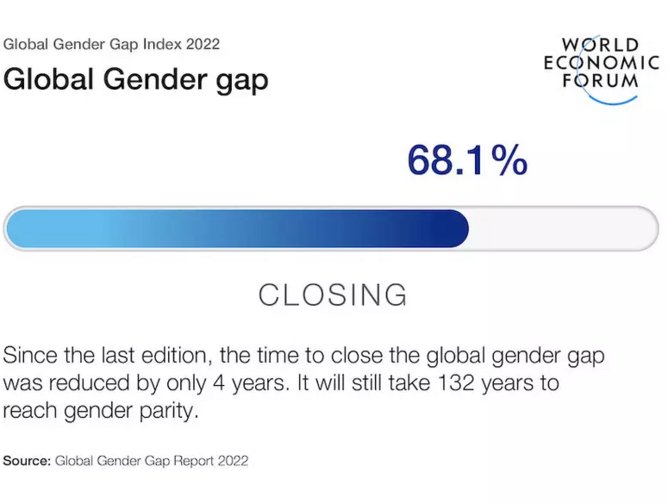
Global Gender Gap Report: Time to parity far too long | Sustainability Magazine
Saadia Zahidi, Managing Director, World Economic Forum and co-author of the report, says more needs to be done across the board to accelerate gender parity
sustainabilitymag.com →The World Economic Forum ’s (WEF) Global Gender Gap Report 2022 finds in 2022 the global gender gap has been closed by 68.1%, meaning it will take another 132 years to reach gender parity. This is three decades longer than the situation in 2020, before COVID-19 impacts on gender equality. Having closed more than 90% of its gender gap (the only country to have done so), Iceland has been named the most gender equal country for the 12th year in a row. Finland follows in second place, Norway (3rd), New Zealand (4th), Sweden (5th), Rwanda (6th), Nicaragua (7th), Namibia (8th), Ireland (9th) and Germany (10th). While the global gender gap has been closed by 68.1%, the report shows the remaining gap is unequal, with regions progressing at different speeds. Zahidi says: “In North America, it will take 59 more years to get to parity at the current rate of change. 60 years when it comes to Europe, 67 years for Latin America, 98 years for Africa, 115 years for the Middle East and North African region, 152 when it comes to central Asia, 168 for East Asia and finally south Asia, nearly 200 years. So things do look very different in different parts of the world. And that regional breakdown also gives you a sense of developing and developed regions.” The rate of progress also varies significantly by sub-index. While more than 90% of the gap has been closed in Educational Attainment and Health and Survival, just 22% has been closed in Political Empowerment, unchanged from 2021. This year's report highlights the gender gaps that remain in leadership by industry. While the share of women hired into leadership roles has seen a steady increase, this has not been reflected equally in all industries. Some industries are close to achieving gender parity, for example, Non-Governmental and Membership Organisations (47%) - but for others the gender gap remains persistent. Energy (20%), Manufacturing (19%) and Infrastructure (16%) sit at the bottom end of the scale. “I think what is very clear is that there are systematic gaps across the board, and that we are not making sufficient progress,” says Sue Duke, Vice President, Head of Global Public Policy & Economic Graph, LinkedIn . “When it comes to female leadership, we do not have a single country, and we do not have a single industry that has reached parity. So there are systematic challenges faced by women across the world.” Duke concludes, “There are key areas that the data points to, that we need to start tackling immediately. If those barriers are going to go away for women all across the world, key areas like internal mobility, like, equal hiring practices and increased flexibility need to be addressed. Without those, women everywhere are going to continue to struggle to break through, and in particular struggle to break through to the highest ranks of corporate and government organisations.” Zahidi has a BA in Economics from Smith College; a MPhil in International Economics, from the Graduate Institute Geneva; and MPA, from Harvard University. Zahidi is currently Head of Centre for the New Economy and Society and Member of the Managing Board. Zahadi is Co-Author of Forum reports on Human Capital, Gender Gaps and Future of Jobs. Author, Fifty Million Rising (2018). Zahadi is also a recipient of honours and awards, including: BBC 100 Women (2013 and 2014); Financial Times/McKinsey inaugural Bracken Bower Prize (2014); long listed for FT/Mckinsey Business Book of the Year (2018). Interests: future of work, education and skills, income inequality and using big data for public good. The Global Gender Gap Index benchmarks the current state and evolution of gender parity across four key dimensions (Economic Participation and Opportunity, Educational Attainment, Health and Survival, and Political Empowerment). It is the longest-standing index which tracks progress towards closing these gaps over time since its inception in 2006. This year, the Global Gender Gap Index benchmarks 146 countries
Excerpt from a page describing this subject · 21,059 chars · not written by Vinony
Wikidata facts
- Instance of
- human
- Gender
- female
- Citizenship
- Pakistan
- Place of birth
- Pakistan
- Occupation
- economist
- Educated at
- Geneva Graduate Institute
- Employer
- World Economic Forum
- Languages spoken
- English language
- Award
- BBC 100 Women
- Image
- Saadia Zahidi cropped.jpg
Show 5 more facts
- Commons category
- Saadia Zahidi
- affiliation string
- World Economic Forum
- affiliation
- World Economic Forum
- on focus list of Wikimedia project
- BBC 100 Women Edit-a-thon
Sources (3)
via Wikidata · CC0