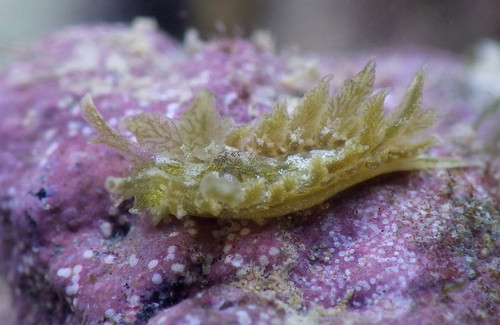
(c) Jeff Goddard, some rights reserved (CC BY-NC), uploaded by Jeff Goddard · cc-by-nc
Sacoglossa
Sign in to saveSacoglossa are a superorder of small sea slugs and sea snails, marine gastropod mollusks that belong to the clade Heterobranchia known as sacoglossans. There are 284 valid species recognized within this superorder. Sacoglossans live by ingesting the cellular contents of algae, hence they are sometimes called "sap-sucking sea slugs". Some sacoglossans simply digest the fluid which they suck from the algae, but in some other species, the slugs sequester and use within their own tissues living chloroplasts from the algae they eat, a very unusual phenomenon known as kleptoplasty, for the "stolen"
Species
kieuwloze zeenaaktslakken
Superorder
- PhylumMollusca
- ClassGastropoda
via
Museum specimens
- Specimen records
- 18
- With media
- 3
- Family
- Carabidae
- Collections
- CAS, UF, ANSP
- Recorded in
- Cook Islands, United States, Indonesia, Costa Rica, Scattered Islands, French Polynesia, Oman, Mariana Islands
Wikidata facts
- Instance of
- taxon
- Parent taxon
- Tectipleura
- Image
- Lettuce Sea Slug 11-03-2006.jpg
Show 5 more facts
- Commons category
- Sacoglossa
- taxon name
- Sacoglossa
- taxon rank
- superorder
- topic's main category
- Category:Sacoglossa
- taxon common name
- Saftsauger
Sources (1)
via Wikidata · CC0
~11 min read
Encyclopedic overview
15 sectionsContents
- Appearance
- Distribution
- Use of ingested cellular material
- Oxynoacea
- Plakobranchoidea
- Evolution
- Taxonomy
- 2004 taxonomy
- 2005 taxonomy
- 2010 taxonomy
- 2017 taxonomy
- Autotomy
- References
- Further reading
- External links
Sacoglossa are a superorder of small sea slugs and sea snails, marine gastropod mollusks that belong to the clade Heterobranchia known as sacoglossans. There are 284 valid species recognized within this superorder. Sacoglossans live by ingesting the cellular contents of algae, hence they are sometimes called "sap-sucking sea slugs". Some sacoglossans simply digest the fluid which they suck from the algae, but in some other species, the slugs sequester and use within their own tissues living chloroplasts from the algae they eat, a very unusual phenomenon known as kleptoplasty, for the "stolen" plastids. This earns them the title of the "solar-powered sea slugs", and makes them unique among metazoan organisms, for otherwise kleptoplasty is known only among other euthyneurans and single-celled protists.
The Sacoglossa are divided into two clades - the shelled families (Oxynoacea) and the shell-less families (Plakobranchacea). The four families of shelled species are Cylindrobullidae, Volvatellidae, Oxynoidae, and Juliidae, the bivalved gastropods. The shell-less Plakobranchacea are grouped in six families, divided between two clades ("superfamilies"), the Plakobranchoidea and the Limapontioidea. All sacoglossans are distinguished from related groups by the presence of a single row of teeth on the radula. The teeth are adapted for the suctorial feeding habits of the group.
Excerpted from Wikipedia’s “Sacoglossa” article, available under the CC BY-SA 4.0 licence.