
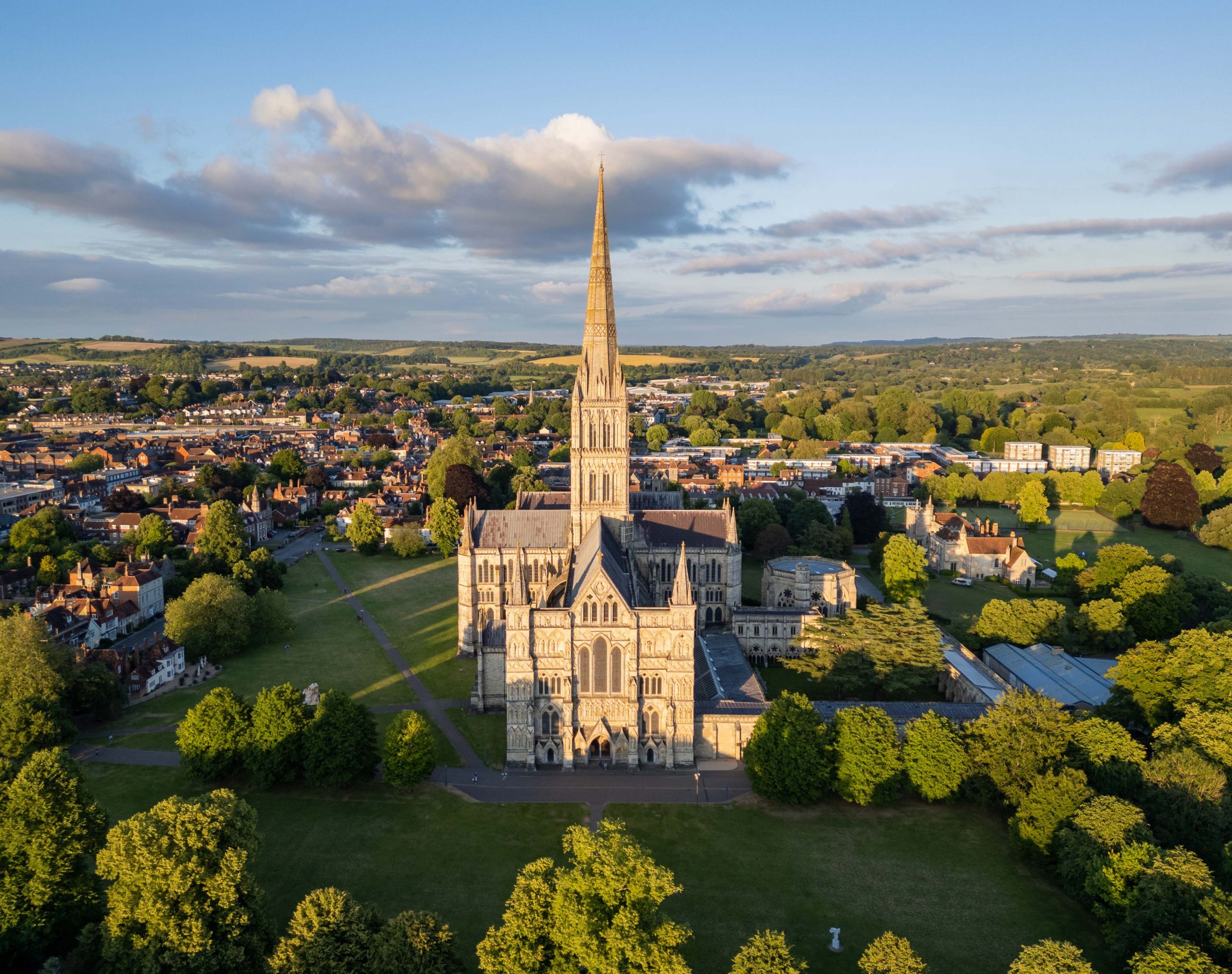
File:SalisburyCathedral-wyrdlight-EastExt.jpg · Wikimedia Commons · See Wikimedia Commons
Salisbury Cathedral
Sign in to saveAlso known as Cathedral Church of the Blessed Virgin Mary
church of England cathedral in Salisbury, England, UK
Key facts
- Location
- Salisbury , Wiltshire
- Country
- England
- Denomination
- Church of England
- Previous denomination
- Roman Catholic
- Churchmanship
- Anglo-Catholic
- Website
- www .salisburycathedral .org .uk
- Architect s
- Richard Poore ; Elias of Dereham (possibly)
- Style
- Early English Gothic
- Years built
- 1220–1330
- Groundbreaking
- 1220 ; 806 years ago ( 1220 )
- Length
- 442 feet (135 m)
- Province
- Canterbury
- Diocese
- Salisbury
- Bishop
- Stephen Lake
- Dean
- Nicholas Papadopulos
via Wikipedia infobox
Official website
Homepage
Home of Britain's tallest spire, oldest working clock, and original 1215 Magna Carta. Open daily for worship and visiting.
salisburycathedral.org.uk →Link to the official site · 17,491 chars · not written by Vinony
Wikidata facts
- Named after
- Mary
- Religion
- Anglicanism
- Country
- United Kingdom
- Located in
- Salisbury
- Material used
- limestone
- Location
- Salisbury
- Dedicated to
- Mary
- Official website
- www.salisburycathedral.org.uk
- Image
- Salisbury Cathedral.jpg
- Height
- 123
- Length
- 134.7
Show 8 more facts
- Commons category
- Salisbury Cathedral
- topic's main category
- Category:Salisbury Cathedral
- architectural style
- Gothic architecture
- diocese
- Diocese of Salisbury
- inception
- 1220-00-00
- native label
- Salisbury Cathedral
- OS grid reference
- SU1430229533
- associated electoral district
- Salisbury
via Wikidata · CC0
~28 min read
Encyclopedic overview
Salisbury Cathedral, formally the Cathedral Church of the Blessed Virgin Mary, is an Anglican cathedral in the city of Salisbury, England. The cathedral is regarded as one of the leading examples of Early English Gothic design. Built over a relatively short period, some 38 years between 1220 and 1258, it has a unity and coherence that is unusual in medieval English cathedrals. The tower and spire were completed by 1330. The cathedral's spire, at 404 feet (123 m), is the tallest in England.
The original cathedral in the district was located at Old Sarum, about 2 miles (3.2 km) north of the present city. In 1197 bishop Herbert Poore determined on a relocation but this was not taken forward until the episcopate of his brother, Richard Poore in the early 13th century. Foundation stones for the new building were laid on 28 April 1220 by the Earl and Countess of Salisbury. By 1258 the nave, transepts and choir were complete. The only major additions were the cloisters, added 1240, the chapter house in 1263, and the tower and spire, which was constructed by 1330. At its completion it was the third highest in England, but the collapse of those at Lincoln Cathedral and Old St Paul's Cathedral in the 16th century saw Salisbury become England's tallest.
Excerpted from Wikipedia’s “Salisbury Cathedral” article, available under the CC BY-SA 4.0 licence.